

Audio By Carbonatix
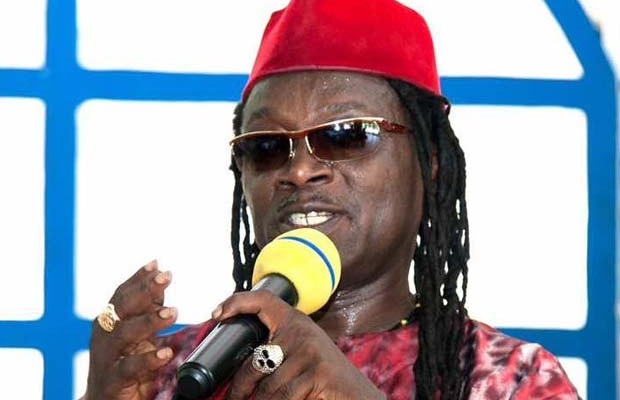
Veteran highlife musician Amandzeba has spoken about the seeming nonchalance of Ghanaians in helping promote and preserve Ghana's highlife music genre.
He told Kwame Dadzie on Joy FM's Showbiz A-Z that although highlife is rich in Ghanaian culture and has the potential to represent the country globally, Ghanaians seem to have failed in projecting it.
He made this comment while discussing UNESCO’s move in to list highlife as intangible cultural heritage.
“Collectively, we seem to have failed. We normally trivialize our heritage, everything. The Chinese can make our kente, they can do anything at all with our own heritage and then we sit in silence and keep admiring them while we know that we have the thing and must be developed here.
It’s just like music. When we had highlife, right from the outset, it affected everybody along the coast even all the way to Zaire, Congo and other places. Take the likes of Fela Kuti, Miriam Makeba, Hugh Masekela. They were here [because of highlife]," he said.
He also recounted that a lot of music stars across the world keep asking what Ghanaians are doing to project the highlife genre.
According to Amandzeba, while National Folkore Board is working at making UNESCO list highlife as intangible cultural heritage is commendable, the media must also take the responsibility to make sure the genre lives on.
A few weeks ago, Ama Serwah Nerquaye-Tetteh, the Secretary General of the Ghana Commission for UNESCO, mentioned that highlife will be listed by UNESCO as Ghana’s intangible heritage soon.
This comes after series of engagements and conferences organised by the Ghana Folklore Board and the Ghana Cultural Forum to discuss plans by which Ghana’s highlife can be listed as a UNESCO’s list of Intangible Cultural Heritage (ICH).
An intangible cultural heritage (ICH) is a practice, representation, expression, knowledge, or skill considered by UNESCO to be part of a place’s cultural heritage.
Intangible heritage consists of non-physical intellectual wealth, such as folklore, customs, beliefs, traditions, knowledge, and language.
Intangible cultural heritage is considered by member states of UNESCO in relation to the tangible World Heritage, focusing on intangible aspects of culture.
Jamaica’s reggae and Congo’s rhumba are some music genres listed by UNESCO as intangible heritage.
Latest Stories
-
Black Sherif drops new 6-track EP ‘Sun Sherif’
40 minutes -
GTA partners Africa’s Brain Bank for Medical City groundbreaking
52 minutes -
How to check 2026 WASSCE results on mobile phone
58 minutes -
President Mahama is a professional comedian – DKB
1 hour -
Final day of Joy FM Back-to-School Fair: Come shop, save and prepare for the new school year
2 hours -
GSE showed strong performance in August 2026 despite recording more stock losses
4 hours -
If CJ needs ethics law to know SOE comments were wrong, he may not be worthy of office – Arthur Kennedy
5 hours -
Stop touring state agencies and focus on the Judiciary’s problems – Arthur Kennedy to CJ
5 hours -
Apologise and don’t do it again – Arthur Kennedy to Chief Justice over SOE comments
5 hours -
Chief Justice remains committed to judicial independence, justice and equality – Judicial Service
6 hours -
Ghana concludes evacuation of citizens from South Africa; total returnees reach 1,900 – Ablakwa
6 hours -
Africa must define its own green transition path – Prof Fatima Denton
6 hours -
WASSCE 2026: English Language performance falls to 62.4% – WAEC
7 hours -
WASSCE 2026: Social Studies records sharp rebound as Maths, Science also improve
7 hours -
2026 WASSCE entry rises by 11% as 512,862 candidates sit exams
7 hours