

Audio By Carbonatix
The Executive Director of Educate Africa Institute, William Boadi, says former President John Mahama’s campaign promise to abolish academic fees for first-year university students is not feasible.
“While this promise, made by the Flagbearer for the National Democratic Congress (NDC) could potentially enhance access to higher education, it raises several critical questions about its feasibility and broader impact on Ghana’s educational and employment landscape.”
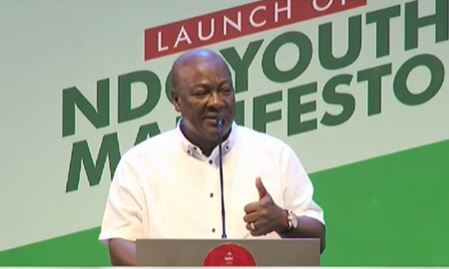
Mr Boadi said this in an interview with the Ghana News Agency as a reaction to the promise made by the Former President at the launch of the NDC Youth Manifesto in Accra.
“Addressing the pressing need for educational access is crucial, yet it must be balanced with ensuring educational quality and support systems for students beyond their first year,” he added.
He said while removing financial barriers could boost educational enrollment, maintaining high educational standards and providing scholarships or financial aid for continuing students were essential components of a comprehensive approach to educational reform.
He said the ability to implement such a policy hinged on securing adequate financial resources, scaling up university infrastructure, and ensuring long-term sustainability without negatively affecting the national budget or other vital services.
“Effective solutions include updating curricula to include practical and industry-relevant skills, fostering partnerships with businesses for internships, and enhancing faculty training. These measures are necessary to ensure that students are well-prepared to meet the challenges of the modern job market,” he added.
Mr Boadi said political promises should be grounded in addressing Ghana’s most pressing needs with realistic and sustainable solutions.
He said this would ensure that policies did not only promise access but also enhanced the quality and applicability of education and improved employment prospects for graduates.
“By focusing on these critical areas, we can work towards a future where Ghana’s educational and employment systems are robust and effective,” he said.
Meanwhile, Daniel Oppong Kyeremeh, President of the National Union of Ghana Students, has called for a broader consultation with educational stakeholders on the promise.
He said they should take a critical look at the policy, especially in the area of funding and selection to ensure that those who needed it the most received it as well as a possible scale up to include continuing students who were also financially handicapped.
On Monday, August 12, 2024, the NDC unveiled its 2024 Youth Manifesto, which includes a pledge by the Flagbearer, John Dramani Mahama, to waive academic fees for first-year tertiary students if elected.
Latest Stories
-
Mahama arrives in Egypt for AU summit and inaugural Alamein Africa Forum
13 minutes -
How the NPP and NDC undermine the GFA, then demand accountability
44 minutes -
Godfred Dame questions 2-night EOCO detention of Baffour Awuah over GH¢2.2m legal fees
51 minutes -
GH¢1.64bn NHIS claims paid in 2026 as Private Health Facilities welcome improved reimbursements
58 minutes -
Blue Medics champions healthy ageing at Akuapem North older persons commemoration
1 hour -
NPP elects national executives today in Kumasi ahead of election 2028
1 hour -
Godfred Dame accuses EOCO, CID, AG of using state power to punish political opponents
1 hour -
Walter Mosley visits W.E.B. Du Bois Centre in Accra: A New York Secretary’s homecoming story on where Du Bois spent his final years.
3 hours -
MTN set to deploy 5G services after winning spectrum licenses worth US$202m
6 hours -
NPP national elections: 3,000–4,000 police to handle security, traffic in Kumasi – Karbo
8 hours -
Atta Akyea fumes as Manhyia MP is to spend another night in EOCO custody
8 hours -
SSNIT says La Beach clearance was to protect hotel investments, beaches to remain public
9 hours -
APSU congratulates St Augustine’s College after back-to-back National Investment Quiz wins
9 hours -
Renewed flood intervention at Mallam Junction raises hopes among residents, businesses
10 hours -
St Augustine’s College retain National Investment Quiz title after nail-biting grand finale
10 hours