

Audio By Carbonatix
Kumasi and six other African cities are expected to grow at a much faster pace, supported by infrastructure development, urbanisation and the emergence of megacities.
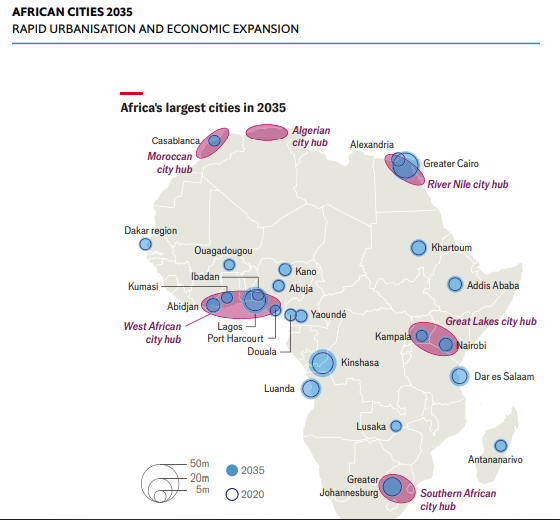
According to the Economist Intelligence Unit, the continent’s established urban heavyweights and megacities including Cairo, Lagos and Johannesburg will still sit at the head of the Africa100 city economies in 2035.
The other six African cities that would grow quickly are Kinshasa, Dar es Salaam, Addis Ababa, Abidjan, Kampala and Dakar.
In a report, the London based firm said it expect rapid urbanisation across Africa to help to create more dynamic and wealthier consumer markets, better connected and more sophisticated commercial and distribution hubs, and larger bases for industrial production and import-export operations.
However, overcrowding, informal settlements, high unemployment, poor public services, stretched utility services and exposure to climate change are just some of the major challenges that city planners will have to grapple with in their drive for sustainable urban economic growth in the next decade
It continued that Africa has and will continue to have the fastest rate of urbanisation of the world’s major regions through to 2035.
Africa’s urban population to hit 1.0bn in 2035
It projected that Africa’s urban population will rise from about 650 million in 2023 to almost one billion in 2035, which represents a compound annual growth rate (CAGR) of about 3.5% and will take the proportion of Africans living in towns and cities to over 50% in 2035.
“Africa’s urban population will continue to grow rapidly in the 2030s, in contrast to other major regions; urban population growth in Asia is expected to decelerate, and the rate in the Americas and Europe will level off during the 2030s. In Africa, the East, Central and West African subregions will record the fastest rate of urban population growth in 2023-35”, it added.
Emergence of megacities to be a major feature of Africa’s demographics
The report stated that the emergence of new urban heavyweights and megacities, the rapid expansion of city clusters and the rising importance of megalopolises will be a major feature of Africa’s demographic and economic future.
It said the continent is projected to have six megacities by 2035—Luanda and Dar es Salaam will join the current giants of Greater Cairo, Kinshasa, Lagos and Greater Johannesburg with a population of more than 10 million resident.
A further 17 cities will have a population that exceeds 5.0 million residents and another 100 or so cities will have populations in excess of one million inhabitants.
Latest Stories
-
Ghana’s mining deaths fall sharply, but Chamber insists ‘three deaths are too many’
1 hour -
Tatale Sanguli officials destroy expired food products, warn traders
1 hour -
Police arrest two watchmen over alleged defilement of 14-year-old student
2 hours -
The woman behind General Mosquito: Could Ghana be meeting its next First Lady?
2 hours -
Court remands man over alleged Labone bank robbery attempt
2 hours -
Supreme Court to rule on injunction application on legal vacation today
2 hours -
Tamale Metropolitan Assembly distributes 10,000 bags of fertiliser to farmers
2 hours -
TUSAAG suspends strike, resumes work after renewed talks with government
2 hours -
PIAC marks 15 years of oil revenue accountability and transparency
2 hours -
Adongo calls for non-political interference in $1.46bn Heritage Fund review
2 hours -
FDA records GH¢70m surplus in 2025 amid concerns over ageing lab equipment
2 hours -
Arise Ghana demands stronger commitment to end galamsey
2 hours -
96% of Ghanaian pensioners willing to work beyond retirement age – Study
2 hours -
Ghana gets nuclear power plant simulator
2 hours -
Temporary Akosombo power control facility to be ready by September – Energy Ministry
2 hours