

Audio By Carbonatix
The Institute of Statistical, Social, and Economic Research (ISSER) has raised concerns about the environmental impact of Ghana’s gold exports, which now account for over half of the country’s export revenue.
In its latest State of the Ghanaian Economy Report, ISSER calls for urgent steps to evaluate and address these environmental costs to ensure sustainable practices in mining and agriculture, cautioning that failure to act could harm Ghana’s tourism sector.
“Gold exports account for over 50% of export revenue, but there is a need to ascertain the environmental costs and address them to ensure sustainable mining and agricultural practices,” ISSER stated.
The report underscores that while gold mining brings significant revenue, it also presents environmental challenges that could disrupt agriculture and hinder tourism, two other key pillars of Ghana’s economy.
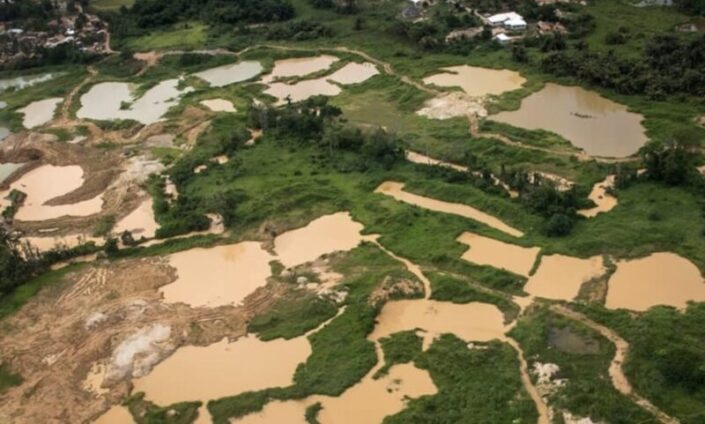
The environmental impact of mining, especially small-scale and illegal mining activities, has become a pressing issue for Ghana, affecting river bodies, farmlands, and forest reserves.
ISSER’s Director, Professor Peter Quartey, highlighted the interconnected risks that unregulated mining poses.
“The effects on tourism cannot be discounted,” he warned, noting that Ghana’s natural landscapes and biodiversity, which attract visitors, are at risk of degradation from unsustainable mining practices.
The report also emphasizes the importance of balancing economic gain from gold exports with environmental sustainability.
“To sustain the benefits of gold exports, we must integrate environmentally conscious practices that will not compromise agriculture or tourism,” ISSER suggests.
The institute’s assessment points to the need for stricter regulatory frameworks and enforcement to curb the negative impact of mining on critical natural resources.
In a bid to protect tourism and agriculture, ISSER recommends that policymakers implement measures to limit mining activities in sensitive areas, such as near water bodies and protected forests.
According to the report, preserving Ghana’s tourism potential is vital for diversification and long-term economic resilience.
“Tourism relies heavily on our natural resources, and if these are compromised by unchecked mining, we stand to lose more than we gain from gold exports,” ISSER cautioned.
Latest Stories
-
Young woman found dead at Kasoa Peace Town
28 minutes -
Livestream: The Law examines lawful arrest in Ghana
53 minutes -
Mahama urges African governments to treat healthcare as an investment, not budget cost
1 hour -
Bawumia congratulates John Boadu and new NPP executives, pledges support ahead of 2028
1 hour -
‘No talent should be left out’ – Bawumia pledges inclusive NPP campaign for 2028
2 hours -
Prof. Mike Oquaye recounts how he blocked Special Prosecutor’s attempt to arrest Bawku Central MP
2 hours -
Make health sovereignty a priority for Africa – Mahama
2 hours -
Dorimon Naa, Wa West DCE lead massive clean-up exercise; threaten sanctions against recalcitrant residents
2 hours -
Photos from Adom FM Y2K Jam
2 hours -
Praye Tiatia steals the show at Adom FM Y2K Jam [Watch]
3 hours -
Boakye Agyarko congratulates John Boadu, pledges support for NPP leadership
3 hours -
Antwi HiMight thrills fans with Antwi ne Antwi hits at Adom FM’s Y2K Jam [Video]
3 hours -
Amb. Edward Boateng congratulates Boadu, Kodua on election wins
3 hours -
John Boadu pledges to rebuild NPP from grassroots and restore ‘winning machinery’
3 hours -
Ashaiman Assembly deploys monitoring system to curb dumping in storm drain
4 hours