

Audio By Carbonatix
President John Mahama has announced a new policy direction aimed at ending the export of Ghana’s mineral ores in their raw form by 2030, as part of his government’s drive to boost industrialisation and job creation.
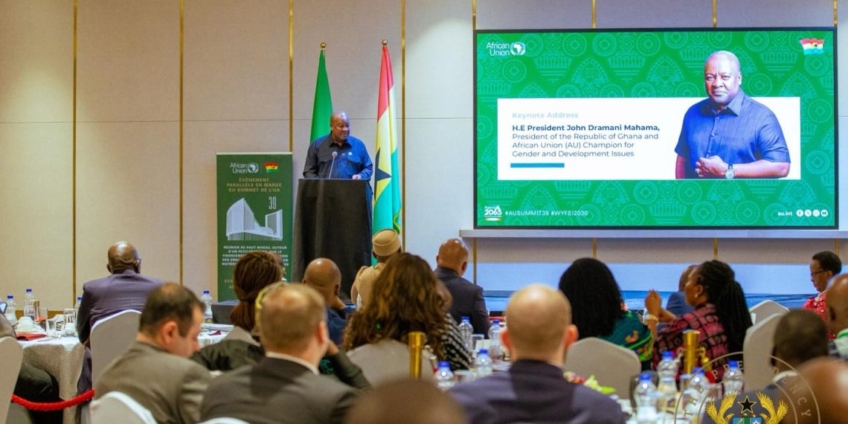
Speaking at the Accra Reset Addis Reckoning event in Addis Ababa on Saturday, February 14, President Mahama said Ghana must move away from exporting unprocessed resources and instead invest in building strong local refining and processing capacity.
“I say in 2030 there will be no mineral ore leaving Ghana. We are not going to ship manganese ore, bauxite, iron ore out of Ghana raw. You must process all that locally. That is the only way we can provide opportunities for our people,” he said.
The President explained that exporting raw materials denies the country significant revenue, jobs, and industrial growth, and has kept Ghana overly dependent on external markets for decades.
According to him, the new policy direction is already being applied to the cocoa sector, which he admitted is facing serious financial and operational challenges.
He disclosed that before leaving for Addis Ababa, his government held an emergency meeting in Ghana to discuss the situation in the sector, particularly issues relating to financing and supply constraints affecting local processors.
As part of ongoing reforms, President Mahama said the government has decided to stop relying on foreign-backed financing arrangements for cocoa purchases and shift to domestic funding through bonds.
He said the new model will allow more cocoa beans to be reserved for local processing and value addition.
“We have the capacity to process 400,000 tonnes of beans, but because those beans are collateralised, we cannot allocate those beans to the local processors, so we have to ship all the beans outside,” he stated.
“Since we produce the beans, we can provide the local processors with 400,000 tonnes of our beans to add value,” he added.
Under the previous system, large volumes of Ghana’s cocoa were used as security for foreign loans, limiting the country’s ability to support domestic industries.
President Mahama said moving to domestic financing will give the government greater control over the sector and ensure that local processors receive enough raw materials to expand production and create jobs.
He noted that adding value to resources such as gold, bauxite, manganese, iron ore, and cocoa would help reduce unemployment, strengthen the cedi, and improve the country’s trade balance.
I
Latest Stories
-
Ghana’s BRICS move requires clear strategy to manage risks – Godfred Bokpin
1 hour -
Pay teachers realistic income – Duncan Amoah to gov’t
2 hours -
Bechem to become chicken capital of Ghana – Mahama projects
2 hours -
Gov’t targets recruitment of 16,500 health professionals in 2026
2 hours -
Two-week strike will not derail academic calendar – GNAT President
2 hours -
Headmaster detained after BBC investigation into alleged sexual abuse of students
2 hours -
GNAT pushes for clear implementation procedures of teachers’ conditions of service
3 hours -
Recurrent strikes threaten quality of education and academic calendars – Prof Bokpin
3 hours -
‘Cockroach’ group leaders among hundreds detained in Delhi protest
3 hours -
Don’t let speed of information become your judgement – CJ tells new lawyers
3 hours -
World Cup visa scandal: People have leveraged public office to facilitate fraud – Senyo Hosi
4 hours -
Glut! Farmers count losses as prices crash, customers happy
4 hours -
GSA postpones auction of unserviceable vehicles
4 hours -
Man charged with attempted murder after stabbing
4 hours -
World Cup visa scandal: Senyo Hosi says issue goes beyond calls for Sports Minister’s resignation
4 hours