

Audio By Carbonatix
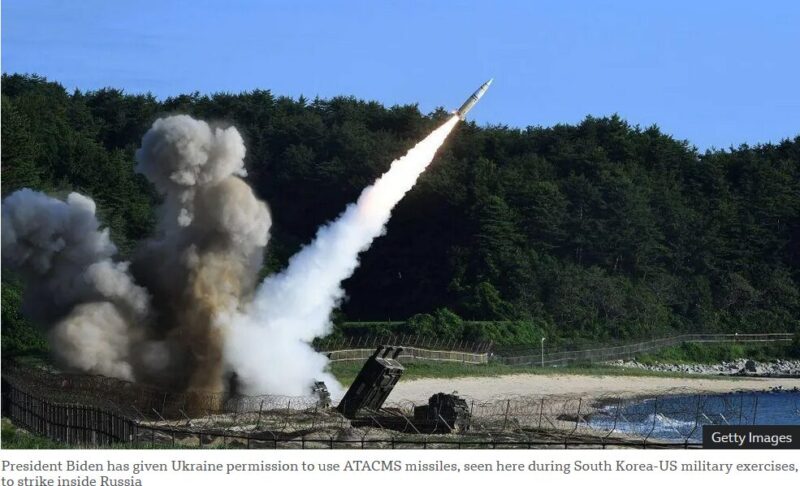
President Biden’s decision to allow Ukraine to strike inside Russia with long-range missiles supplied by the US has sparked a furious response in Russia.
"Departing US president Joe Biden… has taken one of the most provocative, uncalculated decisions of his administration, which risks catastrophic consequences," declared the website of the Russian government newspaper Rossiyskaya Gazeta on Monday morning.
Russian MP Leonid Slutsky, head of the pro-Kremlin Liberal-Democratic Party, predicted that the decision would "inevitably lead to a serious escalation, threatening serious consequences".
Russian senator Vladimir Dzhabarov called it "an unprecedented step towards World War Three".
Anger, yes. But no real surprise.
Komsomolskaya Pravda, the pro-Kremlin tabloid, called it "a predictable escalation".
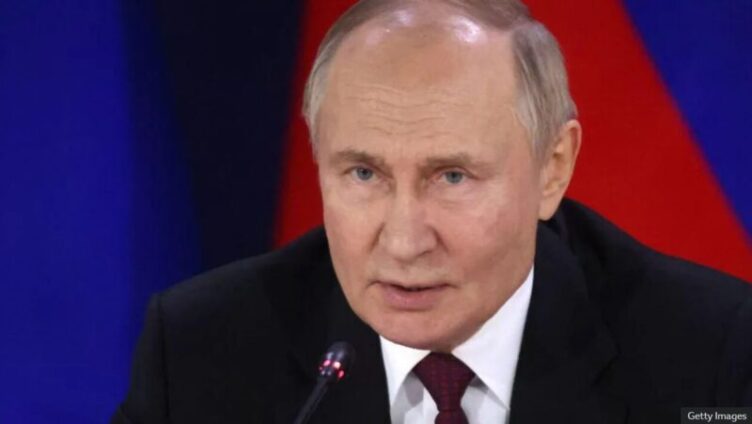
What really counts, though, is what Vladimir Putin calls it and how the Kremlin leader responds.
So far he’s stayed silent.
But on Monday President Putin’s spokesman Dmitry Peskov told journalists that “if such a decision has been taken it means a whole new spiral of tension and a whole new situation with regard to US involvement in this conflict".
Mr Peskov accused the Biden administration of “adding fuel to the fire and continuing to stoke tension around this conflict".
Western leaders would argue that it’s Russia that is ‘adding the fuel’ by recently deploying North Korean troops to the war zone to fight alongside Russian forces and by continuing to attack Ukraine.
President Putin himself may have yet to comment. But Russia’s president has said plenty before.
In recent months, the Kremlin has made its message to the West crystal clear: do not do this, do not remove restrictions on the use of your long-range weapons, do not allow Kyiv to strike deep into Russian territory with these missiles.
In September President Putin warned that if this were allowed to happen, Moscow would view it as the "direct participation" of Nato countries in the Ukraine war.
"This would mean that Nato countries… are fighting with Russia," he continued.
The following month, the Kremlin leader announced imminent changes to the Russian nuclear doctrine, the document setting out the preconditions under which Moscow might decide to use a nuclear weapon.
This was widely interpreted as another less-than-subtle hint to America and Europe not to allow Ukraine to strike Russian territory with long-range missiles.
Guessing Vladimir Putin’s next moves is never easy.
But he has dropped hints.
Back in June, at a meeting with the heads of international news agencies, Putin was asked: how would Russia react if Ukraine was given the opportunity to hit targets on Russian territory with weapons supplied by Europe?
"First, we will, of course, improve our air defence systems. We will be destroying their missiles," President Putin replied.
"Second, we believe that if someone is thinking it is possible to supply such weapons to a war zone to strike our territory and create problems for us, why can’t we supply our weapons of the same class to those regions around the world where they will target sensitive facilities of the countries that are doing this to Russia?"
In other words, arming Western adversaries to strike Western targets abroad is something Moscow has been considering.
In my recent interview with Alexander Lukashenko, the leader of Belarus, Putin's close ally seemed to confirm the Kremlin has been thinking along these lines.
Mr Lukashenko told me he had discussed the subject at a recent meeting with Western officials.
"I warned them. 'Guys, be careful with those long-range missiles,'" Mr Lukashenko told me.
"The Houthi [rebels] might come to Putin and ask for coastal weapons systems that can carry out terrifying strikes on ships.
"And if he gets his revenge on you for supplying long-range weapons to [President] Zelensky by supplying the Houthis with the Bastion missile system? What happens if an aircraft carrier is hit? A British or American one. What then?"
But some of the media reaction in Russia appeared designed to play things down.
"The Russian armed forces had already [previously] intercepted ATACMS missiles during attacks on the Crimean shore," a military expert told the Izvestia newspaper, which went on to suggest that President-elect Trump might "revise" the decision.
This is, to put it mildly, an unusual situation.
In two months’ time, President Biden will be out of office and Donald Trump will be in the White House.
The Kremlin knows that President-elect Trump has been far more sceptical than President Biden about military assistance for Ukraine.
Will that be a factor in Vladimir Putin’s calculations as he formulates Russia’s response?
Latest Stories
-
White House bars CNN from travelling with Trump on Air Force One
23 minutes -
Fennis wins second consecutive ITF J60 title in Accra
27 minutes -
Spain beat England in thriller after Kane penalty miss
33 minutes -
GPL 2026/27: Zaidan’s late goal ends Hearts of Oak unbeaten start
36 minutes -
CEOs demand clarity on pay harmonisation, board autonomy as FWSC engages SOEs bosses over IPEC transition
39 minutes -
2026 Women’s Super Cup: FC Savannah, Epiphany Warriors maintain top spots ahead of final group games
48 minutes -
‘Is EOCO responsible for determining lawyers’ fees?’ – Baffour Awuah
49 minutes -
David Beckles claims second J60 Accra title
1 hour -
No France cocaine suspect linked to Mahama, Vice President’s security details – NACOC
1 hour -
Anwelle Foundation launched in Jirapa to tackle poverty, youth unemployment
2 hours -
Joy Sports Editor Fentuo Tahiru Fentuo to moderate inaugural Music Meets Football Summit in Zambia
2 hours -
Court premises too volatile for Baffour Awuah’s attempted arrest by EOCO – Inusah Fuseini
2 hours -
Drug bust: Under no circumstances will NACOC leadership be compromised – Twum-Barimah
2 hours -
VIDEO: EOCO’s attempted arrest of Baffour Awuah was flawed beyond saving – Law Lecturer
2 hours -
Genuine Ghanaian exporters may face heightened foreign inspections over drug busts – Lawyer
2 hours