

Audio By Carbonatix
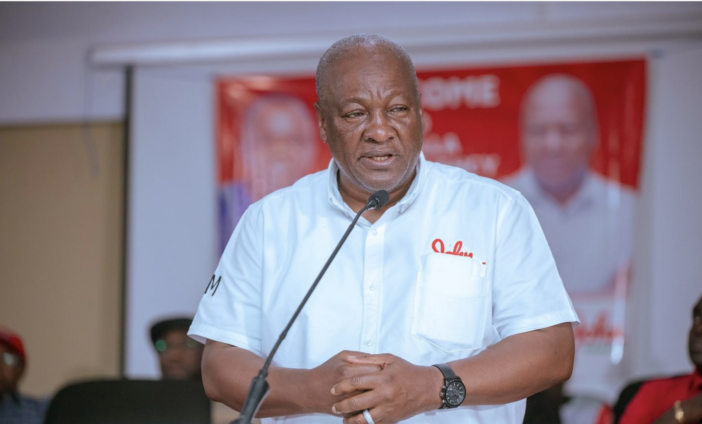
Former President John Dramani Mahama has once again highlighted his commitment to transforming Ghana’s economy with an innovative and ambitious 24-Hour Economy Policy.
“This game-changing initiative, outlined under the next National Democratic Congress (NDC) government, seeks to revitalize key sectors and create a robust economic framework capable of driving sustainable growth”.
He said at the heart of the policy was a deliberate strategy to stimulate economic activity by enabling businesses and public institutions to operate around the clock in three eight-hour shifts.
“This 24-hour operational model is designed to increase employment, productivity, production, and revenue, while enhancing access to public services”.
In a recent address, Mahama emphasized the transformative potential of this policy. “The 24-Hour Economy is more than just a policy; it’s a catalyst for industrialization, export promotion, and job creation. It’s about building an economy that works for everyone, every hour of the day,” he said.
The 24-Hour Economy focuses on key sectors such as agro-processing, manufacturing, pharmaceuticals, construction, financial services, and more.
Strategic investments in infrastructure, energy, and security will provide the foundation for businesses to thrive. Public institutions with high customer traffic, such as ports, customs, and the DVLA, will also operate around the clock to enhance efficiency.
He said to ensure seamless implementation, an Accelerated Export Development Authority (AEDA), chaired by the President, would oversee export promotion efforts under this strategy.
“Additionally, a new Employment Act will be enacted in consultation with organized labor and stakeholders to complement existing labor laws and regulate the 24-hour economy effectively.
Mahama’s 24-Hour Economy Policy is underpinned by a comprehensive support package for businesses. Participating enterprises will benefit from tax incentives, financing support through the Ghana Exim Bank, and cheaper electricity rates based on a Time-of-Use tariff system.
The government will also promote the “Made in Ghana Agenda” by prioritizing local goods, thereby stimulating domestic demand and fostering a sense of national pride.
The policy also addresses workers’ welfare by promoting good work ethics and ensuring efficient eight-hour shifts across public and private sectors.
Mahama’s vision prioritizes sustainable, decent-paying jobs that empower individuals and strengthen families.
“The Policy reflects his forward-thinking approach to governance and economic development. By focusing on import substitution, export promotion, and industrialization, he seeks to position Ghana as a competitive player in the global economy.”
Latest Stories
-
Ablakwa seeks Russian support for Africa-led fight against Sahel extremism
8 minutes -
Host mining communities are partners in development, not obstacles – GJA President
10 minutes -
Ghana to sign 5 new petroleum agreements soon – Energy Minister
11 minutes -
GJA President urges Ghana to weigh environmental and social costs alongside mining revenues
22 minutes -
Irresponsible mining: The land is not your own – Prof Mike Oquaye cautions
30 minutes -
62 Ghanaians killed, 15 missing in Russia-Ukraine war – Ablakwa
31 minutes -
GJA President urges responsible, sustainable mining
32 minutes -
Ghana must take charge of its mineral resources – Prof. Mike Oquaye
38 minutes -
KickedIn uses technology to connect African football talent with global opportunities
39 minutes -
GoldBod did not record GH¢22bn loss; audited accounts show GH¢5.44bn surplus – Institute of Fiscal Policy Governance
43 minutes -
Mining comes with responsibility to future generations – Ga Mantse
46 minutes -
Ga Mantse calls for measurable CSR and stronger local participation in mining communities
52 minutes -
Ga Mantse urges mining industry to protect communities beyond the life of mines
1 hour -
Empowerher in Upper West region
1 hour -
Ga Mantse challenges mining stakeholders to consider long-term impact of Ghana’s mineral wealth
2 hours