

Audio By Carbonatix
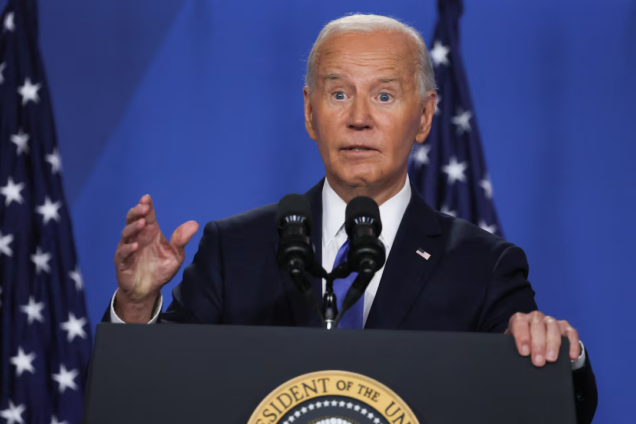
President Joe Biden is to remove the US designation of Cuba as a state sponsor of terrorism as part of a prisoner release deal, the White House said on Tuesday.
Shortly afterwards, Cuba announced it would release 553 prisoners detained for "diverse crimes". It is hoped these will include participants in anti-government protests four years ago.
President-elect Donald Trump reinstated the country's terror designation in the final days of his first presidency in 2021, banning US economic aid and arms exports to the country.
But on Tuesday, a Biden administration official said an assessment of the situation had presented "no information" that supported the designation.
Cuba said Biden's move was a step "in the right direction" despite its "limited nature".
"This decision puts an end to specific coercive measures that, along with many others, cause serious damage to the Cuban economy, with a severe effect on the population," the country's Ministry of Foreign affairs said in a statement.
Hundreds of prisoners will "gradually" be freed following talks brokered by the Catholic Church, a separate statement read a few hours later.
Details about the prisoners have not been announced - it was hoped the deal would prompt the release of some protesters imprisoned after large anti-government protests in Cuba over the nation's economic decline in 2021.
Cuba currently sits alongside North Korea, Syria and Iran on the US State Sponsors of Terrorism list.
This means they are deemed by the US to have "repeatedly provided support for acts of international terrorism".
Adding Cuba back to the list after its removal in 2015 by President Barack Obama, Trump citied the communist country's backing of Venezuelan leader Nicolas Maduro.
At the time Cuba called the move "cynical," "hypocritical" and an act of "political opportunism".
Alongside prompting the prisoner release, this decision is also significant because it can be seen as a step towards normalising relations between Cuba and the US.
This could pave the way for dialogue on other contentious issues.
It could also help Cuba's dire economic situation, as some major banks and foreign investors have struggled to operate there legally.
Biden is to notify Congress of his plans, which also include reversing Trump-era financial restrictions on some Cubans, a White House statement said.
He will also suspend the ability of individuals to make claims to confiscated property in Cuba, the statement read.
It is unclear whether Trump will reverse this latest decision when he returns to office on 20 January.
The president-elect's nominee as the next US secretary of state, Marco Rubio, has long advocated for sanctions on Cuba.
His family left the country in the 1950s before the communist revolution that put Fidel Castro in power.
Latest Stories
-
WASSCE 2026: English Language performance falls to 62.4% – WAEC
8 minutes -
WASSCE 2026: Social Studies records sharp rebound as Maths, Science also improve
21 minutes -
2026 WASSCE entry rises by 11% as 512,862 candidates sit exams
28 minutes -
WASSCE 2026: English Language performance falls to 62.4% – WAEC
42 minutes -
WAEC cancels 2026 WASSCE results of 8,295 candidates over examination irregularities
1 hour -
WAEC releases provisional 2026 WASSCE results for 512,862 candidates
1 hour -
CJ’s remarks on SOEs were made in good faith, not to undermine judicial independence – Judicial Service
4 hours -
Bright Future Alliance pays courtesy call on Akufo-Addo, invites him to African Leaders of Influence Lectureship Series
4 hours -
This is an attempt to break the Minority caucus – Patricia Appiagyei on alleged GH¢70k payment
5 hours -
‘OSP hasn’t contacted me’ – Patricia Appiagyei assures cooperation if invited
5 hours -
I find it strange that this memo was purportedly written by me – Patricia Appiagyei
5 hours -
Ayariga calls for stronger church partnership to tackle sanitation, environmental challenges
6 hours -
I don’t think we have an industry – Patchbay Band manager
6 hours -
Patchbay Band questions recognition of live bands in Ghana’s music industry
6 hours -
Newsfile to discuss SOEs’ GH¢19.8bn profit, dissolution of 9 boards, CJ’s visits to SOEs, GH¢70k gift rejection
6 hours