

Audio By Carbonatix
A joint study by the University of Port Harcourt, Nigeria and the Kwame Nkrumah University of Science and Technology, Kumasi has unveiled alarming findings regarding the presence of cancer-causing substances in meats singed with different fuel sources.
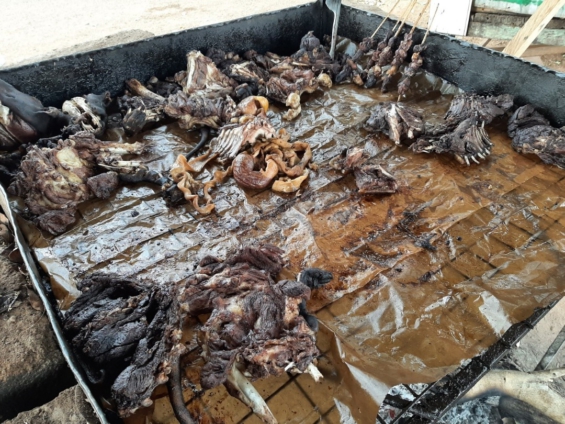
The study published in the journal Environmental Health Insights has found that meats singed with tyres in Ghana contain high levels of harmful chemicals called polycyclic aromatic hydrocarbons (PAHs). These chemicals can increase the risk of cancer.
The study led by Prosper Manu Abdulai from the University of Port Harcourt tested meats singed with tyres, firewood, and LPG gas in Ghana’s five largest cities: Kumasi, Accra, Koforidua, Tamale, and Ho.
The researchers collected 180 samples of cattle and goat meat singed using three different fuel types: firewood, liquefied petroleum gas (LPG), and tyres.
They found that meats singed with tyres had the highest levels of PAHs, especially a dangerous chemical called Benzo[a]pyrene.
Children and older adults are more at risk from these chemicals.
“We did a health risk assessment and we realise that kids and adults who take this meat whether singed with firewood or tyre are at serious risk of getting cancer,” he warned.
The study recommends using safer methods like LPG gas for singeing meat and calls for stricter rules to prevent the use of tyres. This is especially concerning as the levels of this harmful substance in tyre-singed meats exceeded regulatory limits set by the European Food Safety Authority (EFSA).
The researchers call for the urgent need to explore and promote alternative singeing methods that minimise PAH formation.
LPG, which demonstrated the lowest PAH levels among the tested fuels, could be recommended as a safer alternative to traditional fuels like firewood and tyres.
Moreover, the study advocates for stricter regulations regarding the use of tyres for meat singeing, urging authorities to impose heavy penalties for non-compliance to protect public health and ensure that consumers are not exposed to harmful substances.
“The stakeholders should have something to do at the abattoirs so that all of them will use the LPG,” he recommended.
Latest Stories
-
Ghanaian tech professionals develop SMS-based AI tool for non-smartphones
25 minutes -
MTN@30: Three customers drive away brand-new Land Cruiser Prado in Kumasi
45 minutes -
If BOST made GH¢684m profit, why use NPA Bill 2026 to weaken it? – IERPP questions Gov’t
46 minutes -
NPP alleges executive, administrative confusion over Arabic, Chinese language policy
47 minutes -
Minority accuses AMA of targeting Konkomba Yam Market in planned demolition over 24-hour market
55 minutes -
Ghana struggles to raise local funds for delayed cocoa season as investors demand higher returns
1 hour -
GSA delays laboratory equipment replacement despite available funds
2 hours -
IERPP calls for withdrawal of proposed NPA Bill, raises concerns over BOST mandate
2 hours -
We’re not demolishing Konkomba Yam Market – Accra Mayor dismisses Minority’s claims
2 hours -
Nitiwul, Accra Mayor clash over Konkomba Yam Market demolition for 24-Hour-Economy market
2 hours -
BoG urges digital asset businesses to build compliance into operations at Digital Assets Summit Africa
2 hours -
NGIS Money Market Fund’s net assets rise 33.3% to GH¢11.78m
2 hours -
Vaglas join Vughin to mark Dɛng Festival of Sonyor in Savannah Region
2 hours -
Ghanaian model Eligere Di Merrebel attends 2026 Venice Film Festival
2 hours -
“You can’t take our GH¢82m and run away to Nigeria” – Roads Minister fires Enchi–Elubo road contractor
2 hours