

Audio By Carbonatix
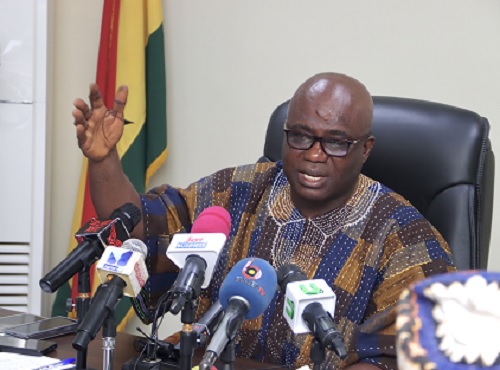
The Ministry of Food and Agriculture has begun the process to install irrigation facilities in eight regions to provide an all year-round production of raw materials to feed government’s 24-hour policy.
Dubbed, “Irrigation for wealth creation”, the first phase of the programme will focus on the Volta, Oti, Central, North East, Northern, Savannah, Upper West and Upper East regions.
Consequently, the sector minister, Eric Opoku, has tasked regional ministers to lead negotiations to secure 10,000 hectares of land for the project, which will begin immediately after Parliament approves the government’s budget.
Target
The 10,000-hectare target is expected to contribute to the country's potential irrigable land of 1.9 million hectares.
Currently, only 1.6 per cent of the 1.9 million hectares is under irrigation, significantly below the West and Central African average of 13.9 per cent.
The regional ministers who met with the Minister of Food and Agriculture yesterday are to begin negotiations with chiefs in the areas marked for the project.
The negotiations, surveying, mapping and design of the project are expected to begin from February 18, this year.
The minister said phase two would cover all the other regions.
Irrigation
Mr Opoku said the project aligned with the government’s vision of utilising agriculture as a driving force for economic growth.
He said farming in Ghana was seasonal, and that the government was resetting the sector by moving away from rainfall to irrigation-based agriculture.
That, he said, would help the farmers to farm throughout the year, adding, “For the 24-hour policy to work to perfection, there is the need to ensure sustainable agriculture production
“If you set up a factory here that takes raw materials from the agriculture sector and if production is seasonal, agriculture will produce the raw materials for three months and the remaining months will not be functional.
“But if you have an irrigation infrastructure in place to ensure water supply throughout the year it will provide an uninterrupted supply for the industry,” he added.
Smallholder farmers
For areas where smallholder farmers already operate in, he said the project would not have a negative impact on them, saying the government would provide them with the facilities to enable them to work throughout the year.
“It is going to affect them positively but as for the land we have the assurance that these are areas earmarked for irrigation long ago, so we only have to finalise the discussions with the chiefs,” he said.
Latest Stories
-
Remittances drop marginally year-on-year to US$3.65bn in half-year 2026
2 minutes -
T-bills: Government exceeds target by 139%, interest rates tumble
5 minutes -
Why Chelsea need more than a new goalkeeper to be title challengers
9 minutes -
Outlook of Ghana’s external sector remains positive for second-half of 2026 – BoG
12 minutes -
Prisoners freed early are returning to jail at rapid rate, governors tell BBC
13 minutes -
Two charged after €2.3 million worth of drugs seized in Dublin
20 minutes -
Head teacher evacuated 900 children minutes before Nepal floods hit school
20 minutes -
Chelsea beat Brithon in seven-goal thriller to maintain perfect start
26 minutes -
Fernandes hat-trick helps Man Utd recover to beat Ipswich
31 minutes -
Former Agriculture Minister Ibrahim Adam passes on
32 minutes -
“A giant leap forward”: Nasa launches powerful new space telescope to explore mysteries of the Universe
36 minutes -
Eight killed and others missing after ferry capsizes off northern Cyprus
41 minutes -
Education Ministry reschedules 2026/27 CSSPS results to September 4
55 minutes -
Trump says US will refill Strategic Petroleum Reserve using Venezuelan oil
1 hour -
ASWAJ reaffirms Sheikh Mohammad Kamil as First National Deputy Imam, urges constitutional compliance
1 hour