

Audio By Carbonatix
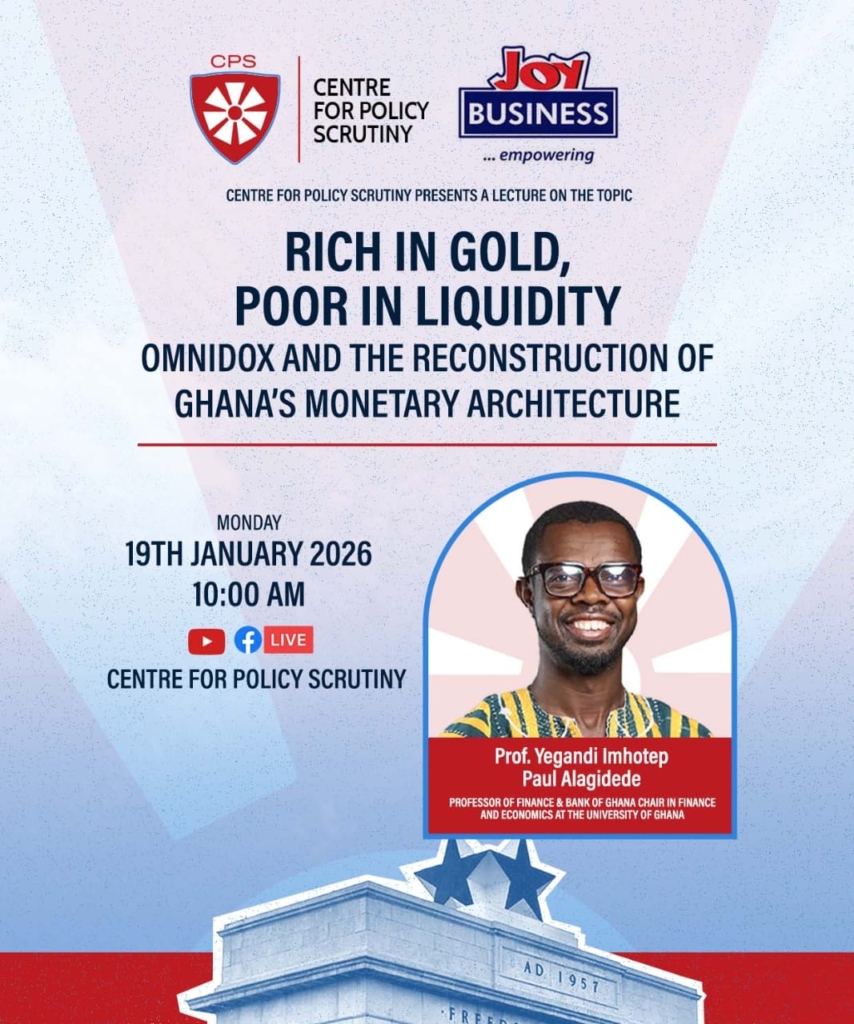
The Centre for Policy Scrutiny (CPS), in collaboration with JoyNews, will on January 19, 2026, host a major public lecture in Accra to examine Ghana’s efforts to strengthen the cedi by leveraging the country’s vast gold reserves.
The event is expected to attract policymakers, economists, financial sector leaders, and academia as the nation debates bold options for reshaping its monetary architecture.
The lecture, themed “Rich in Gold, Poor in Liquidity: Omnidox and the Reconstruction of Ghana’s Monetary Architecture,” will explore the emerging discourse on Ghana’s move toward gold-backed monetary systems and the implications for liquidity, stability, and long-term economic sovereignty.
According to CPS, the partnership with JOYNEWS is grounded in a shared commitment to deepening public understanding of critical economic reforms. Executive Director of CPS, Dr. Adu Owusu Sarkodie said the discussion could not be more timely as the country continues to confront persistent currency volatility and external financing pressures.
“Ghana remains one of the world’s leading gold producers, yet our economy continues to suffer from chronic liquidity constraints and dependence on foreign capital flows,” he said. “This lecture provides a platform to unpack how resource-backed monetary frameworks can help stabilise expectations, reduce vulnerability, and enhance our domestic financial capacity.”
He added that CPS values the partnership with JOYNEWS because of the broadcaster’s role in shaping national economic conversations and amplifying policy-driven dialogue.
The keynote speaker for the lecture will be Professor Yegandi Imhotep Paul Alagidede, an eminent African economist whose work centres on reimagining development and finance through endogenous, resource-based models. Professor Alagidede is the Bank of Ghana Chair in Finance and Economics at the University of Ghana and a Professor of Finance at the University of the Witwatersrand.
He is widely known for pioneering frameworks such as Metanomics, Omnidox, Resource-Based Monetary Sovereignty (RBMS), and Endogenous Resource-Backed Currencies (ERBC). His research challenges orthodox monetary thinking by proposing operational systems that allow African economies to monetise real assets—such as gold—within disciplined, rule-based structures that preserve monetary credibility.
Professor Alagidede’s participation is expected to provide rigorous analysis and practical insights into how Ghana can transition from commodity dependence to a more sovereign, asset-anchored financial model. The organisers say the lecture will contribute significantly to ongoing national conversations about stabilising the cedi and reducing structural vulnerabilities in the economy.
Latest Stories
-
SSNIT increases stake in Societe Generale Ghana to 24.36%
9 minutes -
Africa cannot rely on government budgets alone to finance climate ambitions – Deputy Finance Minister
29 minutes -
COMAC gives Finance Ministry 14 days to suspend implementation of Section 136 of Customs Act
29 minutes -
WhatsApp introduces optional parental controls for teenagers
32 minutes -
Afoko could help Bawumia pursue ‘clean break’ ahead of 2028 – Dr Amakye-Boateng
33 minutes -
Global Capacity Hub conference connects Ghanaian businesses to technology, investment opportunities in London
41 minutes -
Overcharge passengers and face sanctions, GPRTU warns drivers
43 minutes -
Government seeks $165m to complete operational phase of Boankra Integrated Logistics Terminal
54 minutes -
‘Show us the evidence’ – Upper West teachers demand proof of arrears payments
1 hour -
GH¢1 D-Levy suspension will offer relief to fuel consumers – COPEC
1 hour -
Youth Olympic Games in Africa: policy, regulation, and perspectives on shaping youth lives
1 hour -
Contractors move to site for construction of 120-bed trauma hospital in Bole – Kwakye Ofosu
1 hour -
Poor institutional leadership hindering Ghana’s creative industry – Oscar Provencal
1 hour -
CSA demands faster sharing of cyber threat intelligence among financial institutions
2 hours -
CSA warns Ghanaians to verify money requests as AI makes online fraud harder to detect
2 hours