

Audio By Carbonatix
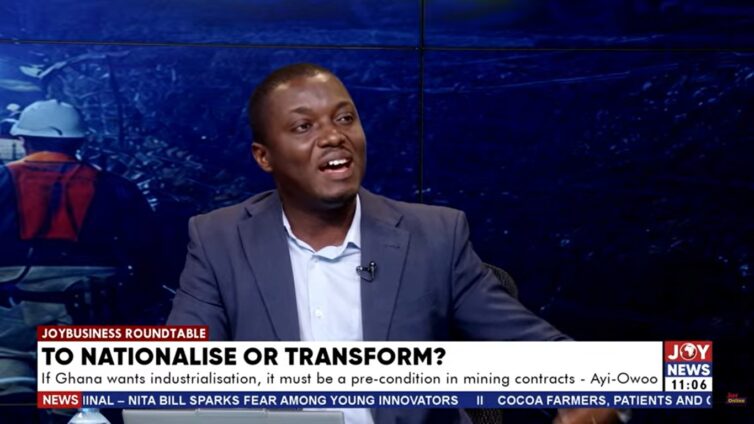
A Partner at Deloitte Ghana, Gideon Ayi-Owoo, has called for stronger and more forward-looking policy frameworks to improve Ghana’s extractive sector and ensure balanced benefits for all stakeholders.
Speaking at a high-level discussion hosted by Joy Business in Accra on Tuesday, May 26, under the theme “To Nationalise or Transform? Rethinking Ghana’s Approach to Mining, Oil and Critical Minerals”, Mr Ayi-Owoo stressed that the long-term sustainability and competitiveness of the sector depend largely on the quality and consistency of policies governing it.
According to him, the extractive industry requires deliberate policy alignment to create a stable and predictable environment that supports long-term planning, responsible investment, and shared prosperity across the value chain.
“We just have to have a good policy in place so that whatever decision we are going to take, it benefits everyone,” he said.
Mr Ayi-Owoo urged the government to introduce clear and bold policy guidelines governing the renewal of mining leases to reduce uncertainty in the sector.
“The government should come out with a very clear, bold guideline policy that will say that these are the conditions under which I am going to renew, so that if the old or the current owner fulfils, it is very clear,” he stated.
He further argued that if Ghana intends to pursue industrialisation through mining, the requirement should be explicitly embedded in mining agreements and lease conditions.
“If you want industrialisation, make it a precondition, put it on paper that this is how I see industrialisation, and let the mining companies be aware,” he added.
Mr Ayi-Owoo also emphasised the importance of certainty in lease renewal processes, warning that unclear rules could discourage reinvestment in the sector.
“Ghana's challenge is beyond the leases expiring; we need certainty to ensure that the lease renewal rules will encourage reinvestment,” he explained.
His remarks formed part of broader discussions at the forum, which brought together industry experts, policymakers, and academics to examine Ghana’s approach to resource governance amid evolving global energy and commodity trends.
Latest Stories
-
Total revenue & grants stood at GH¢144.5bn in July 2026, lower than targeted amount – BoG
9 minutes -
Ghana Sports Fund urges sports federations to submit credible proposals and measurable targets
13 minutes -
Musk says US government may be behind slowdown of Ukraine drone speeds
30 minutes -
Picking Chief Justices nearing retirement could give Mahama immense power – Bentil
40 minutes -
Netflix to shed 1,000 jobs in steepest cuts since 2022
1 hour -
Burnham had two hospitality dinners with Man City chairman, deleted records show
1 hour -
Semenyo ‘froze’ after alleged racist abuse, court told
1 hour -
‘Shameless’ – Mourinho critical of Vinicius Jr ban timing
2 hours -
Loyalty can outweigh competence in Chief Justice selection – Bentil
2 hours -
Man City suffer as PSG masterclass sets up Champions League win
2 hours -
Customer Service Africa CEO urges business leaders to observe staff and customer interactions
2 hours -
On night of mayhem for Liverpool, Barcola arrives in style
2 hours -
Muzic Mensah finds healing and renewed love in new single ‘WayƐ Late’
2 hours -
FIFA to offer extra £2.6bn for football development
2 hours -
Government backing is no EPA permit – Authority warns GoldBod, ministries
3 hours