

Audio By Carbonatix
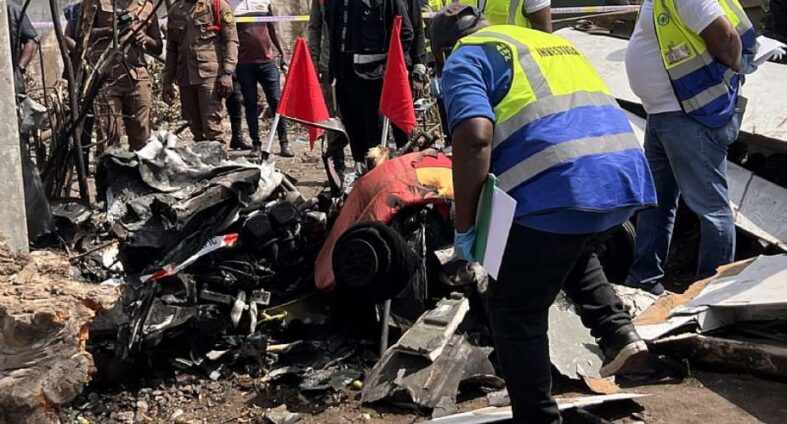
The Aircraft Accident and Incident Investigation and Prevention Bureau (AIB Ghana) has revealed that persistent mobile phone communication during flight contributed to the fatal microlight aircraft crash in Tema that claimed two lives.
According to the Bureau’s final investigation report, the accident was primarily caused by engine failure and poor maintenance practices, but investigators also identified pilot distraction as a contributing factor.
Presenting the report on Tuesday, May 26, the Bureau’s Head of Investigation, Paul Fordjour, disclosed that evidence gathered during the probe pointed to a combination of mechanical failure and pilot-related factors.
“Our findings indicate that engine failure was the probable cause of the accident, with pilot actions also contributing to the incident,” he stated.
Captain Fordjour further revealed that investigators identified persistent mobile phone communication during the flight as a major distraction.
“There was a distraction due to persistent communication on the cell phone,” he added.
The report indicated that the aircraft had experienced repeated engine overheating incidents before the crash, yet the defects were not properly rectified before subsequent flights.
Investigators found that during earlier short flights and landings in Ho, white smoke was repeatedly seen coming from the aircraft’s engine, signalling recurring mechanical problems.
The Bureau also disclosed that the pilot attempted to cool the overheating engine by pouring water on it — an action investigators described as unsafe and inappropriate.
In addition, AIB Ghana found that no flight permits had been issued for the aircraft’s operations, leaving Air Traffic Control (ATC) unaware of both the aircraft’s movements and its recurring mechanical difficulties.
The Bureau said the findings highlight serious concerns over maintenance standards, operational discipline, and compliance with aviation safety procedures.
According to investigators, the accident underscores the need for stricter adherence to maintenance protocols, operational regulations, and safety standards to prevent similar tragedies in future.
Latest Stories
-
Ghana must close gaps that allow drug trafficking – Dr Pelpuo
8 minutes -
Emmanuel Osei: President Mahama, dissolve GFA and save our soul
21 minutes -
Uganda Airlines to launch direct Accra-Entebbe flights from October 27
22 minutes -
Ghana records surge in 2025 tourism receipts as Ahafo Region honors top industry players
25 minutes -
I don’t have an official car, I use my own – Pelpuo
35 minutes -
Maiden Black Star Fashion Week to highlight Ghana’s national fashion platform
36 minutes -
GPRTU has entrusted vehicle inspection responsibility to station masters – GPRTU member
36 minutes -
President Mahama to open housing finance conference in Accra on October 7
44 minutes -
Cocaine probe: Speaker is right in dismissing Minority’s motion of parliamentary inquiry – Dr Pelpuo
44 minutes -
Academic City presents cybersecurity white paper to Communications Minister
45 minutes -
Pelpuo calls for independent commission to oversee Ghana’s public sector remuneration
45 minutes -
Bekwai MP to engage Assembly over traders displaced by market redevelopment
46 minutes -
Accra-Abidjan flight relaunch will boost trade, investment and regional integration – Ambassador Alhassan Abu
48 minutes -
Mahama tasked me to identify initiatives that fit Reset Agenda – Pelpuo
48 minutes -
Makola and Abossey Okai named in crime index as fake goods trade grows
51 minutes