

Audio By Carbonatix
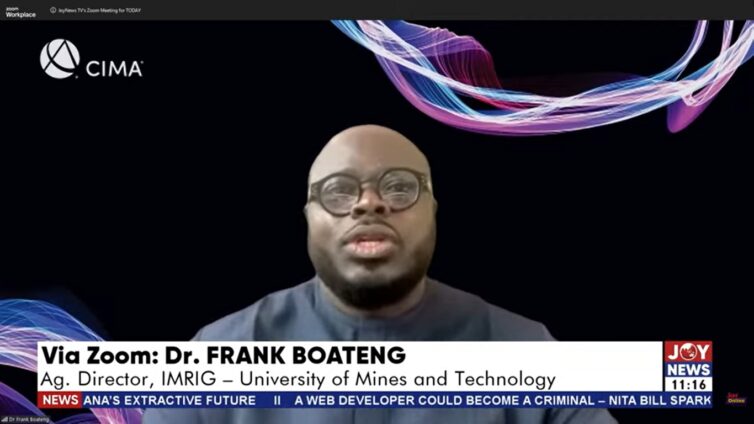
A lecturer at the University of Mines and Technology (UMaT), Dr Frank Boateng, has urged Ghana to prioritise maximising returns from its mineral resources through effective partnerships and revenue-sharing arrangements rather than pursuing the nationalisation of the mining sector.
Speaking during a high-level discussion on “To Nationalise or Transform? Rethinking Ghana’s Approach to Mining, Oil and Critical Minerals” in Accra on Tuesday, May 26, organised by Joy Business, Dr Boateng argued that the country’s immediate focus should be on how to derive greater value from the rents and royalties generated by mining activities.
"What we need to do now is be able to benefit more from our rent. And also make sure that, because of the kind of capital you need to mine, if we are in a hurry to give the mining companies to individuals to run, it will be difficult to mine," he said.
According to him, Ghana has previously experimented with state ownership and control of mining operations, but those efforts were largely unsuccessful due to the enormous capital requirements associated with the industry.
He noted that the sector was eventually returned to private operators, many of whom are not foreign entities, after the State struggled to sustain the significant investments needed to run large-scale mining operations.
"When the government took over (the mining sector) prior to the liberalisation in the early 80s, we all saw that we were not able to manage these mines, and that brought about the privatisation, where we brought in private investment," he added.
"It takes so much to build a gold mine," he added.
Dr Boateng maintained that the financial demands of establishing and operating mines remain beyond the reach of most local investors, making it difficult for Ghanaians to take over existing mining assets or develop new ones without substantial external support.
Rather than pursuing outright nationalisation, he advocated a stronger public-private partnership model that would enable the country to benefit from private capital, technical expertise and operational efficiency while ensuring that the State receives a fair share of the wealth generated from its natural resources.
Dr Boateng argued that a collaborative approach between government and private investors offers a more practical and sustainable pathway for growing the mining industry and maximising economic benefits for the country.
His comments come amid growing public debate over the future of Ghana’s extractive sector, as stakeholders weigh calls for greater national control of natural resources against the realities of financing and managing large-scale mining operations.
Latest Stories
-
Ghana eyes stronger trade ties as Australia hosts multicultural trade and investment forum
2 minutes -
Margaret-Marie Krakue
5 minutes -
Ayariga announces plans for live broadcast of MMDAs’ meetings on local radio stations
8 minutes -
Mrs Anna Tackie
10 minutes -
Ghana links Afghan heroin and Brazilian cocaine to global drug markets – Global Organised Crime Index
17 minutes -
NHIA launches nationwide inter-school quiz to deepen students’ knowledge of NHIS
24 minutes -
Political protection could be masking Ghana’s cocaine trade – Global Organised Crime Index
29 minutes -
AFCON 2027Q: ‘We have to dissolve the GFA’ – Effia MP after Black Stars lose to Gambia
31 minutes -
NPP announces voting schedule and ID requirements for October 3 national elections
33 minutes -
Lupus can mimic HIV symptoms and damage kidneys if untreated – KNUST expert
36 minutes -
Focus on Sickle Cell Foundation seeks to introduce sickle cell education through comics in Ghanaian schools
41 minutes -
NPP rewrites the campaign playbok as opposition reality shapes National Executive contest
43 minutes -
Road safety education will fail without enforcement – NRSA boss
44 minutes -
Daily Insight for CEOs: Finishing Q3 strong and entering Q4 with purpose
45 minutes -
National Ambulance Service begins ‘Operation Restore Fleet’ to restore grounded ambulances
45 minutes