

Audio By Carbonatix
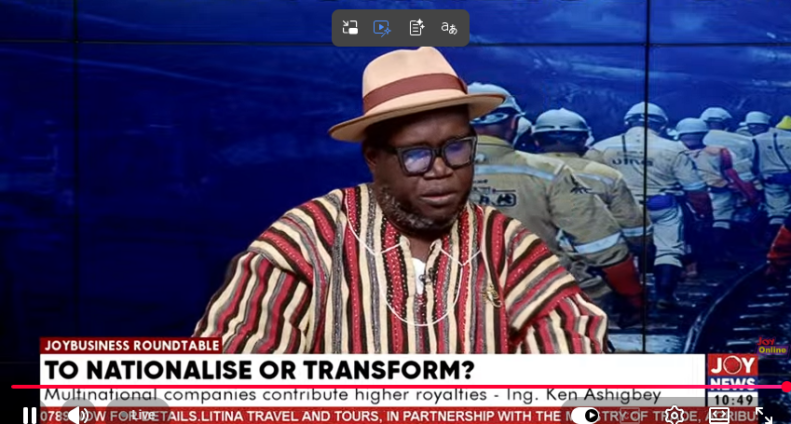
The Chief Executive Officer of the Ghana Chamber of Mines, Ken Ashigbey, has raised concerns about Ghana’s mining revenue structure, revealing that multinational mining companies contribute a higher share of royalties despite accounting for a smaller portion of the country’s total gold production.
Speaking on the JoyBusiness RoundTable, Mr Ashigbey said companies with majority ownership from the United States accounted for 12 per cent of Ghana’s production in 2025 but contributed 23 per cent in royalties.
“Companies whose majority ownership comes from the US contributed 12% of Ghana’s production but paid 23% in royalties,” he stated.
He further noted that Chinese-owned firms produced 10 per cent of total output and also contributed 23 per cent in royalties, while South African companies accounted for 18 per cent of production but paid 37 per cent in royalties.
“South African firms contributed 18% of production, yet they paid 37% in royalties,” he added.
According to him, Canadian and Australian companies contributed 2 per cent and 3 per cent of production, respectively, while each paid 5 per cent in royalties.
In contrast, Ghanaian-owned large-scale mining companies accounted for just 4 per cent of production, with the broader local sector contributing 7 per cent.
Mr Ashigbey argued that the figures point to an imbalance in Ghana’s mining economy, where multinational firms contribute less to overall output but bear a larger share of royalty payments.
“The small-scale sector contributed 52% of production but paid virtually nothing in royalties,” he said.
He maintained that Ghana’s mining revenue system is not delivering optimal value to the state and host communities and requires reform.
Mr Ashigbey further stressed the need to rethink how mining revenues are distributed, noting that most mineral royalties currently flow into the Consolidated Fund rather than directly supporting mining communities.
“Only 8% of mineral royalties are disbursed into mining areas, and that has to change if we want to see development,” he stated.
He also outlined the current distribution structure, explaining that 78 per cent of royalties go into the Consolidated Fund, 2 per cent goes to the Minerals Income Investment Fund (MIIF), while the remaining 20 per cent is shared among various state institutions and beneficiaries.
Mr Ashigbey expressed concern that too much revenue remains centralised in Accra, leaving mining communities with limited direct benefits for local development projects.
He also highlighted the broader tax contributions of large-scale mining firms, noting that despite public criticism, multinational companies remain significant contributors to government revenue through taxes and royalties.
He therefore called for a national conversation on how Ghana can maximise benefits from its mineral resources while ensuring more equitable development for mining communities.
Latest Stories
-
Engage Now Africa to construct a 10-unit classroom block for struggling Navrongo Vocational Training Centre
2 minutes -
One digital financial breach could expose linked accounts to fraud – Financial Crimes Manager
6 minutes -
Ghana Russia Centre signs ICT cooperation agreement with Moscow University
10 minutes -
The powerhouses of the village: Honouring Ghana’s rural women on International Rural Women’s Day
11 minutes -
Vincent Assafuah petitions CHRAJ to investigate alleged irregularities in 2026 World Cup visa arrangements
11 minutes -
12-year-old boy found dead in muddy pit at Opeikuma
13 minutes -
GHS begins Yellow Fever vaccination campaign in three Upper West districts
14 minutes -
Organised Labour pushes for higher 2027 base pay despite slowing inflation
16 minutes -
Parliament’s Human Rights Committee demands swift justice in Obuasi SHTS sexual abuse case
26 minutes -
From Campaign Propaganda to Gov’t Accountability: When the message-makers demand a seat at the table
45 minutes -
Ashanti Region Security Coordinator warns sand winners to stay off Accra–Kumasi Expressway site
49 minutes -
PZ Cussons Ghana promotes hand washing among schoolchildren through Camel campaign
1 hour -
30 NDC aspirants file nominations in Upper West as regional election approaches
1 hour -
UPSA launches laptop assembly plant, requiring new students to assemble their own devices
2 hours -
UCC sociologist calls for action on gender inequality to end child marriage
2 hours