

Audio By Carbonatix
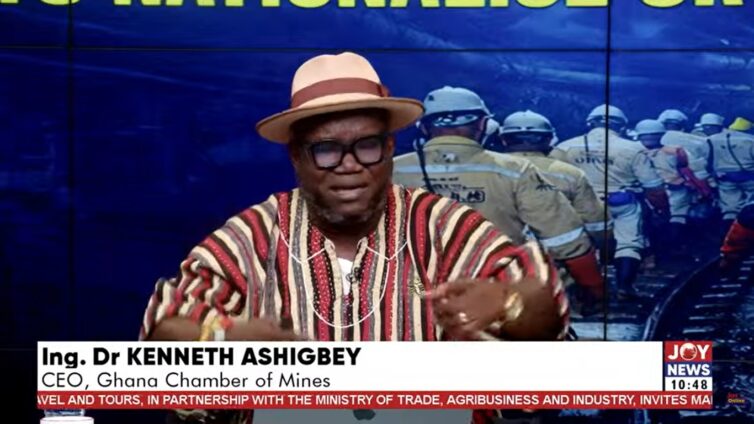
The Chief Executive Officer of the Ghana Chamber of Mines, Ken Ashigbey, has stressed that Ghana cannot rely solely on local capacity to fully exploit its vast mineral resources, insisting that foreign investment remains essential to unlocking the sector’s full potential.
He argued that the scale of Ghana’s mineral deposits is too large for domestic actors alone to develop effectively, and called for a strategic approach that attracts international capital and expertise.
Mr Ashigbey said Ghana’s underground gold reserves are immense, describing them as running into “trillions of ounces”, and noted that local capacity constraints make external partnerships unavoidable.
“The thing we should bear in mind is that, beyond the things we are mining, there are six gold belts, the six trillions of ounces of gold that are sitting there and we as Ghanaians alone will not be able to do it; we still need to be able to attract some investors to come and do it,” he said.
He made the remarks during a high-level policy dialogue titled “To Nationalise or Transform? Rethinking Ghana’s Approach to Mining, Oil and Critical Minerals”, organised by JoyNews in Accra on Tuesday, May 26.
The forum brought together industry leaders, policymakers, academics and governance experts to examine Ghana’s extractive sector model amid renewed debates over nationalisation and alternative approaches that combine local participation with foreign investment.
Mr Ashigbey’s comments come amid growing national discussions about how best to manage Ghana’s natural resources, with some advocating full nationalisation while others support hybrid models that leverage external financing and technical expertise alongside domestic involvement.
Ghana has been a gold-producing country for over a century and also possesses significant deposits of bauxite and manganese. About 15 years ago, it entered the oil production era following the start of commercial crude production from the Jubilee Field in December 2010.
Attention is now increasingly shifting towards lithium and other critical minerals as Ghana positions itself within the global energy transition and rising demand for battery-related resources.
Mr Ashigbey’s remarks highlight the ongoing policy tension between resource sovereignty and the practical need for international partnerships in a capital-intensive and technologically complex industry.
Latest Stories
-
NCA announces major voice and data disruption across Northern Ghana due to fibre cuts
9 minutes -
Photos: Housing solutions take centre stage at Day 2 of the 3rd Republic Bank-JoyNews Habitat Fair
41 minutes -
Video: Immunity should be exercised without creating classism – Inusah Fuseini on cocaine bust
1 hour -
Ghana Air Force passes out 293 recruits after six months of intensive training
1 hour -
EOCO vrs Baffour Awuah: EOCO should have secured warrant before arrest attempt at court – Inusah Fuseini
1 hour -
Triple fibre cuts disrupt telecom services across Northern, Oti regions – Sam George
1 hour -
Politicisation could undermine parliamentary probe into cocaine seizures – Dr Osae-Kwapong
2 hours -
EOCO chases MP: Can Section 41 cure lacuna in EOCO Act? – Inusah Fuseini asks
2 hours -
GNFS, GWL inspect fire hydrants in Ministries enclave; 23 found faulty
2 hours -
Gov’t directs release of 50,000 bags of grain to ECOWAS
2 hours -
Ghana, Germany deepen cooperation on railways, labour mobility
2 hours -
Huge crowds greet Pope in Paris for open-air Mass
2 hours -
Ghana’s Charles Amofah Elected Vice President of African Bowling Federation
2 hours -
‘I never said I’ll declare a state of emergency’ – President Mahama on galamsey
3 hours -
Bobby Banson condemns EOCO’s attempted arrest of Nana Agyei Baffour Awuah
3 hours