

Audio By Carbonatix
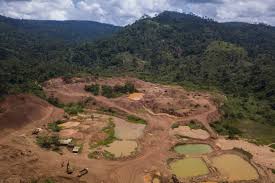
The Western Region, long regarded as a major hub for artisanal and small-scale gold mining, is experiencing an alarming expansion of mostly unregulated and unlicensed mining activities, commonly known as galamsey.
A new report by the Global Initiative Against Transnational Organised Crime reveals that while the region’s economy is largely driven by agriculture, employing about 70% of its estimated two million residents, there is a growing dependency on mining and its allied sectors, including oil and gas extraction, cocoa processing, timber, and palm oil production.
However, it is illegal gold mining, often conducted under the radar of regulatory authorities, that is rapidly transforming the economic and environmental landscape of the region.
Satellite imagery analysed between 2015 and 2021 highlights a significant surge in artisanal and small-scale gold mining activity, particularly around Wassa Akropong and Asankragua, where the communities are emerging as gold trade hotspots.
Illegal mining beyond boundaries
The report underscores that while it is difficult to determine the legality of every mining site without physical inspection, a significant portion of ASGM operations clearly extend beyond licensed mining concessions. Some also take place within concessions designated solely for exploration, not exploitation, and others flout basic environmental and health regulations, qualifying them as unlicensed operations under the country's law.
According to the report, overlaying satellite imagery with the mining cadastral maps reveals a disturbing picture: vast stretches of mining activity occurring illegally, both outside sanctioned zones and within areas where miners lack the appropriate licences or permits.
The phenomenon, experts warn, is not merely a question of geography but of impunity and weak regulatory enforcement.
Asankragua: a new mining frontier
While Wassa Akropong has long been on the radar of researchers and authorities, the growth of artisanal and small-scale gold mining in and around Asankragua marks a new frontier. Once overlooked, Asankragua has become a burgeoning hotspot, with predictive computer models indicating strong potential for further mining activity in its environs.
The researchers attribute this development to the arrival of foreign nationals, particularly Chinese actors, who are introducing sophisticated technologies and accelerating the scale and intensity of artisanal and small-scale gold mining operations.
This foreign influence, the report notes, has brought with it an influx of advanced mining machinery and processing techniques, facilitating a gold rush that is not only largely unregulated but also environmentally destructive, the report stated.
Cocoa plantations under threat
One of the most troubling consequences of this illegal mining boom is the widespread destruction of cocoa plantations, a critical source of livelihood for thousands of rural families in the Western Region.
According to the findings, in many communities, gold mining pits have replaced cocoa farms, undermining food security and threatening the country's global reputation as a top cocoa producer.
Images captured near Abooso, for example, show shocking levels of deforestation and water turbidity, both indicators of environmental harm caused by unregulated mining. Ground-truthing exercises, or field verification visits, remain essential for confirming satellite findings and gauging the true extent of the damage.
Call for stronger oversight and enforcement
The report calls for urgent policy attention and enhanced regulatory oversight. It recommends more consistent ground-based investigations to supplement satellite surveillance and advocates for the review of current mining policies to ensure proper licensing, compliance, and enforcement mechanisms.
Environmentalists and local leaders are also calling for a rethinking of the development model in the region. “We cannot trade our forests, farms, and water bodies for short-term gain,” one local official remarked. “Ghana must invest in sustainable mining practices and community engagement, especially in high-risk zones like Asankragua.”
Below is the full report
Latest Stories
-
51,000 teachers’ promotion arrears to be validated for October payment – Education Minister
7 minutes -
Kwabena Boamah appointed Board Chair for Impact Investing Ghana
15 minutes -
Striking teacher unions to meet Fair Wages and Salaries Commission on October 6
29 minutes -
EOCO working with AG to arraign Nana Baffour Awuah before weekend court
32 minutes -
Duraplast reassures customers after fire, announces October 5 reopening
40 minutes -
Call off strike, gov’t will not renege on promotion arrears pledge – Haruna Iddrisu appeals to teacher unions
42 minutes -
Committee set up to validate teachers eligible for 20% deprived-area allowance – Education Minister
46 minutes -
Five-member committee to search for new Black Stars coach after Sports Ministry-GFA meeting
1 hour -
Pinktober: Breast cancer survival exceeds 90% when detected early – Breast Society of Ghana
1 hour -
TCDA to adopt Upper West’s MATCO mango farm as northern prototype, issues warning against felling shea trees
2 hours -
‘Fear delegates’ tag: Afoko touts genuineness among delegates ahead of NPP delegates conference
2 hours -
John Boadu: The leader our party needs at this time – Amb. Edward Akwasi Boateng
2 hours -
Baffour Awuah: EOCO arrested, detained MP after hours of waiting, questioning – Afenyo-Markin
2 hours -
EOCO court warrant authorised search of Baffour Awuah’s law firm, not residence – Afenyo-Markin
2 hours -
NPP delegates conference: 3,000 to 4,000 police personnel deployed for security in Kumasi – Anthony Karbo
2 hours