

Audio By Carbonatix
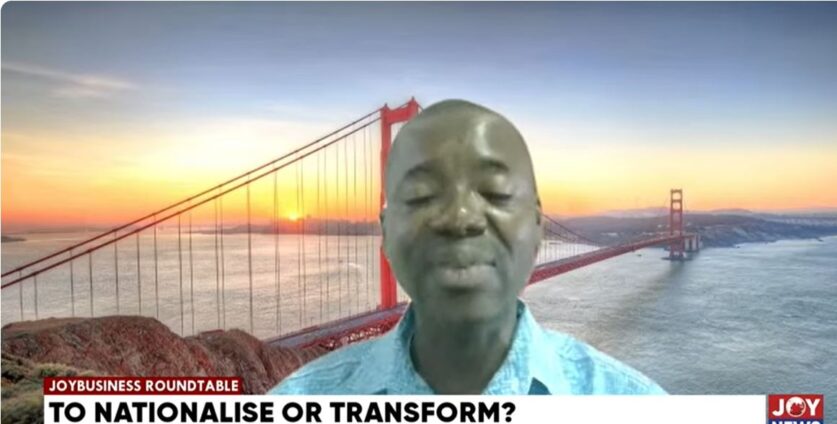
A mineral economist at the Minerals Commission, Wisdom Puplampu, has cautioned against calls for the nationalisation of mines in Ghana, arguing that such a move would not automatically result in greater financial benefits for the state.
Speaking during a JoyBusiness Roundtable discussion on rethinking Ghana’s approach to gold mining, oil, and critical minerals, Mr Puplampu stressed the need for strategic reforms and stronger financing structures to support local participation in the extractive sector.
According to him, Ghana’s local content regulations already provide opportunities for mining companies to list on the stock exchange to raise capital. However, he argued that relying solely on the capital market would not generate the level of funding required for large-scale mining operations.
“The stock exchange cannot give us the required capital we need to operate. So we need a hybrid approach,” he stated on Tuesday, May 26.
Mr Puplampu explained that the proposed hybrid financing model should combine debt financing from banks with equity financing through the stock exchange.
He also called on the National Pensions Regulatory Authority to consider relaxing investment regulations to allow portions of pension funds to be invested in the equity market.
According to him, pension funds represent “patient capital” capable of supporting long-term investments in the mining industry and strengthening local participation.
“And if we adopt the hybrid approach, we’ll be able to make some significant impact,” he added.
Mr Puplampu further emphasised the importance of continuing to attract foreign direct investment into the mining sector, noting that partnerships between local companies and foreign investors remain critical for sustainable growth.
He warned that discussions surrounding the nationalisation of mines could create uncertainty and send negative signals to investors.
“So if we nationalise the mines, when we are telling investors that we are closing our mines, which is not government policy, it creates concerns,” he noted.
Mr Puplampu also argued that nationalisation alone would not necessarily increase state revenue, explaining that local mining companies are already making substantial contributions through corporate income taxes.
Citing data from the Ghana Revenue Authority, he said local mining firms have performed strongly in terms of profitability and tax payments.
“Our local companies have done well when it comes to corporate income tax, which is a measure of how well the companies are doing in terms of profitability,” he said.
He cautioned that if the state assumes control of mining operations without the capacity to manage them efficiently, Ghana could risk losing significant corporate tax revenues currently generated by private operators.
“What that means is that government or the state will not be able to capitalise, but will be losing out on corporate income tax, which is a significant contributor when it comes to revenue streams from the mining industry,” he explained.
Latest Stories
-
He entered at eight. He is now 16: Ghana’s children growing up in prayer camps
2 hours -
‘Development must not always begin from Accra’ — Anwelle Foundation launched in Jirapa
2 hours -
PKO trio eye victories at Odwira Festival
4 hours -
346 Ghana Navy recruits pass out after 26 weeks of intensive training
4 hours -
Newsfile to discuss EOCO-MP arrest, drug trafficking, speech arrests and $235m water debt
5 hours -
JoyNews gets results as listeners raise GH¢40,000 to help 17-year-old student with cerebral palsy attend SHS
5 hours -
Vice President calls for stronger local pharmaceutical production to reduce medicine imports
6 hours -
The brewing tension at KNUST; Beware the Ides of October….
6 hours -
Health Ministry moves to integrate traditional medicine into mainstream healthcare
6 hours -
550 pupils in Kintampo South get educational lifeline as ‘Seeds of Hope’ reaches farming communities
7 hours -
Opoku Mensah urges Christian Council, House of Chiefs to speak up on democratic freedoms
7 hours -
Teacher unions’ strike: Minority demands immediate payment of teacher arrears, 20% deprived area allowance
7 hours -
The Accra-Kumasi Expressway: Building it right
7 hours -
Beyond gold exports: Building value and economic resilience from Ghana’s gold
7 hours -
2027 AFCONQ: Ghana under pressure as Gambia beat Somalia 2-1
8 hours