

Audio By Carbonatix
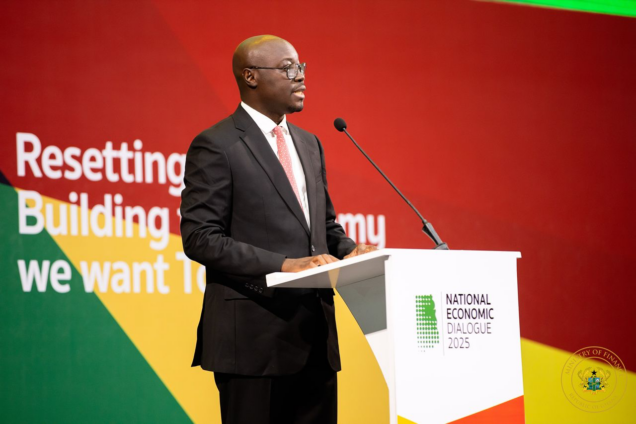
Dr Cassiel Ato Baah Forson, the Minister of Finance, Monday unveiled what he says is a comprehensive strategy aimed at resetting Ghana’s economy through rigorous structural reforms.
The Minister emphasised the urgent need for fiscal discipline and sustainable growth, describing the current macroeconomic situation as “very fragile.”
The announcement was made during the inaugural day of the National Economic Dialogue held at the Accra International Conference.
In a detailed presentation, the Minister outlined seven key focus areas designed to address the nation’s economic challenges.
These included enhanced domestic revenue mobilisation, which would involve strategies to broaden the tax base and improve collection efficiency, ensuring a balance between equity, simplicity, and efficiency.
The Minster said the government also planned to achieve quantitative fiscal consolidation through controlled borrowing and reduced costs, allowing for increased investment in national development.
“Ensuring compliance with public financial arrangements and public procurement rules is another critical area, with a focus on strengthening financial governance and promoting transparency in public spending,” he said.
“Additionally, the Government aims to enhance the efficiency of public spending and social programmes by optimising resource allocation to maximise value for money and ensure fiscal adjustment.”
Dr Forson announced plans to phase out costly, regressive, and ineffective subsidies in the energy sector, transitioning towards targeted social programmes to protect vulnerable populations while reducing fiscal strain.
“Reforming state-owned enterprises (SOEs) is another priority, with specific attention given to addressing contingent liabilities and reducing fiscal burdens in entities like Cocoa Board and the Electricity Company of Ghana,” he said.
He revealed government’s decision to working on strengthening Ghana’s fiscal framework by redesigning fiscal rules and enhancing automatic stabilizers to contain budget fragilities and address revenue year market issues.
The Minister stressed the importance of discipline and a long-term perspective, urging citizens to recognise that “short-term benefits we gain today have long-term consequences for our future.”
He acknowledged the ineffectiveness of fiscal policy over the past eight years and called for a “momentum for reforms,” emphasising that the “quality of adjustment will be key to support growth and protect the poor and most vulnerable.”
“The new reforms are intended to address the current economic climate, particularly the high cost of borrowing and the need to channel dividends to support national development,” he said.
Latest Stories
-
Building Trust in Digital Entertainment: What users should Look for in an online gambling site
5 minutes -
Former Deputy CEO of SIF declares Nandom NPP bid, pledges to rebuild party unity
17 minutes -
Jefferson Sackey to launch PURPOSE: A Memoir of Fearless Journalism, Diplomacy and Growth
20 minutes -
GCB Bank Head of People & Culture shares workforce planning strategies at Mining HR Conference
22 minutes -
Rising cost of political campaigns threatens inclusive participation – CDD-Ghana
26 minutes -
Parents laud convenience, affordability at Joy FM Back-to-School Fair
36 minutes -
End partisan recruitment into security agencies – Asiamah Amoako
41 minutes -
Mahama Ayariga seeks Chief Imam’s prayers, guidance in his new ministerial role
43 minutes -
Photos: Joy FM Back-to-School Discount Fair opens with busy first day
46 minutes -
Overloaded tricycle kills one at Assin Gangan
49 minutes -
Lands Minister vows to fight galamsey ‘all the way’, targets financiers
51 minutes -
‘You carry Ghana’s hopes’ – Sports Ministry rallies Medeama, Nations FC ahead of Africa ties
56 minutes -
BSIFF 2026 puts Ghanaian cinema at heart of festival
57 minutes -
No truth in GH¢70k ‘gift’ claims involving Appiagyei, the memo is fake – Deputy Minority Whip
1 hour -
10-year-old pupil drowns while swimming with friends at Tetekope beach
1 hour