

Audio By Carbonatix
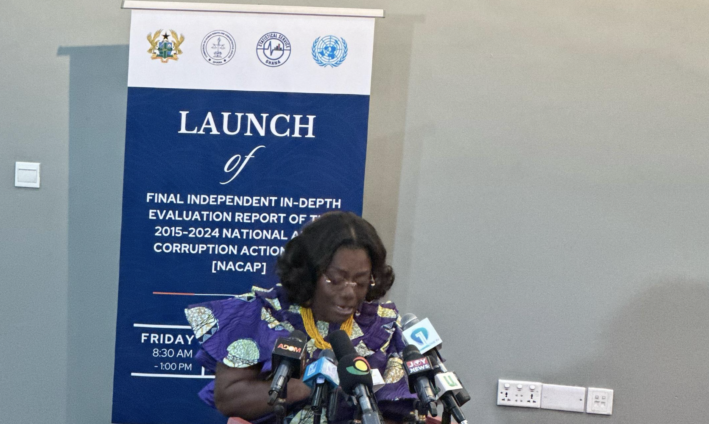
Nana Oye Bampoe Addo, the Deputy Chief of Staff, has expressed the government’s commitment to dealing ruthlessly with corruption, making it a high-risk venture for perpetrators.
She gave the assurance at the launch of the Final Evaluation Report of the National Anti-Corruption Action Plan (NACAP), in Accra, on Friday.
The 10-year anti-corruption strategic plan was implemented between 2015 and 2024 with key objectives of building public capacity to condemn and fight corruption, making it a high-risk, low-gain venture.
It is also to institutionalise efficiency, accountability and transparency in the public, private and not-for-profit sectors.
Again, it sought to engage individuals, media and Civil Society Organisations to report and combat corruption and related matters as well as conduct effective investigations and prosecution of corrupt conduct.
Commenting on the findings of the Report, Nana Oye expressed dissatisfaction over the little progress made in combating corruption in the country, despite the implementation of the NACAP in the past 10 years.
For instance, over the past three years, she noted that Ghana’s Corruption Perception Index (CPI) showed little improvement, highlighting the persistent challenges in the fight against the canker.
In 2022 and 2023, the country maintained a CPI score of 43, indicating a stagnation in anti-corruption efforts.
However, in 2024, the score dropped slightly to 42, signaling a decline in public trust regarding transparency and accountability.
Additionally, Nana Oye explained that other recent surveys on corruption by institutions such as Transparency International, the Centre for Democratic Development, Ghana (CDD) Afro-barometer Reports and the Ghana Statistical Service, showed the lack of progress in the fight against corruption.
“All these surveys have shown that corruption remains a big challenge in Ghana even after several years of implementing NACAP,” she said, adding “This Report has not given us a clean slate on the fight against corruption in Ghana.”
Despite those concerns, the Deputy Chief of Staff said the Government’s commitment to the fight remained unwavering, stressing that the implementation of key strategies such as the “Operation Recover All Loot” was a testament to that fact.
“To show further commitment to addressing corruption, President Mahama has appointed a Presidential Advisor for the National Anti-Corruption Programme. He is Professor Francis Dodoo,” she said.
Nana Oye Bampoe Addo pledged government’s commitment to the implementation of a NACAP II, to ensure the canker was reduced if not eradicated from the Ghanaian society.
“Let me announce that government is fully committed to satisfying the anti-corruption international obligations of the state as contained particularly in the UNCAC and in this direction will support the development of NACAP II.”
Professor Simon Mariwah, the National Consultant for the Evaluation Report, who presented the findings, stressed the need for the establishment of a dedicated fund to ensure constant funding for NACAP II.
He noted that while the activities of the Plan met key objectives of the priorities of implementing agencies including its relevance, coherence, efficiency and effectiveness, it lacked adequate and sustained funding.
“CHRAJ should spearhead the securing of long-term funding for anti-corruption initiatives and should facilitate the establishment of a NACAP Fund to support the implementation of NACAP activities across the various sectors of the economy,” he urged.
Prof Mariwah, also the Head of Department, Geography and Regional Planning, University of Cape Coast, proposed that a regular evaluation, specifically mid-term evaluation, be held during the NACAP II implementation to enable stakeholders to track the progress to inform decision making.
Dr Joseph Whittal, the Commissioner on Human Rights and Administrative Justice (CHRAJ), said as the implementing agency of the Plan, it would adopt the recommendations to improve on subsequent plans.
Key among them, he noted, was to explore a sustainable funding for the next NACAP to ensure their smooth running.
“There are quite a number of lessons that have been learned,” he said.
“One is sustainability. We need funding, dedicated funding to ensure that the NACAP II is not going to run into the difficulties that NACAP I did. And so funding is very, very important.”
Latest Stories
-
Banks NPL ratio of 16.1% is still too high – S&P
48 minutes -
Guidelines, regulations of cryptocurrency in Ghana fall short of comprehensive oversight – IMF
1 hour -
I didn’t want to be in the spotlight – Tems
2 hours -
COCOBOD’S GH¢16.3bn SPV: Real progress toward a sustainable cocoa sector
2 hours -
Impossible for England to find another Kane – Tuchel
4 hours -
Ghana lose Morocco friendly as Atlas Lions turn to Mali
4 hours -
Burnham ‘really concerned’ if Man City owners sell up after rule breaches
4 hours -
2026/2027 GPL: Kelvin Nkrumah strike sends Medeama top of league table
4 hours -
Punish Manchester City this season, say other club chiefs
4 hours -
Emmanuel City crowned champions of maiden Global Game Scouting Tournament
4 hours -
MPship should not shield anyone from arrest – Felix Ofosu-Kwakye
4 hours -
Thomas Partey loses father Jacob Teye Partey
4 hours -
Gov’t rejects Baffour Awuah ‘kidnap’ claims, says EOCO officer was lawfully executing arrest
4 hours -
Martin Kpebu explains when EOCO can arrest Manhyia South MP after securing court warrant
4 hours -
EOCO’s reasons for seeking Manhyia South MP arrest warrant not justified – Kpebu
4 hours