

Audio By Carbonatix
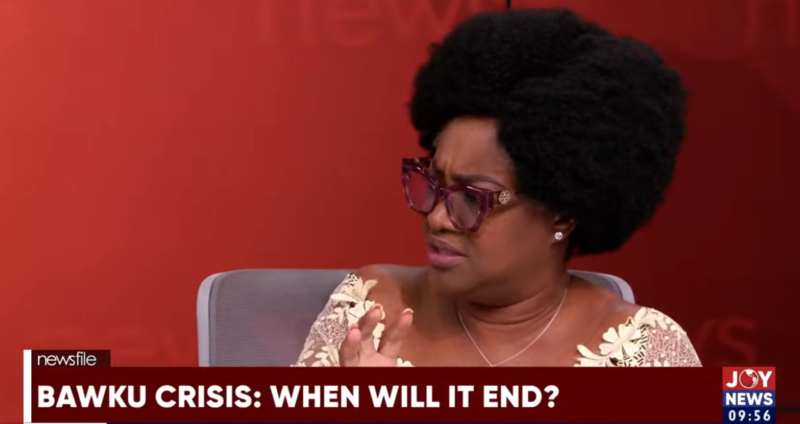
The Executive Secretary of the National Interest Movement, Susan Adu-Amankwah, has said that military enforcement cannot bring lasting peace to the troubled town of Bawku.
Speaking on JoyNews’ Newsfile on Saturday, April 12, she urged for a more thoughtful and inclusive approach to resolving the long-standing conflict.
“Peace is not a sudden event, it is not a destination, it is a journey, it takes time, it takes effort and it takes commitment. Both sides have to feel that there is something to gain by peace,” she explained.
Referring to the ethnic tensions between the Kusasis and Mamprusis in Bawku, she expressed hope that the two groups would eventually recognise the mutual benefit of peaceful coexistence.
“Bawku has not grown, and at a point, both the Kusasis and the Mamprusis will see that there is something to gain by peace,” she said.
She criticised recent attempts to force integration in the area, saying that such actions have only worsened the situation. “My understanding was that peace by force was trying to happen,” she said. “Apparently the police said they were going to force integration, so they bussed Mamprusi women to the market. It was in that scuffle that a policeman shot the youth leader, and that sparked this present situation.”
Adu-Amankwah warned that trying to impose peace through military means would not address the underlying issues.
“You cannot enforce peace, you cannot push the peace,” she said. “Peace is not the absence of conflict, it is a state of harmony, justice, and calmness. Getting the military to go there and enforce it does not necessarily mean there is peace. We need to go to the root of the matter.”
She expressed support for the Asantehene’s involvement in efforts to resolve the crisis, noting his deep understanding of the issue and the respect he commands.
“The Asantehene is going there because he knows the root,” she said. “We shouldn’t expect him to wave a magic wand. He has to work for that peace.”
Adu-Amankwah also appealed to the youth of Bawku to remain calm. “We would want the young people to tone down, because they are the ones going to be the victims if they don’t.”
She made a reflection on the cost of the crisis, not only in terms of security operations, but also in lost potential.
“It is expensive to send the police and military there. It is expensive to have a part of our nation not growing,” she said. “We have to look at the pros and cons of what is more expensive and what is more long term."
Latest Stories
-
Pope walking and recovering ‘as expected’ after surgery, doctors say
2 hours -
Total expenditure as of July 2026 amounted to GH¢147.07bn, 16% below target – BoG
3 hours -
Total revenue & grants stood at GH¢144.5bn in July 2026, slightly below target – BoG
3 hours -
Ghana Sports Fund urges sports federations to submit credible proposals and measurable targets
4 hours -
Sally Rooney books withdrawn in UK over Palestine Action support
4 hours -
Musk says US government may be behind slowdown of Ukraine drone speeds
4 hours -
Picking Chief Justices nearing retirement could give Mahama immense power – Bentil
4 hours -
Netflix to shed 1,000 jobs in steepest cuts since 2022
4 hours -
Burnham had two hospitality dinners with Man City chairman, deleted records show
4 hours -
Semenyo ‘froze’ after alleged racist abuse, court told
5 hours -
‘Shameless’ – Mourinho critical of Vinicius Jr ban timing
5 hours -
Loyalty can outweigh competence in Chief Justice selection – Bentil
5 hours -
Man City suffer as PSG masterclass sets up Champions League win
5 hours -
Customer Service Africa CEO urges business leaders to observe staff and customer interactions
6 hours -
On night of mayhem for Liverpool, Barcola arrives in style
6 hours