

Audio By Carbonatix
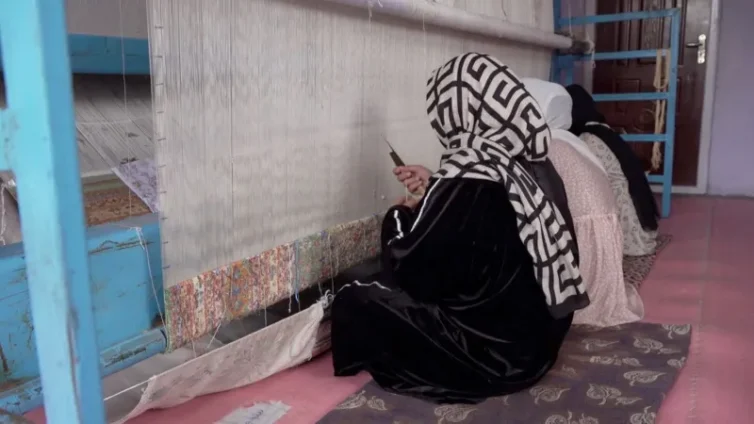
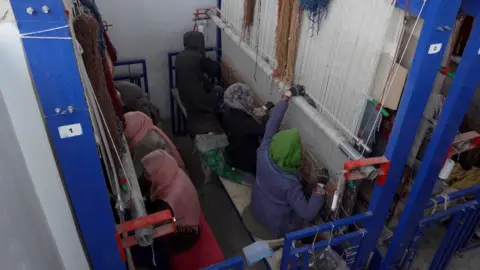
At a workshop in Kabul where carpets are made, hundreds of women and girls work in a cramped space, the air thick and stifling.
Among them is 19-year-old Salehe Hassani. "We girls no longer have the chance to study," she says with a faltering smile. "The circumstances have taken that from us, so we turned to the workshop."
Since the Taliban seized power in 2021, girls over the age of 12 have been barred from getting an education, and women from many jobs.
In 2020, only 19% of women were part of the workforce - four times less than men. That number has dropped even further under Taliban rule.
The lack of opportunities, coupled with the dire economic situation the country faces, have pushed many into long, laborious days of carpet weaving - one of the few trades the Taliban government allows women to work in.
According to the UN, the livelihoods of about 1.2 to 1.5 million Afghans depend on the carpet weaving industry, with women making up nearly 90% of the workforce.
In an economy that the UN warned in a 2024 report had "basically collapsed" since the Taliban took power, the carpet export business is booming.
The Ministry of Industry and Commerce noted that in the first six months of 2024 alone, over 2.4 million kilograms of carpets - worth $8.7m (£6.6m) - were exported to countries such as Pakistan, India, Austria and the US.
But this has not necessarily meant better wages for the weavers. Some the BBC spoke to said they had seen none of the profit from a piece sold in Kazakhstan last year that fetched $18,000.
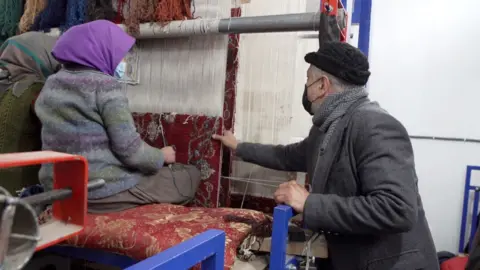
Within Afghanistan, carpets sell for far less - between $100-$150 per square metre. Needing money to help support their families and having few options for employment, workers are trapped in low-paid labour.
Carpet weavers say they earn about $27 for each square metre, which usually takes about a month to produce. That is less than a dollar a day despite the long, gruelling shifts that often stretch to 10 or 12 hours.
Nisar Ahmad Hassieni, head of the Elmak Baft company, who let the BBC go inside his workshops, said that he pays his employees between $39 and $42 per square metre. He said they are paid every two weeks, with an eight-hour workday.
The Taliban has repeatedly said that girls will be allowed to return to school once its concerns, such as aligning the curriculum with Islamic values, are resolved - but so far, no concrete steps have been taken to make that happen.
Mr Hassieni said that, following the rise of the Taliban government, his organisation made it its mission to support those left behind by the closures.
"We established three workshops for carpet weaving and wool spinning," he says.
"About 50-60% of these rugs are exported to Pakistan, while the rest are sent to China, the USA, Turkey, France, and Russia to meet customer demand."
Shakila, 22, makes carpets with her sisters in one of the rooms of the modest rental they also share with their elderly parents and three brothers. They live in the impoverished Dasht-e Barchi area, in the western outskirts of Kabul.
She once had dreams of becoming a lawyer, but now leads her family's carpet-making operation.
"We couldn't do anything else," Shakila tells me. "There weren't any other jobs".
She explains how her father taught her to weave when she was 10 and he was recovering from a car accident.
What began as a necessary skill in times of hardship has now become the family's lifeline.
Shakila's sister, 18-year-old Samira, aspired to be a journalist. Mariam, 13, was forced to stop going to school before she could even begin to dream of a career.
Before the Taliban's return, all three were students at Sayed al-Shuhada High School.
Their lives were forever altered after deadly bombings at the school in 2021 killed 90 people, mostly young girls, and left nearly 300 wounded.
The previous government blamed the Taliban for the attack, though the group denied any involvement.
Fearing another tragedy, their father made the decision to withdraw them from school.
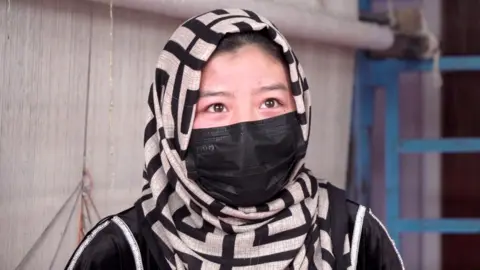
Samira, who was at the school when the attacks happened, has been left traumatised, speaking with a stutter and struggling to express herself. Still, she says she would do anything to return to formal education.
"I really wanted to finish my studies," she says. "Now that the Taliban are in power, the security situation has improved and there have been fewer suicide bombings.
"But the schools are still closed. That's why we have to work."
Despite the low pay and long hours of work these women face, the spirits of some are unbroken.
Back at one of the workshops, Salehe, determined and hopeful, confided that she had been studying English for the past three years.
"Even though schools and universities are closed, we refuse to stop our education," she says.
One day, Salehe adds, she plans to become a leading doctor and build the best hospital in Afghanistan.
Latest Stories
-
JoyNews-Republic Bank Habitat Fair finale turns homeownership dreams into real possibilities
12 minutes -
Bamiri chief commissions KG block, guest house to boost education and revenue
30 minutes -
NSMQ 2026: Yaa Asantewaa Girls’ going ‘beck’ to Tanoso after Bishop Herman deals them early exit
54 minutes -
Data Protection Commission acquires two vehicles to strengthen data protection enforcement
1 hour -
NSMQ 2026: Holy Child School storms back from two-year NSMQ absence to book One-Eighth ticket
3 hours -
GNFS dismisses reports of unpaid 2025 rent allowance
4 hours -
Gordon Asare-Bediako steps down from NPP Communications Director race, backs Dennis Aboagye
4 hours -
GES dismisses requirement for newly promoted teachers to submit documents for salary adjustments
4 hours -
Meko Bono 2026: Vice President pledges agricultural revival as Atebubu hosts grand homecoming
5 hours -
Russian skydiver Sergey Boytcov sets world record with 11,551-metre stratosphere jump
5 hours -
Ablakwa-led committee submits five reports to Mahama ahead of 2027 AU chairmanship
5 hours -
Africa not seeking Western cash in reparations campaign – Ablakwa
5 hours -
Production decline, reserve depletion threaten Ghana’s upstream sector – Jinapor
6 hours -
Surveyors caution against treating compensation disputes as professional misconduct
6 hours -
Mahama calls for AU dialogue on migration after South Africa xenophobic tensions
6 hours