

Audio By Carbonatix
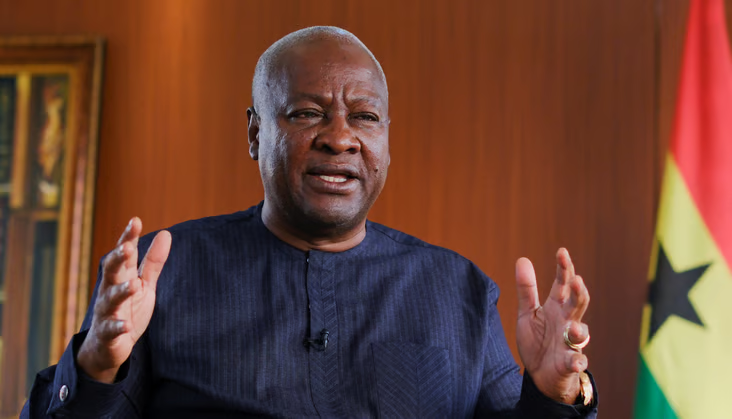
President John Dramani Mahama has warned that Ghana is not immune to the escalating global crude oil prices triggered by the recent exchange of missiles between Israel and Iran in the Middle East.
Speaking during his 'Thank You Tour' in the Savannah Region on Saturday, June 14, the President acknowledged the potential economic fallout and outlined steps his administration is taking to mitigate the impact on domestic fuel prices.
"Despite the work we have done in stabilising the economy, Ghana is not immune from the shocks of global events," President Mahama stated, highlighting the nation's vulnerability to international geopolitical developments.
He specifically pointed to "recent events in the Middle East which involve an exchange of missiles between Israel and Iran," noting that these developments "have started to escalate crude oil prices dramatically."
Global crude oil benchmarks, such as Brent crude, have seen significant surges in response to heightened tensions in the Middle East, a region critical to a substantial portion of the world's oil supply.
This instability directly impacts countries like Ghana, which, despite being a crude oil producer, remains a net importer of refined petroleum products.
Data from the International Energy Agency (IEA) indicates that oil constitutes a significant portion of Ghana's total energy supply, with the transport sector being the largest consumer of refined oil products.
To safeguard Ghana's economy and protect consumers, President Mahama revealed that he has issued directives to his key ministers.
"I've asked our Minister of Finance and Minister of Energy to keep a close eye on the development and model the possible impacts on our petroleum prices," he disclosed.
The current Minister for Finance is Dr. Cassiel Ato Forson, while the Minister of Energy is John Abdulai Jinapor.
The President's directive underscores a proactive approach to potential economic headwinds.
Ghana is currently engaged in an Extended Credit Facility (ECF) programme with the International Monetary Fund (IMF), aimed at achieving macroeconomic stability and fiscal discipline.
The government's 2025 budget targets a 1.5% primary surplus, making the management of external shocks like rising oil prices crucial to maintaining these hard-won economic gains.
The ministers have been tasked not only with monitoring the situation but also with preparing "measures to protect the recent gains that we have made."
These measures could potentially include strategic reserves, targeted subsidies, or other fiscal interventions to cushion the Ghanaian public from sharp increases at the pump.
Latest Stories
-
Jason Arday: 10 things you may not know about British-born Ghanaian former Cambridge professor found dead at 41
41 minutes -
KNUST partners with government to manufacture locally-made agricultural machines and smart traffic lights
48 minutes -
Government to add constitutional referendum to 2027 District Assembly elections
2 hours -
Government disburses GH¢23.1 billion to clear road contractors’ arrears – Roads Minister
2 hours -
NPP Ashanti elections: 1,020 delegates to choose 11 regional executives
3 hours -
Galamsey: ‘Challenge is prosecution, not arrest’ — Lands Minister
4 hours -
MTN to build 80 new sites across the five regions of the north as part of a $1.1bn investment
5 hours -
The Polygamist’s creator says women see themselves reflected in her Netflix hit
6 hours -
UEW Hospital suspends OPD services over GAUA strike
6 hours -
Muzic Mensah selected for Boomplay’s inaugural ‘NEXT WAVE’ Programme
7 hours -
Prime Insight to tackle legal vacation controversy and $1million AKSA bribery case
7 hours -
Ghanaian evacuee from South Africa dies on arrival in Accra
8 hours -
Suicide and the fight to stay alive
8 hours -
POS Foundation raises alarm over student cohabitation, sexual harassment on university campuses
9 hours -
Nandom NPP primary heats up as four candidates enter 2028 race
9 hours