

Audio By Carbonatix
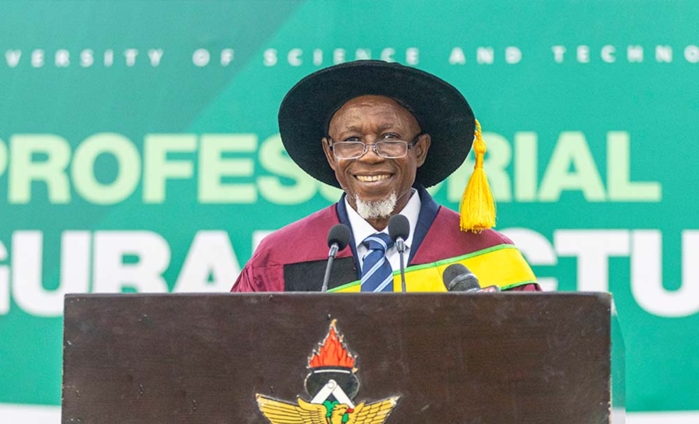
An economist at the Kwame Nkrumah University of Science and Technology (KNUST), Kumasi Prof. Mohammed Hadrat Yusif, has called for sweeping reforms to Ghana’s monetary policy framework, including granting operational independence to the Bank of Ghana (BoG).
According to him, such reforms are essential to restoring macroeconomic stability and supporting long-term national development.
Delivering his Professorial Inaugural Lecture, Prof. Yusif examined Ghana’s monetary policy history and its persistent structural weaknesses.
The lecture, titled “Monetary Policy in Ghana: Revisiting the Tobin’s Model,” traced the economic divergence between Ghana and peer countries like South Korea and Malaysia, nations that were at similar levels of development at independence but have since outpaced Ghana in growth and stability.
“Ghana’s monetary policy has failed. Inflation is high, debt levels are unsustainable, and the infrastructure needed for sustainable development remains inadequate,” he stated.
Prof. Yusif observed that although the BoG was established in 1957 to stabilise prices, manage exchange rates, and control money supply, Ghana continues to face significant economic challenges.
He cited a sharp rise in public debt as evidence of policy failure. Domestic debt as a percentage of GDP, he noted, rose from 35% in 2016 to 90% in 2024, while external debt increased from 20% to 50% in the same period.
In 2024, Ghana’s inflation stood at 22.5%, compared to rates below 2.5% in countries like South Korea, Malaysia, and Singapore.
Prof. Yusif partly blamed the situation on what he described as the Ministry of Finance’s dominance over the central bank, which he argued undermines the BoG’s independence.
“The Bank of Ghana should be allowed to operate free from political interference. Monetary policy must be compatible with the broader macroeconomic goals of the country,” he said.
Among his proposals were a shift from inflation targeting to nominal GDP targeting, a review of the Fiscal Responsibility Act (2018) and the Bank of Ghana Act (2002), and greater investment in research and development.
He also called for deeper collaboration between the BoG and academic institutions such as KNUST to support evidence-based policy making.
Prof. Yusif underscored the importance of public-private partnerships for infrastructure development, responsible gold and cocoa production, and stronger support for small and medium enterprises (SMEs), especially in the context of the Africa Continental Free Trade Area (AfCFTA).
Latest Stories
-
English football’s independent regulator would quit over Man City interference
17 minutes -
Anthropic seeks rehearing of case over Pentagon’s security risk branding
28 minutes -
NDC Deputy National Organizer Aspirant Hamza Umar targets grassroots mobilisation
1 hour -
Partisan appointment cycle will persist without meaningful reforms – Osae-Kwapong
2 hours -
‘This cycle is not going to be broken any soon’ – Osae-Kwapong on partisan appointments
3 hours -
Partisan appointments won’t help restore trust in EC – Osae-Kwapong
3 hours -
Villarreal fight back to beat Napoli and end losing run
3 hours -
Tresoldi nets hat-trick as Club Brugge win Inter thriller
3 hours -
PSG’s Luis Enrique hopes Man City avoid sanctions
4 hours -
Lisandro Martinez issues scathing attack on Man Utd board – has he made things worse?
4 hours -
Saka responds to Arteta’s challenge with ‘huge impact’
4 hours -
Viking hold Bayern in thriller as Kane breaks Messi record
4 hours -
Gordon scores as Barcelona beats Galatasaray
4 hours -
Bumble bought for $1.3bn in ‘bet on the future of humanity’
4 hours -
Imagination Africa, Mentors Chess Academy to host second African Genius Chess Championship at Ghud Park
4 hours