

Audio By Carbonatix
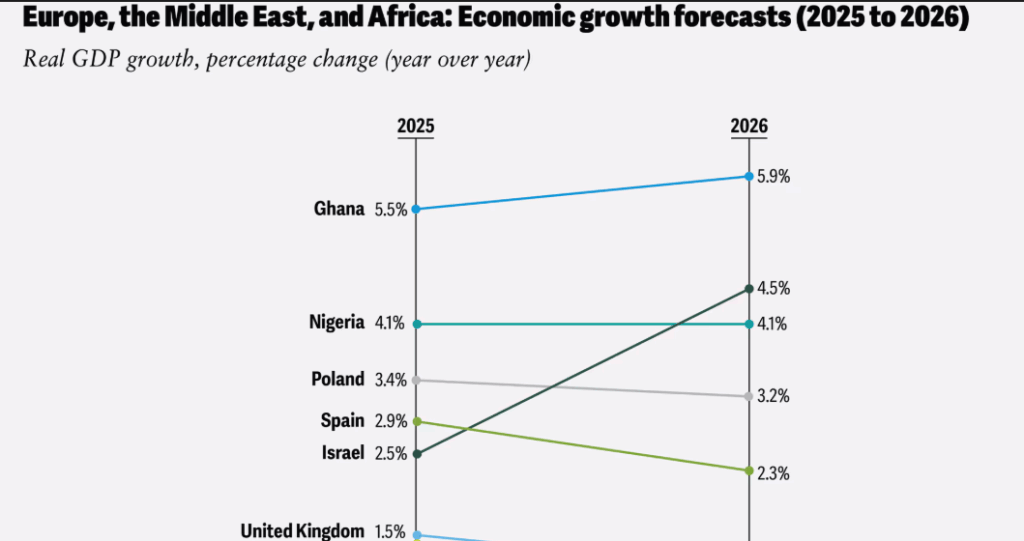
Deloitte is predicting a 5.9% Gross Domestic Product (GDP) for Ghana’s economy in 2026, higher than the 5.5% recorded in 2025.
At the same time, it is forecasting an unchanged growth rate of 4.1% for Nigeria in 2026.
In its Global Economic Outlook 2026, the professional services firm said the expansion in the Ghanaian economy will be driven by improved exports from the development of the Bibiani gold mine in western Ghana and ongoing government initiatives such as the 24-hour Economy Programme and the Accelerated Export Development Programme.
However, it warned that several factors including fluctuations in cocoa production due to climate events, the spread of the swollen shoot virus, smuggling activities, and volatility in commodity prices could impede these forecasts.
The Ghanaian economy recorded a real economic growth of 6.3% in the second quarter of 2025, mainly driven by Fishing, which grew 16.4%, followed by Information, Communication and Technology at 13.1%, and Finance and Insurance at 9.3%.
Ghana achieved a single-digit inflation rate of 6.3% as of November 2025, after about four years in double digits, driven by a strong cedi, falling nonfood prices, and reduced supply-side pressures.
Deloitte said, “Potential risks to Ghana’s inflation outlook include higher tariffs on utilities such as electricity and water, and persistently high domestic food prices.”
BoG and Interest Rates
The Bank of Ghana (BoG) resumed adjusting interest rates, implementing a 1,000-basis-point cumulative cut to its monetary policy rate in 2025.
Deloitte predicted further rate cuts toward 17% by the end of 2026, highlighting, “While these reductions are expected to ease financing constraints and stimulate credit and domestic demand, excessive easing may jeopardise progress made in inflation control”.
Cedi Performance
The cedi strengthened by over 40% in the first nine months of 2025—to an average of around GH¢13 (retail market) per US dollar, driven by higher gold revenues, frequent Bank of Ghana interventions, successful debt restructuring, and initiatives like the Ghana Gold Board.
Deloitte therefore projected an average GH¢13.01 per US dollar in 2026.
However, it warned that potential monetary policy easing could reverse some of these recent gains, especially if the demand for gold diminishes along with declining global uncertainty.
Latest Stories
-
English football’s independent regulator would quit over Man City interference
16 minutes -
Anthropic seeks rehearing of case over Pentagon’s security risk branding
27 minutes -
NDC Deputy National Organizer Aspirant Hamza Umar targets grassroots mobilisation
1 hour -
Partisan appointment cycle will persist without meaningful reforms – Osae-Kwapong
2 hours -
‘This cycle is not going to be broken any soon’ – Osae-Kwapong on partisan appointments
3 hours -
Partisan appointments won’t help restore trust in EC – Osae-Kwapong
3 hours -
Villarreal fight back to beat Napoli and end losing run
3 hours -
Tresoldi nets hat-trick as Club Brugge win Inter thriller
3 hours -
PSG’s Luis Enrique hopes Man City avoid sanctions
4 hours -
Lisandro Martinez issues scathing attack on Man Utd board – has he made things worse?
4 hours -
Saka responds to Arteta’s challenge with ‘huge impact’
4 hours -
Viking hold Bayern in thriller as Kane breaks Messi record
4 hours -
Gordon scores as Barcelona beats Galatasaray
4 hours -
Bumble bought for $1.3bn in ‘bet on the future of humanity’
4 hours -
Imagination Africa, Mentors Chess Academy to host second African Genius Chess Championship at Ghud Park
4 hours