

Audio By Carbonatix
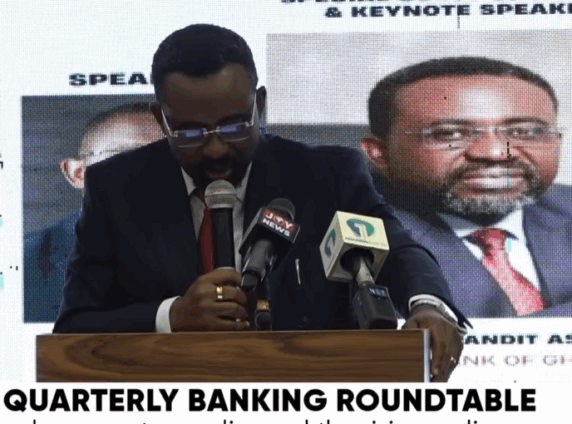
The Governor of the Bank of Ghana (BoG) Dr. Johnson Asiama has categorically stated that the dollar is not a legal tender in Ghana that can be used to pay for goods and services.
He pointed out that businesses and individuals can reject the dollar when used as a medium of payment in the country.
“Let me say that the dollar is not legal tender. It cannot go everywhere the cedi goes. The dollar is not a legal tender in Ghana. What it means is if you pay me in dollars for service or something I sell to you, I have every the right to say no, I will not accept it,” he said at the ABSA-UPSA Quarterly Banking Roundtable.
Appealing to the public to support the central bank in its efforts to stabilize the cedi for the long term, Dr. Asiama urged businesses to reject dollars and rather demand the cedi for payment of goods and services.
He added that accepting the cedi as the only currency for payment is not only legal, but a civil responsibility that will grow the economy to stimulate growth and development.
“Consciously, we must be able to protect the cedi. We must be able to ensure that it's the only form for transacting in this country. Legal tender in its simplest form refers to money that must be accepted if offered in payment of a debt”, he said.
He cautioned that even though a few speculators may desire to pursue selfish interest, expecting volatilities, the overall riding theme must be focused on collective gain of the economy.
“Any attempt to displace the cedi in ordinary commercial transactions whether through mandatory dollar invoicing, preferential pricing in foreign currency, or informal currency substitution, is not only economically distorting, but also legally impermissible”, he warned.
Dr. Asiama stressed the need for Ghanaians to see the cedi as national asset which must be protected used in the rightful money for its intended purpose.
This, he said underscores the pride and integrity in the currency.
It challenges the very fabric of monetary sovereignty. So the legal tender status of the cedi is therefore not a ceremony, but a ceremonial provision. It is the cornerstone of macroeconomic governance. It ensures monetary policy decisions, interest rates, and liquidity management”.
Latest Stories
-
National Peace Council urges investment in youth to sustain Ghana’s peace
4 minutes -
Afenyo-Markin urges youth to speak up against injustice
14 minutes -
CAF annuls Edo Queens victory, orders WAFU B final to resume from extra time
37 minutes -
Interior Minister urges traditional authorities to enforce anti-bushfire bye-laws
38 minutes -
3rd Republic Bank-JoyNews Habitat Fair Clinic ends on a high note after three days of strong patronage
40 minutes -
Ten climbers missing after avalanche hits Himalayan base camp
1 hour -
NPP had more permanent fuel relief measures than current GH¢2 diesel cut – Amin Adam
2 hours -
Photos from the 3rd Republic Bank-JoyNews Habitat Fair Clinic
2 hours -
Ethiopia’s army promises restraint amid fears of new civil war
2 hours -
Amin Adam calls for review of fuel taxes as diesel prices remain above GH¢18
2 hours -
World Vision Ghana, Ahafo districts sign MoU for universal WASH coverage
3 hours -
When the gold engine stutters: What Ghana’s Cedi and reserves are telling us about the new economic architecture
3 hours -
Two reportedly die after being trapped in mining pit at Juaboso
3 hours -
Petrosol cleans up Wa Municipal Hospital, to donate medical equipment
3 hours -
‘If NPP was ‘insensitive’ over fuel prices, NDC must accept same description now’ — Amin Adam
4 hours