

Audio By Carbonatix
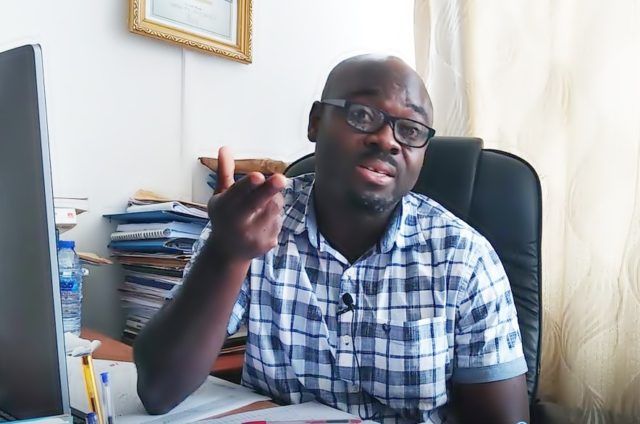
“You recover before you collapse.” That was the criticism from Professor of Financial Economics at the University of Ghana Business School, as he criticised the Akufo-Addo government’s handling of the banking sector cleanup.
Lord Mensah, speaking on PM Express on JoyNews, Wednesday, July 30, argued that the foundational principles of banking were ignored in a process that ultimately cost taxpayers over ¢21 billion.
“In banking, there’s what we call minimising the loss and then maximising the recovery. And for me, this is a principle that’s a baseline for banking activities, be it at the central bank level or the lower bank level,” he explained.
But to him, those principles were set aside in the rush to collapse struggling financial institutions.
“These principles were not applied earlier on, when we had the banking crisis.”
He pointed to the widely accepted banking concept of “too big to fail” to underline how deeply embedded banks become in the economy beyond just their shareholders.
“The existence of a bank takes several dimensions. You’re looking at government interest, employees’ interest, and owners’ interest. So if a bank is about to collapse, you don’t look at just the owner’s perspective alone.”
At the time of the collapse, he said, many of these banks were generating corporate tax revenues between 25% to 30% and supporting hundreds of livelihoods.
“People who are working and able to put food on the table for their kids as a result of working in the bank… they’ve been able to manage their homes and put their kids to certain levels of education.”
He argued that prioritising government interests while ignoring employees and broader economic implications was a flawed approach.
“If you collapse the bank as a result of pushing for the interest of the government, you end up sacrificing employees and at the same time, the state as well.”
Citing an example, Prof. Mensah revealed that some of the banks offered partial recovery settlements.
“If you have a bank that, as a result of solvency and liquidity issues, is owing to the tune of ¢4.97 billion, and the bank has made an attempt to give you GH¢2 billion, you have to take it.”
He insisted that in banking, recovery is always preferable to total loss.
But instead of seizing the opportunity to retrieve part of the losses, he said the decision to collapse the banks transferred the full weight of the cleanup to ordinary Ghanaians.
“Why do you collapse the bank and then transfer all the possible obligations to the taxpayer to the point where the taxpayer had to commit about ¢21 billion and over?”
To him, this indicated a fundamental departure from standard banking practice. “From where I sit, it has to do with the basic principles of banking, which were not applied in the entire banking cleanup.”
Prof. Mensah concluded by aligning with the view of fellow guest, lawyer Martin Kpebu, saying “the motive was more of witch hunting than following banking principles.”
Latest Stories
-
Young woman found dead at Kasoa Peace Town
5 minutes -
Livestream: The Law examines lawful arrest in Ghana
30 minutes -
Mahama urges African governments to treat healthcare as an investment, not budget cost
1 hour -
Bawumia congratulates John Boadu and new NPP executives, pledges support ahead of 2028
1 hour -
‘No talent should be left out’ – Bawumia pledges inclusive NPP campaign for 2028
1 hour -
Prof. Mike Oquaye recounts how he blocked Special Prosecutor’s attempt to arrest Bawku Central MP
1 hour -
Make health sovereignty a priority for Africa – Mahama
2 hours -
Dorimon Naa, Wa West DCE lead massive clean-up exercise; threaten sanctions against recalcitrant residents
2 hours -
Photos from Adom FM Y2K Jam
2 hours -
Praye Tiatia steals the show at Adom FM Y2K Jam [Watch]
2 hours -
Boakye Agyarko congratulates John Boadu, pledges support for NPP leadership
2 hours -
Antwi HiMight thrills fans with Antwi ne Antwi hits at Adom FM’s Y2K Jam [Video]
3 hours -
Amb. Edward Boateng congratulates Boadu, Kodua on election wins
3 hours -
John Boadu pledges to rebuild NPP from grassroots and restore ‘winning machinery’
3 hours -
Ashaiman Assembly deploys monitoring system to curb dumping in storm drain
3 hours