

Audio By Carbonatix
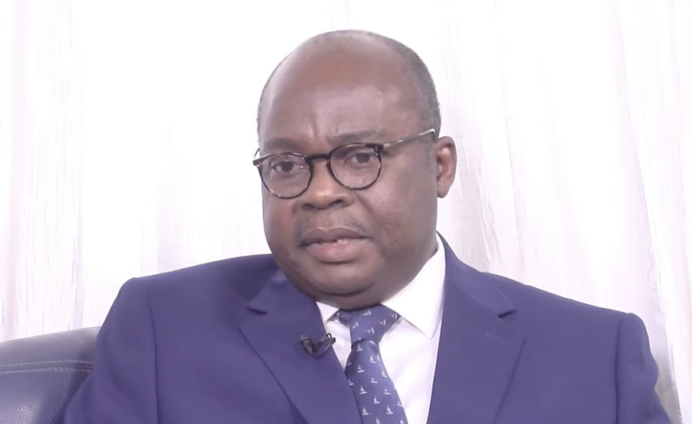
The Governor of the Bank of Ghana (BoG) opened up about the tumultuous banking sector crisis that unfolded in 2017 and the decisive actions that reshaped Ghana’s financial landscape.
With a firm stance in a revealing interview on Joy News’ PM Express Business Edition on January 2, Dr Ernest Yedu Addison, justified the revocation of banking licenses as a critical move to restore stability and confidence in the sector.
Dr Addison painted a grim picture of the banking sector he inherited in 2017. “Sometimes people forget very easily,” he said.
“Women with babies strapped to their backs were being beaten in banking halls because they couldn’t withdraw their money from microfinance institutions. The chaos was undeniable.”
According to the Governor, the sector had devolved into a near Ponzi scheme, leaving depositors without confidence in financial institutions.
“The financial system is supposed to promote savings and channel those savings into investments to support growth. But what we had was a system that had lost public trust,” he stated.
Dr Addison emphasised that the revocation of banking licenses was unavoidable.
“When I give you a bank license, I am giving you permission to take people’s money, but the money is not yours,” he explained.
The Governor detailed the widespread malpractices that plagued the sector.
“Shareholders were taking depositors’ money and using it to run their own businesses. That’s not banking,” he said.
“Some of the funds were being used for brick-and-mortar investments that weren’t liquid enough to meet withdrawal demands. It was a complete disregard for the rules of banking.”
The collapse of Capital Bank and UT Bank in August 2017 marked the beginning of the sector’s cleanup. Over time, other poorly managed institutions were removed, making way for stronger, better-governed banks.
“We cleaned up the system to allow the banking sector to play its rightful role in a market economy like ours,” Dr Addison affirmed.
The IMF’s Role and Prior Actions
Dr. Addison also revealed the International Monetary Fund’s (IMF) involvement in addressing the crisis.
“The IMF flagged the banking sector crisis as a major challenge when I took office,” he said.
Policies to address the issues had been discussed with the previous administration, but no action had been taken.
“By the time we came in, these policies had reached the point of becoming prior actions—either you implemented them, or there wouldn’t be a program for Ghana. It was as simple as that.”
Despite the controversies surrounding the cleanup, Dr. Addison expressed pride in the BoG’s achievements.
“The Bank of Ghana received an international award for the very effective cleanup of our banking system, and I think we should value that,” he said.
The Governor highlighted the transformation of the sector post-cleanup.
“Today, the banks that remain are well-capitalised and adhere to stronger corporate governance standards. They are properly managed and supervised,” he noted.
Reflecting on the challenges and successes, Dr. Addison underscored the importance of vigilance in financial regulation.
“A banking license is a special kind of instrument. It comes with responsibilities and rules that must be respected. The actions we took were justified to protect depositors and ensure the stability of the financial system,” he asserted.
The Governor’s bold decisions during the crisis ultimately set the stage for a more robust banking sector.
“It was not an easy road, but we’ve emerged stronger,” he concluded.
Latest Stories
-
Gbande’s arrest directive confirms NPP’s claims of selective justice – Miracles Aboagye
32 seconds -
US to announce $150 million for Alaska power lines as Vance campaigns in Senate battleground
56 seconds -
Two CHPS compounds, educational facilities under construction in Keta – MP
3 minutes -
Not every difficult season means you’re in toxic love – Counsellor Adofoli explains
6 minutes -
Badminton: Ghana wins bronze, two silver medals at All Africa U-19 Champs
11 minutes -
Black Star Experience announces national choral music contest to discover new Ghanaian talent
21 minutes -
Melcom serves 1,000 meals to children in selected orphanage homes
22 minutes -
Miracles Aboagye questions Mustapha Gbande’s authority to direct EOCO arrest of Manhyia South MP
23 minutes -
My music is a true reflection of who I am – Nigerian singer Ladé
24 minutes -
Activa International Insurance Ghana reinforces culture of compliance and customer protection
30 minutes -
Mining must prove its impact, not just publicise it — Chamber of Mines
40 minutes -
NDC disqualifies Dzifa Gunu from La Dadekotopon contest
47 minutes -
Togbe Afede XIV opposes proposed 5-year presidential term
50 minutes -
World Vision targets 90 percent universal WASH access in Asunafo North, Asutifi North
1 hour -
I told EOCO to arrest Manhyia South MP – Mustapha Gbande
1 hour