


Audio By Carbonatix
The Founder of the Focus on Sickle-Cell Foundation (FoSCel), Amos Andoh, has called on government to broaden its approach to tackling sickle cell disease by making genotype screening more accessible to young people.
Speaking on JoyNews' AM Show on Thursday, June 4, Mr Andoh welcomed the inclusion of newborn sickle cell screening in the first phase of the government's free primary healthcare programme, describing it as a significant intervention that could improve early diagnosis, treatment outcomes and disease surveillance across the country.
According to him, the initiative, particularly under Phase One, Item 9 of the policy, is expected to ensure that babies born in healthcare facilities are screened shortly after birth to determine whether they are living with sickle cell disease.
Mr Andoh said the move represents a major breakthrough in Ghana's fight against one of the country's most prevalent inherited blood disorders.
"If a child is diagnosed very early, treatment can begin immediately. The earlier we know a child is living with the condition, the better the chances of managing it effectively and preventing complications," he explained.
Mr Andoh believes the government's decision to introduce free newborn screening could significantly improve outcomes for thousands of children born each year.
Beyond individual patient care, he noted that the programme would also provide authorities with more accurate data on the prevalence of sickle cell disease in Ghana.
"It will help us know exactly how many people are born with the condition every year and give us reliable records for planning and intervention," he said.
Current estimates indicate that approximately 18,000 babies are born annually with sickle cell disease in Ghana.
However, Mr Andoh argued that the actual figure could be considerably higher than official statistics suggest.
He explained that existing records are largely based on births and diagnoses captured within the formal healthcare system, leaving out many children born outside hospitals and health facilities.
"The 18,000 newborns we talk about are based on records that already exist. But what about mothers who do not deliver in hospitals? What about children who are never screened?" he questioned.
According to him, the country's data collection systems may not adequately capture cases in remote communities and among families with limited access to healthcare services.
Mr Andoh drew on his own experience to illustrate the challenges associated with delayed diagnosis.
"I was six years old before I was diagnosed with sickle cell disease," he revealed.
"There are many people living with the condition who are not in the hospitals and are therefore not reflected in the statistics that government currently has."
He stressed that many individuals may be living with the disease without ever receiving a formal diagnosis, potentially increasing the burden on families and the healthcare system.
While applauding efforts to strengthen newborn screening, Mr Andoh believes prevention must become a central pillar of Ghana's sickle cell strategy.
He called for greater investment in genotype education and testing among young people, particularly those between the ages of 18 and 30 who are preparing for marriage and parenthood.
According to him, awareness campaigns alone are not enough to reduce the number of children born with the disease.
"We should not only focus on awareness. We must encourage young people to know their genotype before they make decisions about having children," he said.
Mr Andoh argued that genotype testing should become a routine health assessment in the same way people regularly monitor their blood pressure, weight and other vital signs.
"Today, if you visit a hospital, checking your vital signs is often free. Genotype screening should become just as normal," he stated.
Despite increasing awareness of sickle cell disease, the cost of genotype testing remains a challenge for many young Ghanaians.
Mr Andoh noted that in some healthcare facilities, individuals may pay as much as GH¢250 for a genotype test, a cost he believes discourages many people from getting screened.
"For many young people, that amount is simply unaffordable. If we want to prevent future cases, we need to make genotype testing easier to access and more affordable," he said.
He suggested that government consider integrating genotype screening into broader preventive healthcare programmes, particularly those targeting young adults.
According to him, while newborn screening is essential, policymakers must also focus on what he described as "the producers" – the young people who will eventually become parents.
"If we are making screening free for newborns, then we should also think about the young people who are going to have these children," he said.
Mr Andoh emphasised that one of the most effective ways of reducing the incidence of sickle cell disease is through informed reproductive choices.
He maintained that widespread genotype awareness could help prospective couples understand the risks associated with certain genetic combinations before starting families.
"If you know your genotype and I know mine, that is the cure," he said.
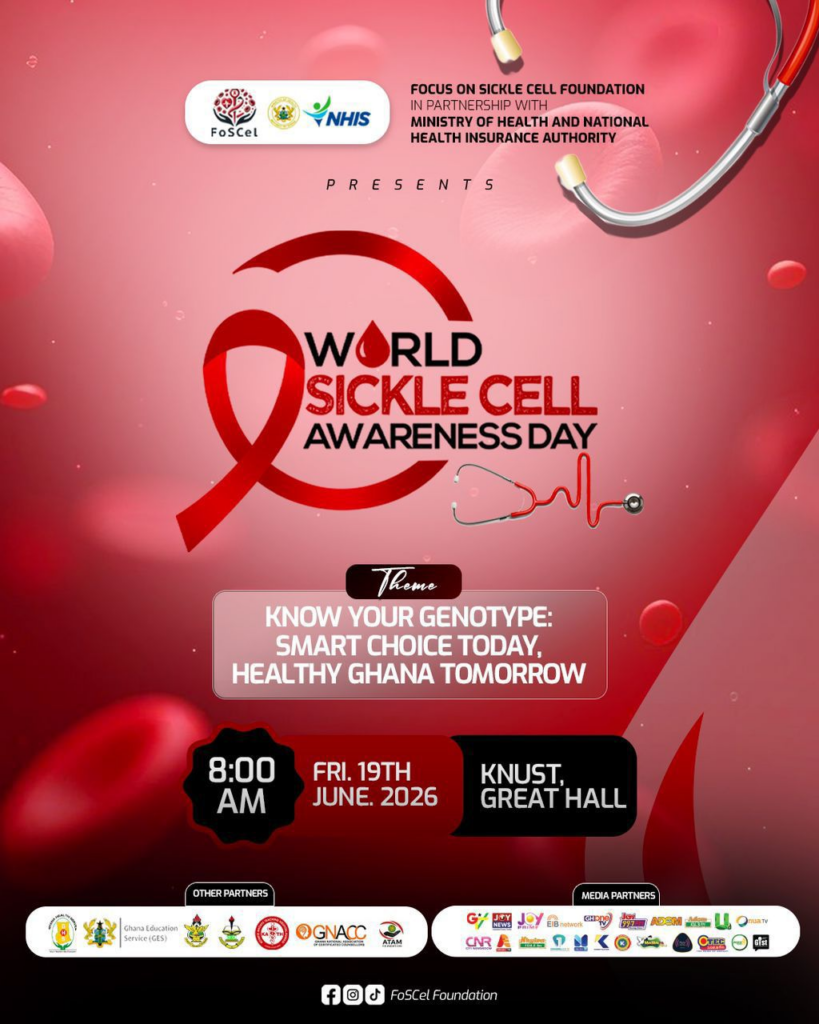
Mr Andoh reiterated activities marking this year's World Sickle Cell Awareness Day, observed globally on June 19.
He disclosed that the foundation's commemoration will take place at the Great Hall of the Kwame Nkrumah University of Science and Technology (KNUST) in Kumasi.
The event, he noted, is expected to attract healthcare professionals, policymakers, advocacy groups, students and individuals living with sickle cell disease from across the country.
As part of the programme, he outlined plans to conduct a large-scale free genotype screening exercise aimed at young people.
"We are hoping to provide free genotype screening for about 1,000 young people who will attend the event," he announced.
Mr Andoh believes the government's decision to introduce newborn screening through the free primary healthcare programme presents a unique opportunity to strengthen the country's response to the disease.
However, he insists that lasting progress will depend not only on identifying affected children early but also on empowering young people with the information and resources needed to make informed reproductive decisions.
Latest Stories
-
“NSA did not tell us of any embassy arrangement” – Kofi Adams
9 minutes -
Glasner suffers loss on Selhurst return as Palace beat Forest
2 hours -
WAFU B U17: ‘We won but I expected more from my boys’ – Kassim Ocansey
2 hours -
Man City cruise to statement win over 10-man Liverpool
2 hours -
Be careful with cross-border lending, foreign currency exposures – BoG to financial institutions
4 hours -
GPL 2026/27: Medeama go three clear as Hearts of Oak recover and Bechem stage stunning comeback
4 hours -
Ntiamoah Foundation launches “BEYOND 20” anniversary campaign
5 hours -
Credit Risk Management Directive: BoG to begin implementation for banks, others from July 1, 2027
5 hours -
Ghana Brands Awards 2026: Leading brands, business trailblazers to shine on November 20
5 hours -
T-bills auction: Demand improves as government exceeds target by about 76%; interest rates soften
5 hours -
Ziope undertakes initiative to build a technologically inclined community, commissions self-help ICT lab
6 hours -
ECG announces power outage in parts of Tema, Central Region due to network fault, maintenance
6 hours -
When the Gospel Becomes a Weapon: The church, blackmail and the abuse of faith
7 hours -
JoyNews’ Jacqueline Ansomah Yeboah selected for UK Media Excellence for Emerging Technologies Fellowship
7 hours -
Mental Health Alliance urges government to operationalise Mental Health Fund
7 hours