

Audio By Carbonatix
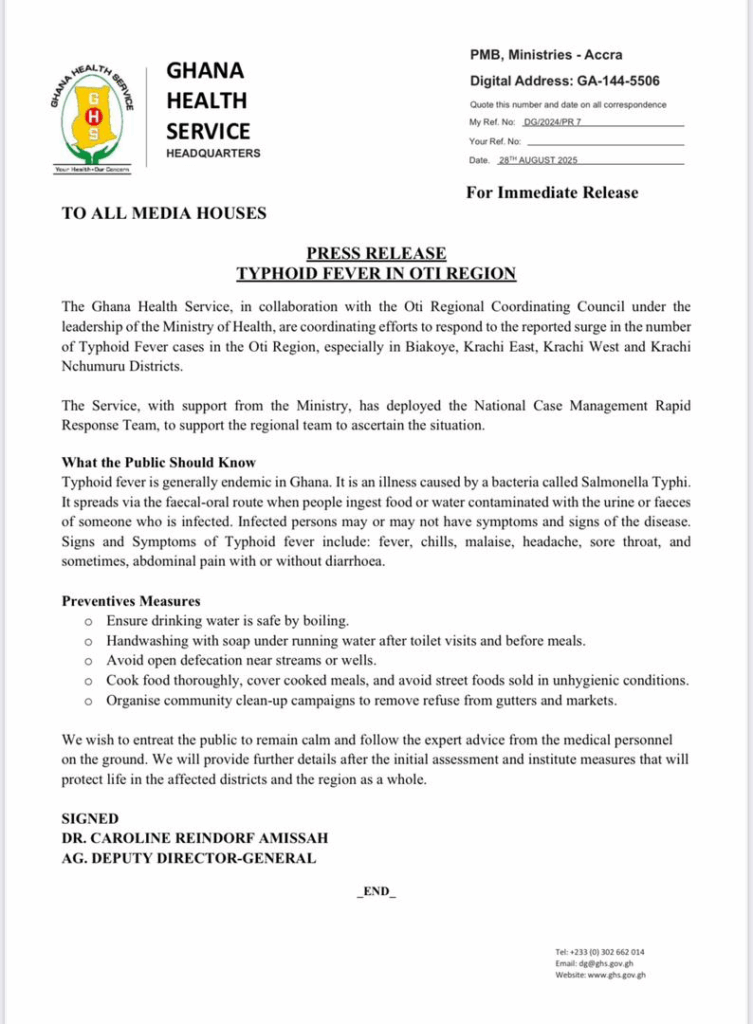
The Ghana Health Service (GHS), in collaboration with the Oti Regional Coordinating Council and under the guidance of the Ministry of Health, has launched an emergency response to a concerning rise in Typhoid Fever cases across several districts in the Oti Region.
According to GHS, the affected areas include Biakoye, Krachi East, Krachi West, and Krachi Nchumuru, where health authorities have reported a significant increase in suspected cases over the past weeks.
In a statement issued on Thursday, August 28, the GHS confirmed that a National Case Management Rapid Response Team has been deployed to support the regional health team in assessing the situation and coordinating a swift response.
“The Ghana Health Service, with support from the Ministry of Health, has deployed the National Case Management Rapid Response Team to support the regional team to ascertain the situation,” the statement read.
Typhoid fever is endemic in Ghana and is caused by the Salmonella Typhi bacteria. It spreads through the faecal-oral route, typically when people consume food or water contaminated with the faeces or urine of an infected person.
Health officials warn that individuals infected with the bacteria may not always show symptoms but can still spread the disease.
Common symptoms include:
- Persistent fever
- Chills
- General malaise
- Headache
- Sore throat
- Abdominal pain (with or without diarrhoea)
The GHS is urging the public, particularly residents in the affected districts, to observe the following preventive measures:
- Ensure all drinking water is safe, preferably by boiling.
- Wash hands with soap under running water after using the toilet and before eating.
- Avoid open defecation, especially near water sources.
- Cook food thoroughly, cover cooked meals, and avoid street food prepared in unhygienic conditions.
- Take part in community clean-up campaigns to eliminate refuse from public spaces, gutters, and market areas.
Authorities are encouraging residents to remain calm and cooperate with health personnel on the ground.
The GHS has assured the public that comprehensive measures will be rolled out following the team’s initial assessment to contain the outbreak and protect lives.
“We wish to entreat the public to remain calm and follow the expert advice from the medical personnel on the ground. We will provide further details after the initial assessment and institute measures that will protect life in the affected districts and the region as a whole,” the statement concluded.
Latest Stories
-
Nvidia boss rejects AI extinction fears as ‘doomsday narratives’
3 hours -
Workers came across human remains – and unearthed a mass grave of 572 people
3 hours -
Each Jehovah’s Witness member now decides whether to accept or donate main blood components
4 hours -
Trump says US will form ‘AI Force’ and appoint an artificial intelligence tsar
4 hours -
Google’s Gemini AI hacked three companies in security test
4 hours -
Converse pulls ‘deeply upsetting’ advert after backlash
4 hours -
Warren Buffett steps down after six decades at Berkshire – ‘Father Time always wins’
4 hours -
Billionaire Man United owner says he has lost confidence in the UK
4 hours -
I have experienced racism a thousand times – Lamine Yamal
5 hours -
Ipswich Town investigates racist abuse of Fatawu
5 hours -
Man City battle past Sunderland in eight-goal thriller
5 hours -
Neville calls Man Utd ‘pathetic’ – but Carrick maintains belief
5 hours -
Cunha rescues point for Man United at Fulham
5 hours -
Government has improved sanitation in one-and-a-half years — Salaga South MP
5 hours -
Impressive defence behind Iraola’s solid Liverpool start
5 hours