

Audio By Carbonatix
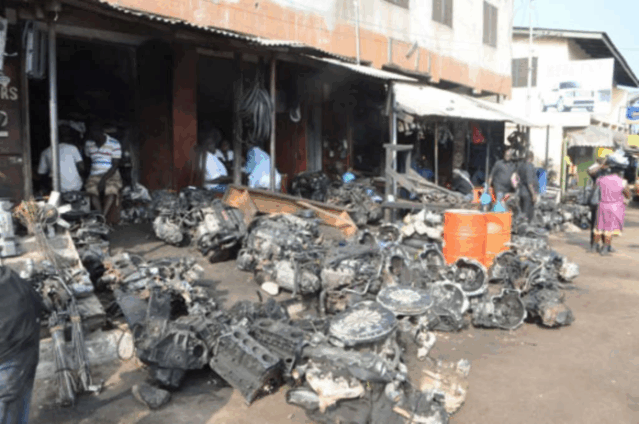
The Abossey Okai Spare Parts Dealers Association has announced plans to close down foreign-owned retail shops in the business enclave on Monday, September 8, 2025, if no intervention is made.
The Association’s Director of Communications, Takyi Addo, confirmed the planned action in an interview on Adom FM’s Dwaso Nsem on Friday.
He explained that the move is intended to enforce the Ghana Investment Promotion Act (Act 865), which restricts retail trade to Ghanaian citizens.
According to Mr. Addo, the action is not targeted at any particular group of foreign nationals but is aimed at ensuring strict adherence to the law.
“On Monday, we are closing all shops of foreigners. There are laws in this country, and we don’t know how they have managed to infiltrate the retail business. Some are driving Uber, others are in trades strictly reserved for Ghanaians. We have been patient for too long, but this time we are serious,” he declared.
He further explained that under Act 865, foreign investors are required to deposit at least $1 million to operate in the retail sector or import goods of the same value.
“Instead, many, especially the Chinese, bring in products worth over $10 million and still engage directly in retail trade, which the law forbids. They are supposed to operate as suppliers, not retailers,” he argued.
Mr. Addo stressed that such practices place Ghanaian traders at a disadvantage, as they face high rent, levies, and import duties while competing with foreign businesses that ignore regulations.
The Association maintained that the action is long overdue, noting that many local spare parts dealers have already been forced out of business at Abossey Okai due to what they describe as “unfair competition.”
This is not the first time local traders have clashed with foreign retailers in Ghana.
The enforcement of Act 865 has been a recurring source of tension, particularly between Ghanaian traders and foreign nationals, most notably Chinese and Nigerian retailers.
In 2020 and 2021, similar disputes led to widespread shop closures, protests, and calls for stricter enforcement of the law.
Successive governments have promised to address the matter, but traders argue that enforcement has been inconsistent, leaving local businesses vulnerable.
Latest Stories
-
Fuel prices set to rise again from Sept 1; petrol could hit GH¢16.21 – COPEC
28 minutes -
REGSEC restricts Akwasidae celebrations in Denkyira amid security concerns
33 minutes -
Eric Adjei distributes free fertiliser to farmers in Jaman North
40 minutes -
Akufo-Addo urges NPP factions to unite behind Bawumia for 2028 victory
51 minutes -
NDC mourns Western Regional Elections Director Papa Assan
58 minutes -
Minerals Commission warns against fake job recruitment schemes
1 hour -
10 recruits dismissed for defying phone ban – Interior Minister
1 hour -
IEAG commends GoldBod, BoG for improving forex stability
1 hour -
Bawumia donates GH¢50,000 to St Jude Catholic Church at Weija
1 hour -
Mahama calls for faster mobilisation of AU Peace Fund resources
2 hours -
Improved roads bring new vehicle options to Tumu-Bolga, Tumu-Tamale, Tumu-Wa routes
2 hours -
Cedi records 7.9% depreciation against US dollar in first half of 2026
2 hours -
GIS launches operation on anti-human trafficking and exploitative street begging
2 hours -
Awutu-Senya District Assembly organises clean-up ahead of Awubia Festival
2 hours -
Vice President Opoku-Agyemang receives Democracy Cup
2 hours