

Audio By Carbonatix
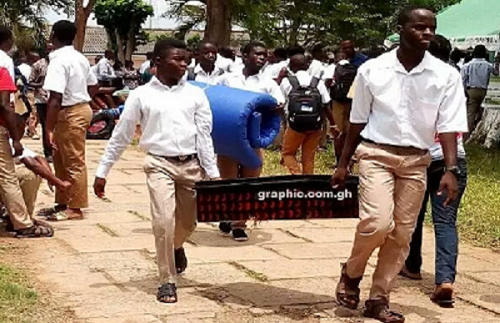
Private Senior High Schools (SHSs) across Ghana are gearing up to welcome their first-ever cohort of students under the government’s pilot Free SHS expansion programme.
The initiative is set to see 25,000 students report to 70 accredited private schools nationwide starting Monday, October 21, as part of efforts to relieve pressure on the public education system and eliminate the controversial double-track calendar.
According to the Ministry of Education, public senior high schools have faced chronic overcrowding since the Free SHS policy was introduced in 2017, with enrolment numbers ballooning from 432,000 in 2016 to over 1.3 million in 2023.
This rapid growth led to the adoption of the double-track system, which splits the academic year and limits classroom time for each cohort.
Education analysts and parents alike have called for creative solutions, prompting the current pilot.
Private Schools “Fully Prepared” for New Students
Speaking on Channel One Newsroom on Friday, October 17, Naphtali Kyei-Baffour, spokesperson for the Conference of Heads of Private Second Cycle Schools (CHOPSS), stressed the readiness of private institutions to play a pivotal role.
“Yes, indeed we are expecting quite a number of students to report to the SHSs. That is the 70 that are part of the piloting system we are doing. We are expecting to receive almost 25,000 of them,” he said.
Kyei-Baffour added that the transition is already underway, with some students visiting their new schools for prospectuses and orientation before the official start of classes.
“Some of them have started coming for their prospectus and are ready to join just as they have been posted. We are ready — in terms of facilities, preparedness, and everything, we are ready to receive them. We are expecting that they come to the various schools from Monday,” he assured.
Pilot Programme Details and Funding
The pilot, officially announced in September 2024, is a collaboration between the Ministry of Education, the Ghana National Council of Private Schools (GNACOPS), and CHOPSS.
According to GNACOPS Executive Director, Obenfo Nana Kwasi Gyetuah, the 70 selected schools span all 16 regions and can accommodate up to 44,000 students, meaning that future expansion is possible.
The state is providing each day student with an annual subvention of GH₵994 (about $70), covering tuition and basic academic needs.
This support—formalized through a Memorandum of Understanding between the Ministry and CHOPSS—is aimed at ensuring parity with public school funding. Parents who wish to board their children at the private institutions will pay the difference between the government grant and the full boarding fee.
The Education Minister, Haruna Iddrisu, described the pilot as “a vital part of the government’s commitment to equitable access to quality education.” He emphasized that integrating private schools helps leverage existing infrastructure, boost educational standards, and foster public-private partnership.
Sector Reactions and Future Prospects
The inclusion of private schools has been widely welcomed by sector stakeholders. President of CHOPSS, I.K. Mensah, hailed the move as a “progressive step” and noted that ongoing conversations with the Ministry could lead to future programme expansion and possible funding adjustments.
Education experts point out that the pilot could serve as a model for other African countries grappling with similar overcrowding.
According to UNESCO, sub-Saharan Africa faces the world’s fastest-growing demand for secondary education, with an additional 90 million students expected by 2030.
The 25,000 students beginning classes this week represent about 6% of all 2024 SHS admissions.
If the pilot proves successful, officials say, it could be scaled up to accommodate tens of thousands more, helping Ghana meet its Sustainable Development Goal 4 target for universal secondary education by 2030.
A New Era for Private Education
For the private schools themselves—many of which have operated below capacity in recent years due to economic challenges—the programme offers a timely boost.
According to GNACOPS, over 2,000 private second cycle institutions are registered nationwide, with a combined capacity to absorb more than 200,000 students.
As the first cohort of government-sponsored students enter classrooms on Monday, educators and families alike will be watching closely to see if this unprecedented partnership can help redefine Ghana’s educational landscape.
Latest Stories
-
La Liga chief dismisses Real’s ref conspiracy claims
24 minutes -
GMA rejects claims its vessel monitoring system is ineffective
35 minutes -
I was close to joining Liverpool in 2016 – Mbappe
47 minutes -
Ministry of Sports and Recreation holds national validation workshop on National Sports Policy Draft
51 minutes -
‘Do you want me to be happy with this poor performance?’ – Bono East Minister fumes over Kintampo market project with less than 1% work done
58 minutes -
London screening honours Nkrumah and 103 years of Ghana cinema
1 hour -
Founder’s Day: Is Nkrumah’s glory fading? – Nkrumah’s iconic fountain at Circle runs dry
1 hour -
GHS calls for stronger systems to ensure safe care for NCD patients
1 hour -
Kufuor calls for Africa’s resources and youthful population to be transformed into opportunities
1 hour -
Mahama administration not clamping down on free speech – Shamima Muslim
1 hour -
Ghana TVET Service, UNESCO, KPMG, Microsoft to train 100,000 facilitators in AI
1 hour -
Kejetia traders demand controls as shop owners resell spaces at inflated prices
1 hour -
Fix Ghana Maritime Authority surveillance system instead of ‘threatening’ NPP – Dennis Aboagye tells NDC
2 hours -
Poor land acquisition for development projects pushing people into poverty – Prof Helen Essandoh
2 hours -
‘This is what we expect from a statesman’ – Brazilian President commends Mahama for leading global reparatory justice push
2 hours