


Audio By Carbonatix
Ghana’s roads are claiming more lives as the number of crashes rise marginally. The latest provisional data from the National Road Safety Authority (NRSA) covering January to September 2025 paints a worrying picture where deaths are up by 20 percent, even though pedestrian knockdowns and overall crashes have reduced over the same period in 2024.
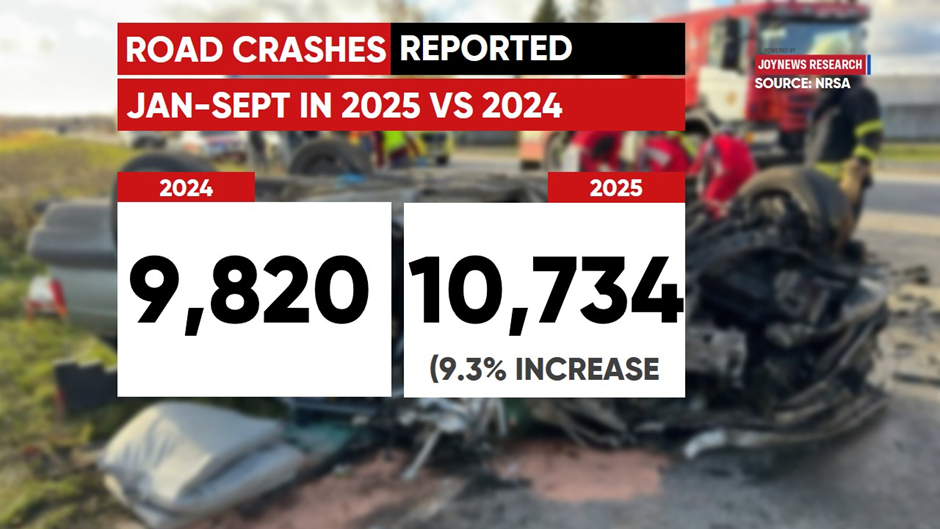
Analysing the provisional data on Road Traffic Crash & Casualty Situation revealed that 2,180 people died in road crashes between January and September 2025 — up from 1,817 deaths during the same period in 2024. The country also recorded 10,734 crashes, involving more than 18,000 vehicles of all types, from private cars and commercial vehicles to motorbikes and tricycles.

While the number of crashes rose by 9.3 percent, the jump in fatalities was much sharper, 20%, suggesting that Ghana’s roads are becoming deadlier per crash.
More crashes don’t always mean more deaths — but 2025 is different
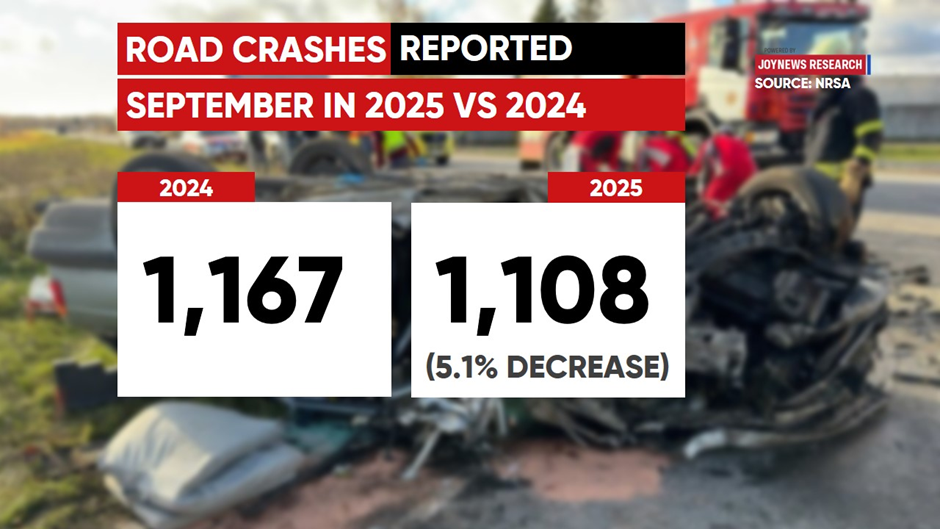
In September alone, the number of reported road crashes dropped by 5.1 percent compared to the same month last year. Yet, deaths surged by nearly 20 percent. This widening gap points to more severe crashes, poor emergency response, and the growing dominance of high-risk road users such as motorcyclists.
The data also shows that pedestrian knockdowns fell by 14.5 percent over the period. A sign of some success in awareness and urban traffic control but that progress has not translated into safer roads for drivers and passengers.
Deadliest seasons
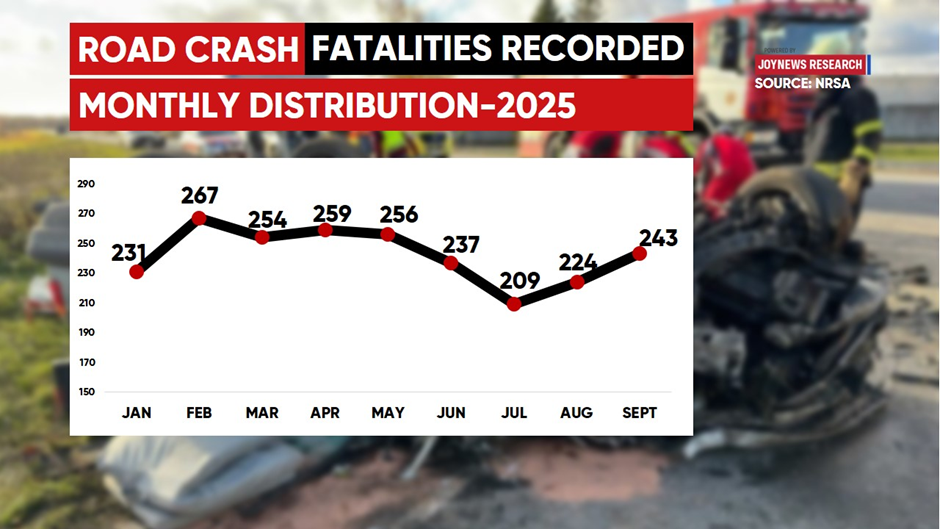
February remains the deadliest month of 2025 so far, with 267 deaths, followed by May, which recorded the highest number of crashes (1,332). Both months coincide with high mobility periods — one after school reopening and the other at the start of the rainy season.
Overall, Ghana’s road crash burden continues to rise despite years of awareness campaigns and improved data systems. The NRSA concludes that the Ashanti, Eastern, and Greater Accra Regions remain the country’s critical injury and death zones.
Better post-crash emergency response, stricter motorcycle regulation, and targeted enforcement in high-risk regions may aid curb the issue. Until then, the numbers suggest a grim truth that Ghana’s roads carry a deadlier cost.
Latest Stories
-
Toobu rejects calls to recall Parliament over 3.9-tonne cocaine shipment
16 minutes -
Residents in 5 Northern Regions warned of approaching rainstorm
18 minutes -
Constituency Games still a work in progress – Sports Minister
36 minutes -
Team Ghana set for historic Karting Africa Showrun in Angola
40 minutes -
52-year-old South African arrested with suspected heroin after arriving from Accra
53 minutes -
Shatta Wale challenges UPSA students to build entrepreneurial mindsets
1 hour -
Finance Minister advises African governments to strengthen regional tax cooperation
3 hours -
NPP accuses NDC of master-minding demolition of Ho regional office fence
3 hours -
Ghana plans stronger regional power trade with Nigeria
3 hours -
GRA Commissioner-General calls for stronger tax cooperation to boost regional revenue mobilisation
3 hours -
NACOC needs more personnel to tackle drug trafficking – Toobu
3 hours -
Railway workers resist KMA eviction order, demand consultation
3 hours -
Legacy Leadership Africa Institute to host boardroom women’s leadership programme
3 hours -
Ghana needs a law to sustain constitutional reforms – CDD-Ghana
7 hours -
COVID fumigation audit: Auditor-General has a lot of questions to answer – Akwatia MP
7 hours