

Audio By Carbonatix
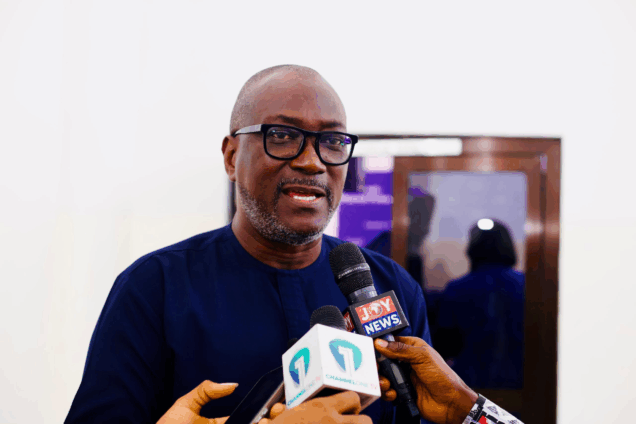
Chairman of the Constitution Review Committee, Prof Henry Kwasi Prempeh, says Ghana’s culture of nonstop political campaigning is not a democratic requirement but a choice the country continues to make.
Speaking on Joy News on December 25, he said the problem persists because Ghanaians allow it. “It’s because we allow it, we allow campaigning 24/7 over four years,” he said.
He rejected claims that constant campaigning is inevitable, arguing that other democracies have found ways to regulate election seasons without undermining political freedoms.
Drawing from regional experience, Prof Prempeh said Ghana is not unique. He recalled a recent visit to Senegal ahead of its last election. “We were in Senegal before their last election, with my team from CDD,” he said.
According to him, the difference was striking. “When we got there, one thing was clearly noticeable: no billboards. You will see no posters, nothing,” he said.
He explained that although elections were just weeks away, campaigning had not officially started. “The election season had not opened so that you couldn’t mount billboards,” he said.
Prof Prempeh said political parties were still active, but within precise limits. “As a party, you could always do your things in-house, things to prepare for an election,” he said.
However, he noted that public-facing activities were restricted. “Outdoor events like rallies, putting posters, doing all those things, jingles and those things, those can be easily regulated,” he said.
He stressed that regulating campaign seasons does not cripple political parties. “If we say that the season, it doesn’t mean that we are handicapping politicians,” he said.
According to him, the idea is often misunderstood in Ghana. “We’re not saying that you cannot be doing your things as a party to get yourself organised,” he said.
Prof Prempeh said a narrow mindset often drives resistance to reform. “The pushback against an idea should also look at it as we are part of a global community,” he said.
He warned against dismissing reforms simply because they challenge the status quo, asking, "How is it working in Sierra Leone?”
He cited the example of Freetown. “The mayor of Sierra Leone, for example, of Freetown, is elected on a party ticket, and she’s from one party and the president of another party; they are coexisting, it’s working,” he said.
Prof Prempeh said Ghana often exaggerates its uniqueness. “In Ghana, people would say, 'Oh, but it’s not going to work with NPP and NDC,” he said.
He questioned that assumption, saying, “You think that we are like from a different planet, right?” he said.
According to him, this inward-looking approach limits reform. “This insularity sometimes causes us to box ourselves into a situation, as if the status quo captures us,” he said.
He insisted that alternatives exist. “So it is not true that you cannot have an election calendar that says campaigning cannot go on until the day,” he said.
Prof Prempeh said such systems are already in practice elsewhere. “It happens in many countries,” he said.
Latest Stories
-
2026 U20 WWC: Ghana’s Ambassador to Czech Republic welcomes Black Princesses to Poland
9 minutes -
Oti NPP executives demand completion of stalled government projects
21 minutes -
Jinapor demands answers as Alima Mahama is asked to pay for Embassy spending outside her tenure
30 minutes -
Russia doubles scholarships for Ghanaian students to 240 annually
31 minutes -
Cedi’s year-to-date loss slumps to 4.09% as recent gains gather pace
49 minutes -
‘Home has spoken’ – Justin Kodua Frimpong says as Ashanti delegates back his re-election bid
54 minutes -
Mustapha Abdul-Hamid, seven others’ NPA case adjourned to August 27
1 hour -
Alima Mahama Refund: Jinapor challenges Ablakwa’s authority, says only Auditor-General can surcharge
1 hour -
Wontumi Conviction: 2 star witnesses placed under police protection amid death threats
1 hour -
Srem-Sai reveals surge in death threats after Wontumi conviction
1 hour -
GCB, Ecobank, 4 others are top tier banks in Ghana – PwC Banking Survey
2 hours -
Today’s front pages: Tuesday, August 18, 2026
2 hours -
Banks’ sustainable success will be defined less by interest margins – PwC
3 hours -
CJ Baffor-Bonnie was part of ‘grand conspiracy to remove Torkornoo – Afenyo-Markin alleges
3 hours -
The GIPA Act: Resetting Ghana’s investment framework
4 hours