

Audio By Carbonatix
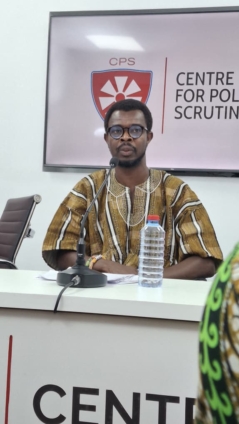
The Centre for Policy Scrutiny (CPS) has expressed worry that despite gold sitting at the center of Ghana’s economic history, yet its role in shaping monetary policy has been underutilized.
Professor Paul Alagidede, who is a fellow of the Center, therefore wants this to change if the country is to escape chronic liquidity constraints.
“Gold plays a very significant role as a store of value and an inflation hedge,” he said.
“It can also serve as a strategic reserve asset for emerging market economies like Ghana”, he added.
Ghana is the sixth-largest gold producer globally, producing about 440 tonnes annually. Yet only a small fraction of this wealth appears on the country’s balance sheet.
Speaking at a public lecture organised by the Centre for Policy Scrutiny (CPS) in partnership with Joy Business, the professor noted that while Ghana holds about 38 tonnes of gold in official reserves, proven in-situ reserves are estimated at around 1,000 metric tonnes.
“From an economic point of view, we can do much better by keeping the gold here rather than selling it for dollars,” he argued.
At current prices, the value of Ghana’s proven gold reserves alone is estimated at about US$146 billion, forming part of a broader natural asset base valued at roughly US$1.5 trillion.
Yet orthodox economics treats this wealth as dormant until it is extracted and sold.
“In the age of reductionism, gold in the ground is seen as dead,” he explained. “But in the age of regeneration, it is an opportunity for balance-sheet renewal", he added.
By activating just 40 to 60% of its in-situ gold equity, Professor Alagidede argued, Ghana could unlock between US$634 billion and US$952 billion in fiscal space.
“The illusion of poverty is very powerful,” he said.
“Orthodox thinking sees Ghana as a poor country that must always look outside for liquidity”, he added.
He acknowledged recent policy shifts, including the establishment of the GoldBod which has mobilized about US$10.8 billion from small-scale and artisanal mining within a year. But he described these as preliminary steps.
“These are baby steps unless they are supported by a deeper shift in monetary philosophy,” he cautioned.
Ultimately, he called for a transition from managing economic flows to managing the national balance sheet, anchored on sovereign assets.
“Ghana is not a poor nation,” he concluded. “It is a wealthy nation in a temporary state of amnesia. It is time to wake up.”
Latest Stories
-
PBee releases new single ‘Lose My Mind’ featuring SIICIE today
12 minutes -
Many have been dismissed – Interior Minister exposes forged WASSCE results in security recruitment
15 minutes -
NCA clears MTN, Telecel, Goal for next stage of 5G spectrum licensing
23 minutes -
Father demands probe into death of Central University student in motorway crash
30 minutes -
Transport Minister orders urgent action to tackle surge in port congestion
35 minutes -
NPP national executive election: Here are the ballot positions
41 minutes -
Court orders police to file disclosures in Labone robbery case
48 minutes -
Central Regional Minister lauds Gomoa Central Assembly for effective utilisation of Common Fund
54 minutes -
What must gov’ts do to make food systems drive job creation in Africa? – Fareeda Mustapha asks Rwanda’s Kagame
58 minutes -
Gender Minister calls for equitable gender roles to support girls’ development
59 minutes -
Prioritise rural businesses in Women’s Bank – NETRIGHT urges gov’t
1 hour -
Guinea backs Morocco’s Sahara autonomy plan as ‘sole solution’ to dispute
1 hour -
NDPC, Youth Empowerment Ministry collaborate to mainstream youth into National Development Planning
1 hour -
Mahama calls for rebranding of Ghanaian football
1 hour -
Emeritus Prof John Bright Kobla Aheto, Esq
1 hour