

Audio By Carbonatix
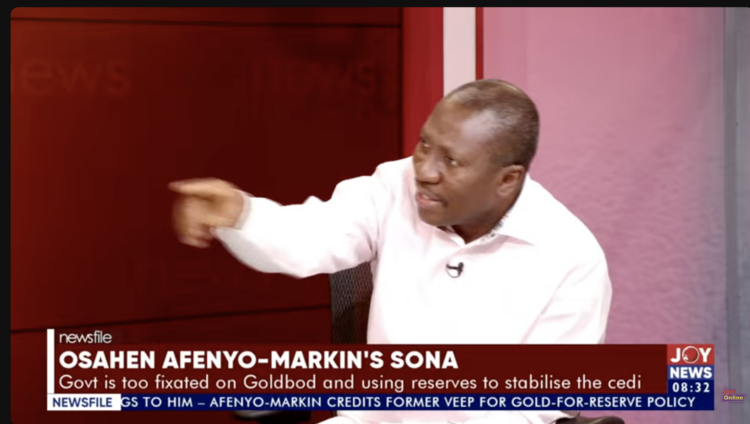
Minority Leader Alexander Afenyo-Markin has criticised the government’s handling of agriculture, arguing that strong public statements are not being matched by concrete action, despite heavy budgetary allocations to the sector.
Speaking on Newsfile a day after President John Dramani Mahama delivered his 2026 State of the Nation Address, the Effutu MP questioned the government’s priorities and the visibility of the Agriculture Minister.
“If government is that serious, there would have been sufficient investment in agriculture — but they are fixated on the gold board thing, abandoning other areas of the economy,” he said.
According to Afenyo-Markin, the administration has devoted much of its attention to the Ghana Gold Board, at the expense of farming, food production and value addition.
His comments come at a time when the government is defending its investment in the agricultural sector. In the 2026 budget, GH¢2.2 billion was allocated to the Ministry of Food and Agriculture, alongside GH¢1.7 billion for roads, processing zones and value chains.
Additional funding includes GH¢245 million for food security and agro-industrial programmes, GH¢828 million for agricultural enclave roads, and GH¢690 million for Farmer Service Centres.
Despite these figures, the Minority Leader insisted that farmers and agribusinesses have yet to feel the impact of the spending on the ground.
He also renewed his criticism of the cancellation of the One District One Factory (1D1F) initiative, which was introduced to promote decentralised industrialisation and job creation.
In July 2025, Trade Minister Elizabeth Ofosu-Adjare told Parliament that the 1D1F programme had been scrapped, with the government shifting focus to agro-processing parks under the 24-hour economy policy.
However, Afenyo-Markin argued that more than a year later, no clear alternative framework has been presented.
“The Trade Minister is yet to outline a concrete replacement strategy,” he said, calling on the government to explain what incentives are being offered to attract private sector investment.
He noted that without a well-defined industrial policy, efforts to link agriculture to manufacturing and job creation could be undermined.
Latest Stories
-
Be careful with cross-border lending, foreign currency exposures – BoG to financial institutions
59 minutes -
GPL 2026/27: Medeama go three clear as Hearts of Oak recover and Bechem stage stunning comeback
1 hour -
Ntiamoah Foundation launches “BEYOND 20” anniversary campaign
1 hour -
Credit Risk Management Directive: BoG to begin implementation for banks, others from July 1, 2027
2 hours -
Ghana Brands Awards 2026: Leading brands, business trailblazers to shine on November 20
2 hours -
T-bills auction: Demand improves as government exceeds target by about 76%; interest rates soften
2 hours -
Ziope undertakes initiative to build a technologically inclined community, commissions self-help ICT lab
3 hours -
ECG announces power outage in parts of Tema, Central Region due to network fault, maintenance
3 hours -
When the Gospel Becomes a Weapon: The church, blackmail and the abuse of faith
3 hours -
JoyNews’ Jacqueline Ansomah Yeboah selected for UK Media Excellence for Emerging Technologies Fellowship
4 hours -
Mental Health Alliance urges government to operationalise Mental Health Fund
4 hours -
Ghana–Holy See agreement heads to Parliament after Cabinet approval
4 hours -
Luv FM Corporate Games 2026: Kumasi Central Prisons, Amanfiman Bank win big amid fun
4 hours -
WAFU B U17: Ghana top Group A after win over Togo
5 hours -
Ho Central Mosque reopens amid unresolved leadership dispute that led to closure
6 hours