

Audio By Carbonatix
The Ghana Journalists Association (GJA) has raised alarm over what it describes as escalating threats against journalists covering the protracted Bawku conflict, warning that the situation poses a serious risk to press freedom, public order and national security.
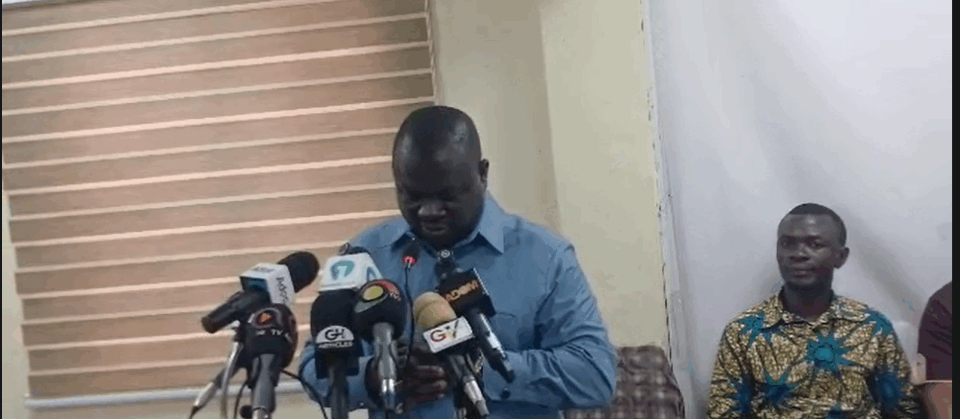
Addressing a press conference, GJA President Albert Dwumfuor said the Association is “gravely alarmed” by death threats, incitement to violence and imminent attacks targeting journalists in the Upper East Region, particularly the Upper East Regional Chairman of the GJA, Albert Sore, over their professional work on the conflict.
“These threats are reckless, criminal and deeply dangerous—not only to the lives of journalists but also to public order and national security,” Mr Dwumfuor said.
According to him, journalists reporting on the Bawku conflict have been openly labelled as enemies, subjected to coordinated online abuse and threatened through social media posts, voice notes and other digital platforms. He warned that the growing atmosphere of fear and intimidation could easily escalate into mob violence if urgent action is not taken.
The GJA President disclosed that the Association has received a detailed incident report from Mr Sore, explaining how a routine journalistic engagement was deliberately distorted by faceless and pseudonymous actors to incite hostility and issue explicit death threats against him and other media practitioners.
Mr Dwumfuor noted that similar threats have previously been directed at other journalists covering the Bawku conflict, pointing to what he described as a disturbing and recurring pattern aimed at silencing the media.
While acknowledging some initial engagement with the Upper East Regional Police Command, the GJA said the continued threats suggest existing security measures are inadequate. The Association is therefore calling for sustained police protection for affected journalists, expedited investigations, and the identification, arrest and prosecution of all individuals and networks involved in issuing threats or inciting violence.
“Any harm to a journalist in the course of duty, particularly where prior threats have been reported, would represent a grave failure of protection and accountability,” the GJA President cautioned.
He further revealed that the National Executive of the Association has formally petitioned the Inspector-General of Police (IGP), seeking urgent intervention over the threats against journalists in the region.
Reiterating that journalists are carrying out a constitutional duty in the national interest, the GJA formally designated the Bawku conflict area as an early warning zone for press safety, calling for heightened vigilance, proactive security deployment and continuous engagement with journalists on the ground.
Mr Dwumfuor stressed that the Association will not accept a reactive approach where action is only taken after harm has occurred, warning that any attack on a journalist in the Upper East Region will attract sustained national and international advocacy until accountability is secured.
The Bawku conflict has, over the years, remained one of Ghana’s most sensitive security challenges, with journalists often playing a critical role in informing the public amid heightened tensions.
Latest Stories
-
Ghanaian professor Kofi Akamani shot dead in US; wife arrested
6 minutes -
Sammy Gyamfi says 2018 NACOC removal from port inspections weakened drug checks
17 minutes -
Greater Accra region accounts for 77% of total secured credit in half-year 2026 – BoG
20 minutes -
Founder’s Day: We face forward, but are we moving?
27 minutes -
Sheenah Naturals unveils Akuaba Collection at Beauty Inside Out Conference
36 minutes -
T-bills: 91-day, 364-day yields to trade slightly higher in second half of 2026
41 minutes -
Black Stars: It’s our decision to leave Kudus to recover – Queiroz
1 hour -
Sammy Gyamfi backs Mahama’s directive to restore NACOC’s at ports
1 hour -
Queiroz provides insight into Kudus’ decision to withdraw from Black Stars squad
1 hour -
I’m not changing after 47 Years – Queiroz fires back at critics
1 hour -
Nkrumah Never Dies: Celebrating the visionary who awakened a continent
3 hours -
Hassan Ayariga calls for Ghanaian ownership in strategic investment deals
3 hours -
Black Stars: Thomas-Asante receives late call-up for September-October games
4 hours -
NPP Techiman South demands immediate release of detained Nurse Salomey Awiti Baffoe
4 hours -
‘Let’s stop the politics’ — Dafeamekpor calls for united fight against drug trafficking
4 hours