

Audio By Carbonatix
National food-based dietary guidelines matter. They shape what children eat in schools, what patients are served in hospitals, how public funds are spent on food procurement, and, often in a less direct way, what millions of people choose to buy and eat every day. Yet, in many countries, these guidelines attract little attention beyond technical or professional circles.
The recent release of the Dietary Guidelines for Americans, 2025–2030, in January 2026 was, however, remarkable. The moment the guidelines were published, public conversation followed. Headlines lit up. Nutrition experts weighed in. Advocacy groups, environmental commentators, and everyday individuals debated what the guidance meant for health, food systems, and the environment. Messages such as “eat real food” and calls to limit ultra-processed foods and added sugars were widely welcomed.
At the same time, the renewed emphasis on protein, including greater room for whole-fat dairy and animal-source foods, sparked vigorous discussion and, in some cases, controversy.
Public-health bodies, academic nutrition experts, environmental voices, industry stakeholders and ordinary citizens all joined the conversation. Ghana’s Food-Based Dietary Guidelines, developed with local evidence and launched in 2023, deserve similar public attention.
Ghana Has Dietary Guidelines Too
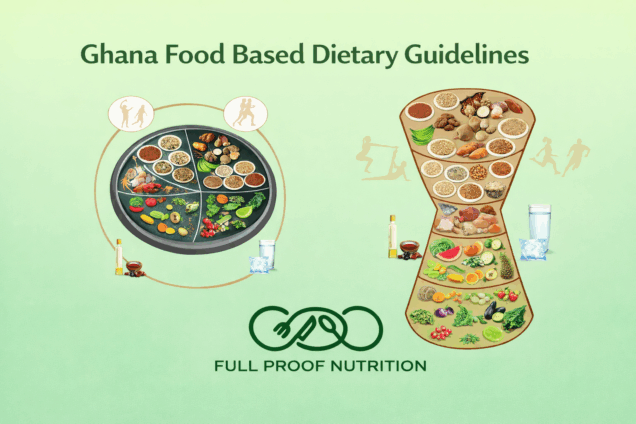
In 2023, the Ministry of Food and Agriculture with its partners officially launched the Ghana Food-Based Dietary Guidelines, following years of research, stakeholder engagement, and technical review. The process of developing the guidelines was evidence-based, culturally grounded, and multisectoral, involving health, agriculture, academia, and development partners. Thus, unlike the unrelatable advice from other contexts that people access online, Ghana’s guidelines are deliberately designed around local foods, eating patterns, health challenges, and food availability. They summarily promote:
- Eating a diverse diet from six food groups
- Regular consumption of fruits and vegetables
- Whole grains, roots and tubers
- Legumes and nuts as important protein sources
- Appropriate amounts of animal-source foods
- Use of healthy oils and limiting excessive salt, sugar, and fats
Since their launch in 2023, Ghana’s Food-Based Dietary Guidelines have received limited sustained attention in mainstream media and public discourse, with engagement largely confined to professional, academic, and policy circles.
What’s missing here?
Outside professional circles, many Ghanaians are unaware that national food-based dietary guidelines even exist, let alone that they were developed specifically to improve our health, food security, and local food systems. What appears to be missing is broad public engagement, and this is not accidental. Public awareness has been limited by the absence of sustained, nationwide communication campaigns that translate the guidelines into everyday language and relatable Ghanaian meals.
At the same time, structural barriers, such as the affordability and availability of fruits, vegetables, and other recommended foods, make the guidelines feel aspirational rather than practical. Nutrition literacy gaps, competing food messages from social media and informal food vendors, and limited integration of the guidelines into schools, markets, and popular media further reduce visibility. Without consistent reinforcement through trusted community channels and supportive food environments, the guidelines remain largely confined to policy documents and professional spaces, instead of becoming a shared public conversation.
A Call to Action
So, here’s the challenge for us. Let’s take ownership of Ghana’s Food-Based Dietary Guidelines by first understanding what they actually recommend, then asking whether our schools, institutions and public programmes are truly aligning with them.
Let’s support and prioritise local foods that reflect the guidance - fruits, vegetables, legumes and whole staples—and push for more public discussion, media attention and community-level education around healthy eating. Good dietary guidelines are only as powerful as the public awareness and the demand behind them.
If Americans can passionately debate protein grams and food processing, surely, we in Ghana can, in ways that suit our context, take interest in guidance designed for us, using our foods, to protect our health and strengthen our food systems. So, do you know your country’s food-based dietary guidelines? Maybe it’s time we all did. You can start by Clicking here to join the free Full Proof Nutrition WhatsApp channel.
All content is aligned as best as possible to the Ghana Food Based Dietary Guidelines. You can also grab a copy of my book on healthy eating (also aligned to the Ghana Food Based Dietary guidelines) - available now on Selar (Buy HEALTHY EATING MADE SIMPLE by Laurene Boateng on Selar) and Amazon (https://amzn.eu/d/6i9OeVb) or call 055-253-9859.
Written by Dr. Laurene Boateng (PhD, RD)
Dr. Laurene Boateng is a Registered Dietitian and Senior Lecturer in the Department of Dietetics, University of Ghana. She is the founder and editor-in-chief of Full Proof Nutrition, a Nutrition Consultancy committed to providing reliable, evidence-based, and practical healthy eating advice through its website www.fullproofnutrition.com. Click here to join Full Proof Nutrition WhatsApp channel to receive more educative content. Send us a mail on fullproofnutrition@gmail.com.
Reference
Ghana’s Food-Based Dietary Guidelines
Latest Stories
-
MOBA must reduce reliance on donations to protect Mfantsipim’s future – Patrick Kittoe
33 seconds -
GCB extends Customer Service Week into month-long customer engagement
1 minute -
Africa risks widening inequality if it fails to build AI expertise – Kweku Awotwi
2 minutes -
Women’s Voices Matter Movement petitions Gender Ministry over women’s rights and development
3 minutes -
Huel ad banned for suggesting its products could replace all meals
15 minutes -
Global InfoAnalytics poll puts John Boadu, Justin Kodua and Titus Glover ahead in NPP executive race
2 hours -
Ghana to establish skills development university with $50m from German support package
2 hours -
Baffour Awuah under EOCO investigation over alleged financial loss and money laundering – Deputy AG
2 hours -
How healthy is Ghana’s health sector?
2 hours -
HACSA Tech4Girls graduates 80 young women with digital and technology skills
2 hours -
Arrest of Manhyia South MP should involve Parliament, not police station – Kpebu
3 hours -
Two Nigerians sentenced to 189 months in US prison over $2.4m cyber fraud
3 hours -
Cristiano Ronaldo leaves Portugal’s training camp after rift with Head Coach
3 hours -
Ghana Energy Awards opens nominations for landmark 10th anniversary edition
3 hours -
Aayalolo contra-flow: Are we treating the symptom instead of the disease?
3 hours