

Audio By Carbonatix
Leading tennis players will expand their protest over prize money at Wimbledon - despite a 20% increase in this year's prize money pot.
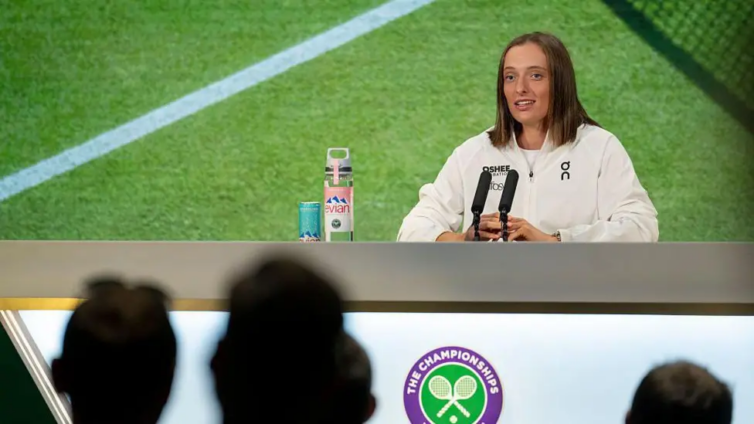
Some players limited pre-tournament media to 15 minutes at the recent French Open, but will go a step further at Wimbledon.
They will not only limit the time they offer at the forthcoming media weekend but also plan to restrict post-match appearances to 15 minutes throughout the first week of the Championships, which start on Monday.
The 15-minute limit is meant to symbolise the 15% of revenue that the Grand Slams - broadly speaking - allocate to prize money.
Representatives of the players say the decision was taken "following detailed consultation with players across both tours".
In Paris, women's world number one Aryna Sabalenka cut short her pre-tournament press conference, while players like Jannik Sinner and Iga Swiatek also followed the 'work to rule' directive.
But Novak Djokovic, who has regularly spoken out on behalf of players' rights, did not take part in the action.
The All England Club (AELTC) said it is "surprised and disappointed" by the move.
"Wimbledon puts the players at the heart of all our decisions and we invest significantly in them every year," it said.
"This is alongside investing hundreds of millions of pounds in upgrades to our player facilities as part of a three-year transformation to create a world-class player performance environment."
Earlier this month, the players welcomed Wimbledon's 20% increase as a "genuine and significant step forward".
The players issued a statement describing the announcement as a "meaningful statement of intent" - while also pointing out it still does not equate to the 16% of tournament revenue they are requesting from all Grand Slams this year.
The total prize fund at this year's championships will be £64.2m, following the largest annual increase in the event's history.
The singles' champions will each take home £3.6m with first-round losers paid £80,000.
But the overall fund is still about £7m short of what the players had been hoping for.
"We don't look at percentages, we don't actually believe that is the right metric," Deborah Jevans, the AELTC chair, told BBC Sport earlier this month.
"It is one metric that is based purely on revenue and doesn't take into account any costs and we cannot run a business in that way.
"We have expenses - we have spoken about infrastructure and investment in grass court tennis.
"You cannot run a sustainable business, and we have nearly been around for 150 years, just by looking at revenue. That is just plainly wrong."
As well as campaigning for the Slams to link prize money to tournament revenue, players are also asking for contributions to their benefit pool and a greater say in how the events are run.
The players say they have not had a "substantive response" from Wimbledon on these two issues.
The AELTC disputes that, and says it contacted players at the end of last year to propose talks on establishing a player council, which could then discuss the issue of benefits.
The offer was rejected by the players.
Sources at the AELTC say they were anticipating talks about the players’ concerns at the end of the championships, although they are not the only organisation involved in the dispute.
The increase in prize money at the French Open was 9.5%, and player representatives say they expect the French Tennis Federation to present proposals on how to narrow the gap between the two sides during the Wimbledon fortnight.
There will also be discussions with executives from the US Tennis Association as they finalise their prize money offer for the US Open, which begins on 30 August.
What are the rules around tournament media?
Grand Slam rules state that all main-draw players are required to participate in "feature media opportunities" before and during the tournament "in order to help drive engagement with the sport".
Media sessions are meant to "enable players to put across their opinions on their performance and provide valuable exposure to the media and fans".
A player can be fined up to £50,000 if they do not appear at all - unless a valid reason has been communicated to the governing bodies.
If the French Open is anything to go by, primary broadcast partners like the BBC and ESPN are likely to be most affected.
At Roland Garros, many of the leading players conducted a press conference followed by just one television interview.
Latest Stories
-
World Cup visa scandal: Mahama will act on corruption allegations – Abass Nurudeen
8 seconds -
Abass Nurudeen accuses Minority of ‘scandal scavenging’ over World Cup visa controversy
1 minute -
US Embassy recognised NSA, GFA and GTA as separate entities for visa applications – Sports Minister’s aide
8 minutes -
Only 30% of Ghanaian teachers satisfied with their jobs – CAPCOE data reveals
19 minutes -
Communities affected by construction of Akosombo Dam urge government to speed up compensation process
40 minutes -
World Cup visa scandal: Sports Ministry not shielding anyone – Sports Minister’s special aide
1 hour -
World Cup visa scandal: Over 30 people misrepresented as GTA board members to US Embassy – Vincent Assafuah alleges
1 hour -
Fire destroys wooden structure near Yesu Mo Villa at Bush Road
1 hour -
NDC threatens sanctions over oversized campaign posters, gives aspirants 5 days to comply
2 hours -
Star Oil paid GH¢2.7bn in taxes, levies in nine months of 2026
2 hours -
Samson’s Take: The rule of law is cheaper before the bulldozer
2 hours -
GRA blames system failure for delay in issuing receipt over passenger’s customs duty
3 hours -
Livestream: Newsfile discusses World Cup visa scandal, beach demolitions, education strikes, BRICS bid
3 hours -
NC-PTAs welcomes end of teachers’ strike, urges parents to prepare children for Monday
3 hours -
Government procures over 2,000 transformers as Ghana’s electricity access hits 89.13% – Energy Minister
3 hours