

Audio By Carbonatix
The Ghanaian media has, in the past couple of weeks, been inundated with competing claims and counterclaims over the operations and financial performance of the Ghana Gold Board (GoldBod). The Minority Leader in Parliament, Alexander Afenyo-Markin, has made a number of allegations about GoldBod, particularly, singling out its CEO, Sammy Gyamfi, for criticism.
GoldBod and Mr. Gyamfi, in turn, have responded to those allegations.
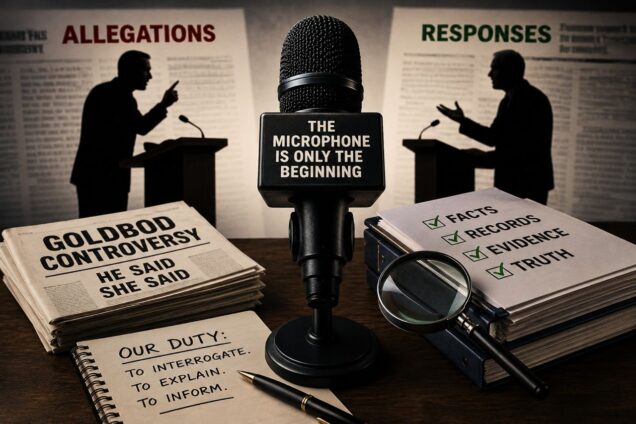
The media has done what it ordinarily does in such circumstances: it has given both sides the microphone and the equal right to be heard, as is expected of an unbiased Western-style mass media.
The allegations and their denial of same about inordinate losses at GoldBod, which the Minority insists calls for investigation and where necessary, criminal prosecutions, have culminated in counter allegations of extortion against the Minority Leader, claims not unfamiliar with Ghana’s Parliament.
Afenyo-Markin has caused to be issued two separate Writs of Summons, calling on Mr. Gyamfi and some media houses to substantiate the claims of extortion he says have been levelled against his person.
The media again have given prime coverage to these. In all the reportage, very little has been done by journalists actively reporting on the exchanges to educate their audience on the matters on which both sides have expressed sharply contrasting views. Little has been done to interrogate the figures, examine the records or explain to the public what the available evidence actually establishes.
If one party is denying responsibility while the other is making allegations of wrongdoing, the journalist’s responsibility should not end with reporting both positions. Certainly, one of these positions must be supported by the evidence, leaving the present writer to question why reporters simply report.
When I began student journalism in 2016, my first couple of stories were less reporting of what happened and more an attempt to make sense of what had happened. I carved a niche for myself in finding the nuance in opposing views, cutting through the noise and calling out the actors. Before long, more people were reading my posts than those of my competitors who would simply report who said what. That instinct to cut through the noise led me to my three-year stint with MYJOYONLINE of the leading Multimedia Group.
It is perhaps that experience which makes me uncomfortable with a conception of journalism that ends with putting two opposing voices before an audience and leaving the audience to determine which one is telling the truth. Giving both sides the microphone is important. But the microphone is only the beginning.
There is, of course, good reason why the media must give the competing sides of a public controversy the opportunity to be heard. John Stuart Mill, in his celebrated defence of freedom of thought and discussion in On Liberty, observed that “if all mankind minus one were of one opinion, and only one person were of the contrary opinion,” mankind would be no more justified in silencing that one person than that person would be justified in silencing mankind. I have previously relied on this principle in writing about freedom of the press and the dangers of suppressing dissent. It remains as relevant today as it was when Mill wrote it.
But Mill’s defence of the right to speak cannot sensibly be converted into a duty on journalists to suspend their own judgment. The microphone protects the right of the speaker to be heard. It does not absolve the journalist of the responsibility to interrogate what has been said.
Walter Lippmann, writing in Public Opinion, drew an important distinction between news and truth. “The function of news,” he wrote, “is to signalize an event”; the function of truth, however, is to bring hidden facts to light, put them in relation to one another and create a picture of reality upon which people can act.
That distinction ought to trouble any journalist who considers the work finished after reporting that one politician said this and another institution said that. News may tell us that a disagreement exists. Journalism at its best should help us understand what the disagreement is actually about.
This is particularly important because the ordinary citizen cannot reasonably be expected to independently examine every IMF report, audited account, government statement or parliamentary claim upon which public debate turns. The media occupies that space between the citizen and the complicated world about which the citizen is expected to form opinions. John Dewey’s conception of communication and democracy similarly recognised the capacity of mass communication to educate citizens about public problems, the connection between political decisions and their consequences, and to help form an informed public.
The GoldBod controversy provides a useful illustration.
The GH¢22 billion figure cited in the controversy was not invented. It appeared in the IMF's Sixth Review of Ghana's Extended Credit Facility programme, completed in July 2026. The question, however, was not simply whether the figure existed. The more important question was: whose loss was the IMF reporting?
That distinction matters. The JoyNews Research desk, in examining the IMF report and GoldBod’s audited accounts, found that the loss referred to the Bank of Ghana and not a GH¢22 billion loss incurred by GoldBod. GoldBod’s own accounts, meanwhile, recorded a surplus rather than the loss alleged. The research desk consequently found the claim that GoldBod made the GH¢22 billion loss to be misleading.
This is precisely the work that journalism ought to do.
It is not to determine whether Afenyo-Markin or GoldBod is politically more attractive. It is not to prevent the Minority Leader from making a claim, nor to deny GoldBod the opportunity to answer it. It is to take the claim, go to the source upon which it is based, examine the evidence and tell the public what that evidence actually establishes.
In this case, the distinction is not a technicality. A GH¢22 billion loss attributed to GoldBod presents an entirely different picture from a GH¢22 billion loss reported by the IMF in relation to the Bank of Ghana. The difference is material to the public’s understanding of the institution, its management and the political allegations being made against it.
The media must therefore resist the temptation to mistake balance for neutrality and neutrality for indifference. There is nothing unbiased about placing a microphone between two people and refusing to examine the truth of what either has said. True journalistic independence requires the courage to subject both claims to the same standard of evidence.
The journalist, and by extension the mass media, must therefore be more than a microphone. In a matter such as GoldBod, the journalist should be able to independently assess the IMF reports and other relevant records, establish whose losses were actually reported, explain that distinction to the public and, where the evidence warrants it, plainly call a misleading claim, the Minority Leader’s in this instance, exactly what it is.
Mill reminds us why the minority must be heard. Lippmann reminds us that news and truth are not the same thing. Dewey reminds us why an informed public matter to democracy. Taken together, they point to a role for the media that is greater than simply providing a platform for competing voices.
The right to be heard is not the same thing as the right to have one’s claims accepted without scrutiny. The microphone is necessary. But after the microphone comes the journalist’s harder duty: to examine, to explain and, when the evidence demands it, to tell the public what the records actually say.
The writer, Oswald K. Azumah, is a lawyer, journalist and communications practitioner.
Latest Stories
-
GRA Customs says travellers bringing more than two phones into Ghana will pay duty
8 minutes -
Average lending rate in Ghana falls from 27% to 15.6% — World Bank
10 minutes -
GAF opens 2026 commissioned officers enlistment; application vouchers go on sale September 3
24 minutes -
Education Minister engages Chinese Ambassador over Damongo University project
27 minutes -
Enterprise Group appoints Jacqueline Benyi as Group COO, Francis Yirenkyi as acting MD of Enterprise Life
33 minutes -
Central Region NADMO activates security, humanitarian response following New Winneba fatal clash
41 minutes -
Black Queens face Côte d’Ivoire as Ghana looks ahead after WAFCON quarter-final exit
46 minutes -
NPP Western North Chairman donates Voxy vans to constituencies to boost party finances
49 minutes -
Insurance Hub 2026 set for October 21 at Wesley Towers Auditorium
52 minutes -
$30m China grant insufficient for Damongo university project – Haruna Iddrisu
58 minutes -
Food vendor recounts how she narrowly escaped New Winneba attack
1 hour -
Military to secure James Town after waste cleanup to prevent illegal dumping, squatting
1 hour -
Charlie Kirk murder suspect pleads not guilty as judge clears way for death penalty trial
1 hour -
Signals Bureau case: ‘We were battle-ready’ – Atta Akyea fires at AG over absence of prosecution team
1 hour -
NSA sets September 4 deadline for final rectification of biodata mismatches
1 hour