

Audio By Carbonatix
While delivering the much anticipated 2023 budget, Ghana’s Finance Minister, Ken Ofori-Atta, unmasked the nature of Ghana’s debt portfolio, saying the country is finding it difficult to carry a debt burden worth $48.9 billion as of September 2022.
Debt restructuring is the only gateway to access the projected $3 billion IMF bailout package. Barely five days after Ofori-Atta confirmed the debt operation exercise, international credit rating agency Moody’s dropped Ghana’s long-term sovereign bonds ratings.
On 4 December 2022, the government finally announced a debt operation exercise called “Domestic Debt Exchange”, which outlined the nature of debt restructuring for domestic creditors. The Finance Minister indicated that domestic bondholders would be asked to exchange their instruments for new ones under the programme. However, the impact of the domestic debt exchange on investors holding government bonds, particularly small investors, individuals, and other vulnerable groups, will be minimised; hence treasury bill holders will be paid the full value of their investments on maturity.
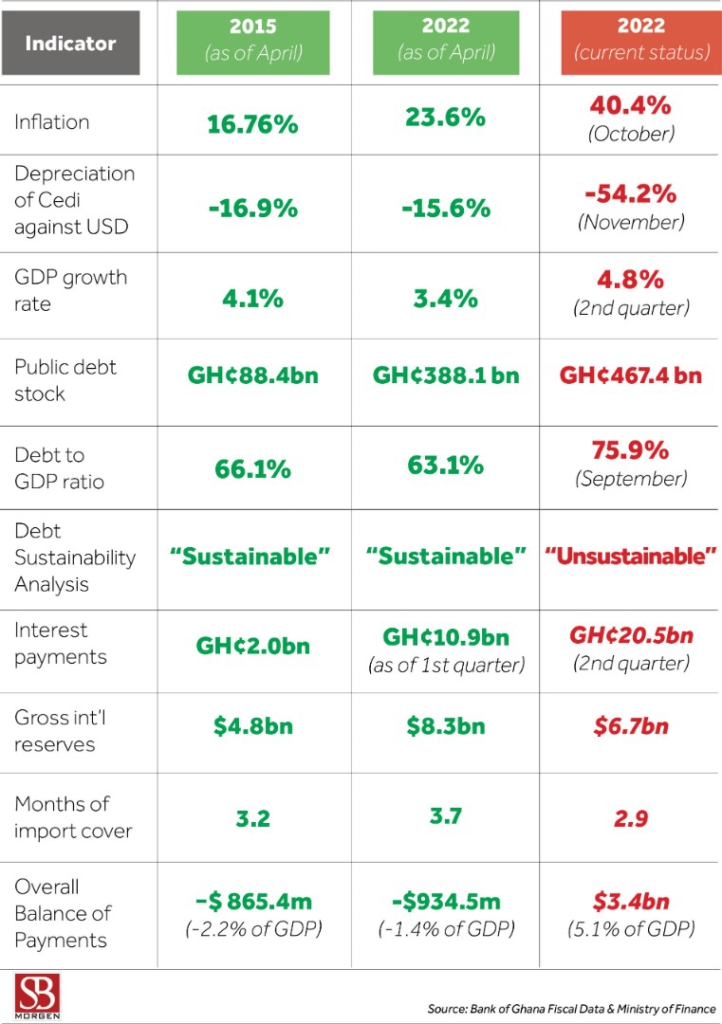
20 years after Ghana received a total relief of approximately US$3.7 billion, equivalent to US$ 2.2 billion in Net Present Value terms, from all its creditors, it is back in the IMF ‘programmes market’ hoping to shop for another bailout packet worth $3 billion. According to the fund, “in cases where a country’s debt is assessed as unsustainable, the IMF is precluded from providing financing unless the member takes steps to restore debt sustainability, including by seeking a debt restructuring from its creditors.” Like the country’s 16th IMF programme in 2015, the government has decided to freeze public-sector employment next year to reduce expenditure. The monetary policy rate has also been hiked from 24.5% to a record 27% to deal with the over 40% inflation rate.
As Ghana walks the path to its 17th IMF bailout, precipitated by a debt sustainability problem, the country will experience the immediate impact, such as losses to investors, shaking of the financial industry, potential bank collapses and stifling of production due to how expensive it will be to procure financing. Added to these is the long-term effect of losing confidence in the Ghanaian government’s security. It will be hard for a government that has defaulted on domestic debt in the currency it prints to convince investors to buy its securities in international currencies that it does not control. This will take at least a decade to restore.
Latest Stories
-
$600m tomato imports undermining Ghana’s economy — Chamber of Agribusiness
21 minutes -
Rainstorm wreaks havoc: Faulty transformers, feeder failures leave parts of 3 regions without power
29 minutes -
CUTS International calls for urgent competition law amid sachet water price hikes
1 hour -
‘I never did this advert’, AI clones hijack Ghanaian identities for profit
1 hour -
25-year-old woman battles trauma after surviving deadly Nkwanta attack
2 hours -
Vice President honoured at Tortsogbeza as South Tongu leaders highlight development needs
2 hours -
Kwahu Business Forum 2026: Corporate citizenship, sustaining African businesses take centre stage with KGL as the case study
3 hours -
Trump seeks $152m to reopen notorious Alcatraz prison
5 hours -
Ex-Chelsea player Oscar retires with heart issue
5 hours -
CA Foundation drives constitutional literacy in Kpone Katamanso municipality
6 hours -
GPRTU to hold talks with Transport Ministry over rising fuel costs
6 hours -
CUTS International urges gov’t to halt sachet water price hike pending cost review
6 hours -
Chief Justice: Efficient Judiciary essential to reducing business costs
6 hours -
Bayern grabs 99th-minute winner to cap superb fightback
6 hours -
Ahmed Ibrahim urges Ghanaians to reflect Easter values in nation-building
6 hours