

Audio By Carbonatix
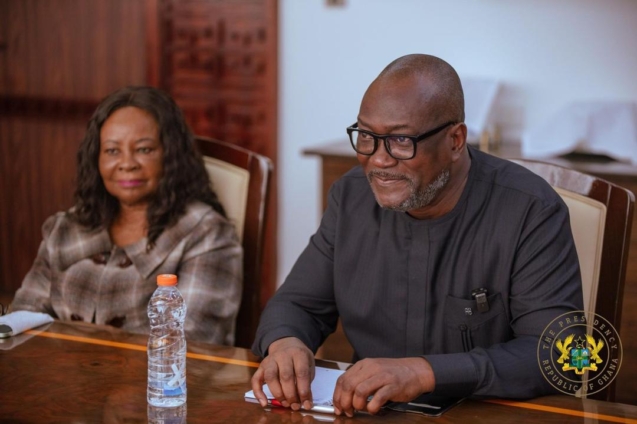
The chairman of the Constitution Review Committee says proposals to strengthen the Council of State are aimed at giving it a meaningful second-look role in major national decisions, not at granting it the power to veto government action.
Prof Henry Kwasi Prempeh, speaking on Joy News, rejected calls to abolish the Council of State, arguing that Ghana’s highly polarised politics make the institution necessary.
“We run a very polarised politics, and every now and then you need some institution in the middle,” he said.
He described the Council of State as a key part of Ghana’s constitutional innovation. “It’s part of our constitutional innovation. We brought it in because we thought it was a borrowing from our traditional system,” he said.
According to him, scrapping the Council would amount to discarding something uniquely Ghanaian.
“It would be sad that the only thing we’re going to throw away is the one institution that we think looks authentically Ghanaian,” he said.
Prof Prempeh acknowledged widespread dissatisfaction with the Council of State but insisted the answer lies in reform, not abolition. “So fix it. There’s a problem with the Council of State; you have to fix it,” he said.
He said the committee gathered public evidence on what people dislike about the body.
“The people said it is not sufficiently independent. It’s bringing the same people from the same party. It’s not diverse enough politically, in terms of class, and all of that,” he said.
He also pointed to concerns about secrecy. “What they do, we don’t know,” he said.
According to Prof Prempeh, the proposed reforms directly respond to these grievances. “So we took all aboard. Opacity. We bring more transparency into what they do and the composition,” he said.
He said changes have been made to limit presidential dominance. “We have changed it so that the President’s men and women don’t dominate it,” he said.
He added that the membership has been broadened. “We have diversified the membership so that ideas are coming from different places,” he said.
Prof Prempeh explained that in some areas, the Council’s advice will carry real weight. “For some of the jobs they do, especially in recruitment, the advice is binding,” he said.
Where the advice is not binding, he said the distinction is clear. “And where the advice is not binding, then fine,” he said.
He revealed that the committee also considered but rejected the idea of turning the Council into a second parliamentary chamber. “Even though we didn’t accept the second parliamentary chamber idea, we said, look, certain agreements and certain bills must go to them,” he said.
He stressed that this does not amount to veto power. “Not so they can veto. They can’t veto,” he said.
Instead, he said the goal is reflection. “Let them have a chance for you to reconsider,” he said.
He listed the types of decisions that should be subjected to this second look. “International agreements, agreements about natural resources, deals like the lithium agreement, those kinds of things,” he said.
Prof Prempeh said Ghana’s two-party system often limits broader input. “We know our politics. The two-party system tends to drive even brilliant minds from coming in,” he said.
He said a restructured Council could bring balance if its members come from diverse institutions. “If you have the Academy of Arts and Sciences putting somebody there, if you had the Trades Union, Ghana Association of Industries, Chamber of Commerce, if they put these people there, the National Chief Farmer is there,” he said.
According to him, such a body can add value. “Then we think that they can bring some reflection, some balance to these things,” he said.
Prof Prempeh said the guiding principle was clear. “That’s the idea. Why we said we shouldn’t throw the baby away with the bath water,” he said.
He admitted there are legitimate concerns. “There is indeed a legitimate grievance around the Council of State,” he said.
But he insisted the focus must be on solutions. “We were looking for solutions, not just to abolish institutions,” he said.
He said the reforms aim to restore the Council’s original purpose. “What we are offering is a way to restore it to its original idea,” he said.
In his view, a reformed Council of State can work and even become a model. “This is something that can work, and then we can showcase it and say, like in Ghana, we have picked some idea from our traditional council of elders and it has worked in our constitutional system,” he said.
Latest Stories
-
A source of excellence across generations – Vice President Opoku-Agyemang lauds Mfantsipim
14 minutes -
(Photos) Mfantsipim School launches historic 150th anniversary
37 minutes -
Knights and Ladies of Marshall group backs Catholic Bishops’ stance on anti-LGBTQ+
2 hours -
Bright Simons writes: All the Filla in the Ibrahim Mahama/E&P – Gold Fields Saga
2 hours -
Monetise Idiocy In Ghana
2 hours -
The Ghanaian prophet and the mysterious death of his scottish wife Charmain Speirs
3 hours -
Nearly 400 sentenced in Nigeria for links to militant Islamists
3 hours -
Ghana’s recovery supported by gold strength despite global oil price pressures – Standard Bank Research
3 hours -
Methodist Church hails Mfantsipim@150; calls for “fresh consecration” to excellence
4 hours -
‘Excellence is our inheritance’ – Nana Sam Brew-Butler hails Mfantsipim’s 150-year reign in leadership
4 hours -
Kwaku Azar writes: A-G vs OSP
4 hours -
Mfantsipim–Adisadel rivalry built excellence, not division – Sam Jonah
4 hours -
Vice President launches Mfantsipim’s 150 years of shaping Ghana’s greatest mind
5 hours -
I assure Otumfuo, Mahama will join him to commission KNUST Teaching Hospital by end of this year – Haruna Iddrisu
5 hours -
Barcelona dominate derby to extend La Liga lead
5 hours