

Audio By Carbonatix
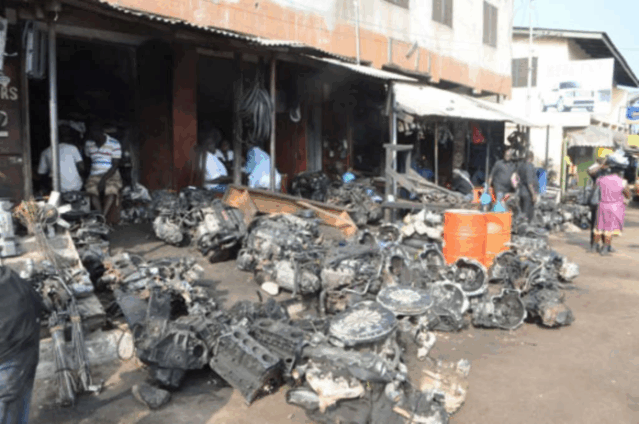
The Abossey Okai Spare Parts Dealers Association has announced plans to close down foreign-owned retail shops in the business enclave on Monday, September 8, 2025, if no intervention is made.
The Association’s Director of Communications, Takyi Addo, confirmed the planned action in an interview on Adom FM’s Dwaso Nsem on Friday.
He explained that the move is intended to enforce the Ghana Investment Promotion Act (Act 865), which restricts retail trade to Ghanaian citizens.
According to Mr. Addo, the action is not targeted at any particular group of foreign nationals but is aimed at ensuring strict adherence to the law.
“On Monday, we are closing all shops of foreigners. There are laws in this country, and we don’t know how they have managed to infiltrate the retail business. Some are driving Uber, others are in trades strictly reserved for Ghanaians. We have been patient for too long, but this time we are serious,” he declared.
He further explained that under Act 865, foreign investors are required to deposit at least $1 million to operate in the retail sector or import goods of the same value.
“Instead, many, especially the Chinese, bring in products worth over $10 million and still engage directly in retail trade, which the law forbids. They are supposed to operate as suppliers, not retailers,” he argued.
Mr. Addo stressed that such practices place Ghanaian traders at a disadvantage, as they face high rent, levies, and import duties while competing with foreign businesses that ignore regulations.
The Association maintained that the action is long overdue, noting that many local spare parts dealers have already been forced out of business at Abossey Okai due to what they describe as “unfair competition.”
This is not the first time local traders have clashed with foreign retailers in Ghana.
The enforcement of Act 865 has been a recurring source of tension, particularly between Ghanaian traders and foreign nationals, most notably Chinese and Nigerian retailers.
In 2020 and 2021, similar disputes led to widespread shop closures, protests, and calls for stricter enforcement of the law.
Successive governments have promised to address the matter, but traders argue that enforcement has been inconsistent, leaving local businesses vulnerable.
Latest Stories
-
ECOWAS urges restraint amid escalating tensions in Gulf region
7 seconds -
Pedestrian struck by vehicle at Pokuase Interchange amid streetlight concerns
9 minutes -
Fact Check: Mahama’s claim that over one million people found employment from 2025 Q1 to Q3 is false
10 minutes -
Health Directorate cracks down on staff absenteeism to boost performance
14 minutes -
Global InfoAnalytics poll tips NDC’s Baba Jamal to win Ayawaso East by-election with 75%
20 minutes -
Ghana eyes West Africa aviation hub as Ambassador Victor Smith engages US helicopter giant
24 minutes -
Lordina Mahama advocates for safer childbirth
35 minutes -
TMA begins poultry distribution to boost food security
52 minutes -
Interior Minister receives Gbenyiri Mediation Committee report on Gonja-Birifor conflict
57 minutes -
Lordina Foundation builds and hands over ultramodern maternity and children’s ward to Asukawkaw Clinic
58 minutes -
Former CJ on Dubai lesson and why Ghana must build its own gold market
1 hour -
It’s never too late – Former CJ Sophia Akuffo backs industrial reset
2 hours -
We would be very far ahead – Ex-CJ Sophia Akuffo laments Ghana’s industrial retreat
2 hours -
Iran, the US, and a World Cup that starts in three months
2 hours -
Why is WhatsApp’s privacy policy facing a legal challenge in India?
2 hours