


Audio By Carbonatix
Advocates for Christ Ghana (A4CG), through its Economy, Business & Finance Gate, has formally called on the Bank of Ghana (BoG) to withdraw its Exposure Draft on the Regulation and Supervision of Non‑Interest Banking, citing what it describes as deep legal, prudential, and regulatory flaws.
In a detailed submission dated December 23, addressed to the Governor of the Bank of Ghana, A4CG, a Christian professional advocacy group, acknowledged the central bank’s objectives of promoting financial innovation and inclusion but argued that the draft guidelines, as currently framed, are “not fit for implementation.”
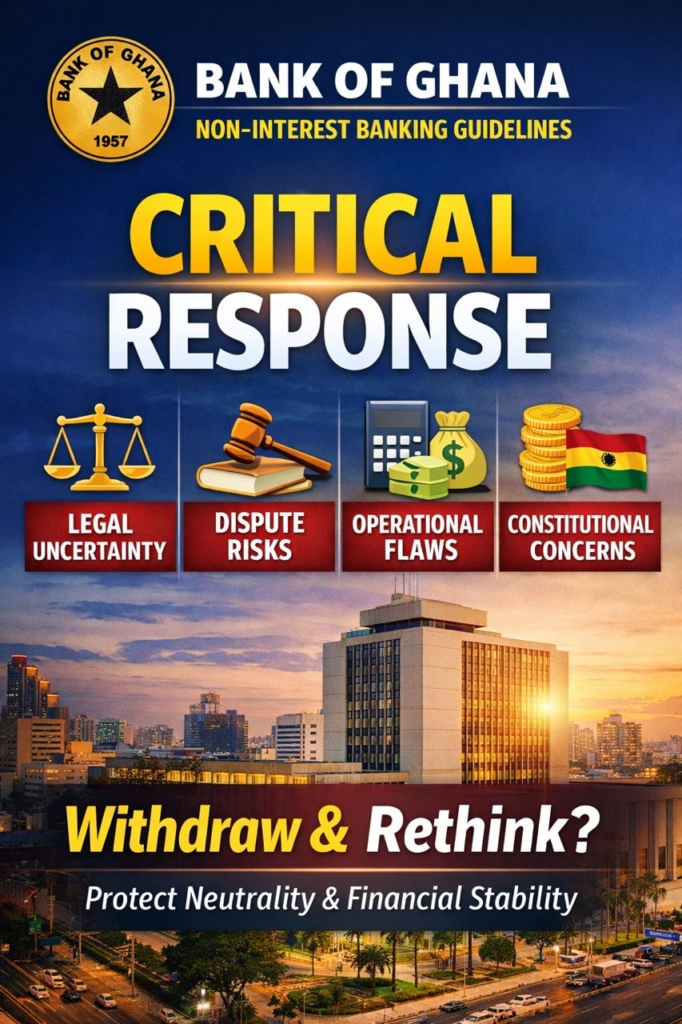
The group said the BoG lacks a tested non‑interest banking model tailored to Ghana’s legal and financial environment, resulting in internal contradictions and regulatory incoherence.
Among the key concerns raised are conflicting standards hierarchies, unclear supervisory authority between the BoG and internal non‑interest banking committees, and dispute‑resolution mechanisms that could weaken consumer protection.
A4CG warned that the proposed structures risk creating a parallel governance and adjudicatory system that may undermine constitutional equality before the law and dilute the central bank’s supervisory primacy.
The submission also criticised the proposed “window” model, which would allow conventional banks to operate non‑interest banking units within existing institutions. According to A4CG, this approach is operationally complex, cost‑opaque, and vulnerable to manipulation in the absence of detailed accounting, audit, and supervisory frameworks.
On prudential regulation, the group argued that applying conventional capital adequacy rules to non‑interest banks without tailored guidance is technically unsound, given the different risk profiles involved.
It further questioned whether there is sufficient market demand in Ghana to justify the costs and systemic implications of a specialised non‑interest banking regime.
A4CG emphasised that its objections are not ideological or faith‑based, but grounded in constitutional neutrality, consumer protection, and public‑interest considerations.
It recommended that any future framework be comprehensively redesigned to ensure regulatory clarity, equal treatment of consumers, and transparency, while avoiding regulatory arbitrage.
The organisation concluded by urging the Bank of Ghana to withdraw the draft, undertake a thorough technical revision, and re‑engage stakeholders to preserve institutional credibility and public confidence.
Below is the full submission:
Latest Stories
-
Ghana to begin camping with 12 athletes after Accra Open Championships – Bawa Fuseni
14 minutes -
Anthony Joshua declines showdown with Tyson Fury but admits they ‘probably’ clash next
28 minutes -
Tyson Fury dominates Makhmudov, calls out Joshua next
47 minutes -
I have supported highway authority financially to fix roads in my constituency – A Plus
2 hours -
US, Iran fail to reach peace agreement after marathon talks in Pakistan
2 hours -
ECG kicks off Phase Two of transformer upgrades at Lashibi; brief outages expected
3 hours -
Port crises loom as 11,000 drivers threaten four-day strike
4 hours -
A source of excellence across generations – Vice President Opoku-Agyemang lauds Mfantsipim
5 hours -
(Photos) Mfantsipim School launches historic 150th anniversary
5 hours -
Knights and Ladies of Marshall group backs Catholic Bishops’ stance on anti-LGBTQ+
6 hours -
Bright Simons writes: All the Filla in the Ibrahim Mahama/E&P – Gold Fields Saga
6 hours -
Monetise Idiocy In Ghana
6 hours -
The Ghanaian prophet and the mysterious death of his scottish wife Charmain Speirs
7 hours -
Nearly 400 sentenced in Nigeria for links to militant Islamists
7 hours -
Ghana’s recovery supported by gold strength despite global oil price pressures – Standard Bank Research
8 hours