


Audio By Carbonatix
Nutrition Lead at AGRA Bertha Mkandawire says Africa needs scalable solutions to deal with malnutrition on the continent.
Scalable solutions in agriculture are innovations or technologies that can be effectively and easily expanded and adapted to increase productivity, efficiency, and sustainability across varying farm sizes and conditions.
She says about 52% of the population on the continent cannot afford a healthy diet and only 6 African countries are likely to meet targets set by governments to improve nutrition by 2025.
She is urging the global community to support ongoing works on the continent to improve nutrition.
“Let’s advance more scalable solutions. What Africa needs now are solutions that are scalable to address the stunting rates that are still quite very high among many African countries,” Mkandawire said.
Speaking at a side event at the ongoing 29th United Nations Climate Change Conference (COP29) in Baku, Azerbaijan, she said due to the importance of nutrition, it has become a big part of AGRA’s work and they are open to working with partners to roll out a nutrition strategy across the continent.
“We realized that on the African continent, many people depend on primary staples; maize, wheat, and rice, as their primary source of calories.
"These crops are facing low productivity because of climate change, and that becomes a very big challenge,” she said.
“We at AGRA are emphasising soil health because improved soil leads to improved nutrients in the crops we are growing,” she added.
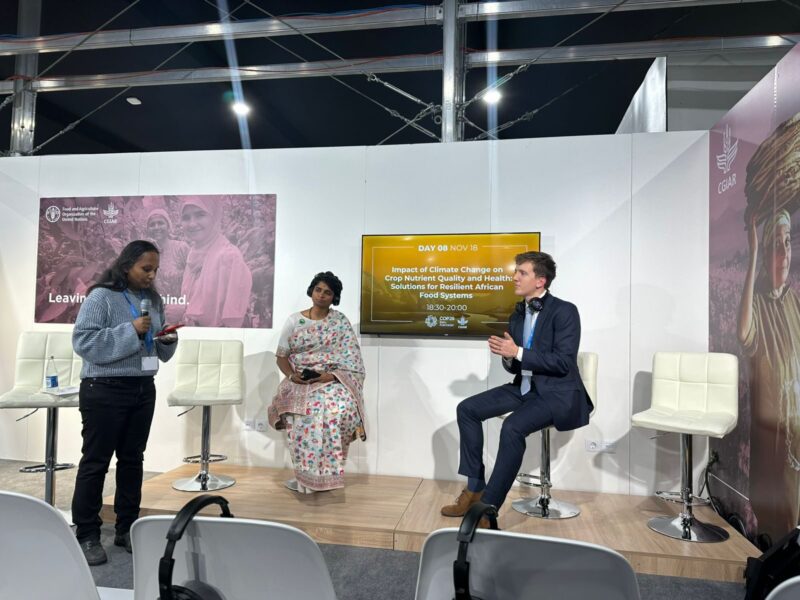
The side event was on the topic; “Impact of Climate Change on Crop Nutrient Quality and Health: Solutions for Resilient African Food Systems.”
It explored the impact of climate change, particularly rising atmospheric carbon dioxide and extreme weather events, on food supply and the nutrient quality of key staple crops.
It highlighted how these challenges heighten malnutrition risks, especially in vulnerable populations, and discussed innovative technologies and resilient food production systems to safeguard food security and improve nutritional outcomes.
Vice President of Global Programs at Farm Journal Foundation Rose Barbuto observed over 3 billion people cannot afford a healthy diet across the world.
She said poor diet is responsible for one-fifth of the mortality rate in the world but higher in low-income countries.
Between 76 to 85% of the population in the developing world cannot afford healthy balanced diets, a situation she said climate change was partly responsible for.
“Beyond traditional yield measures, increased carbon in the atmosphere contributes to the reduction of protein and minerals in plants while increasing the production of sugars and starches due to changing balances in nitrogen and phosphorous levels.
"Elevated carbon dioxide has been shown to decrease protein concentrations in wheat, barley, rice, and potato by 10 to 15%,” she disclosed.
Oliver Camp, Environment and Food Systems Advocacy Advisor of the Global Alliance for Improved Nutrition (GAIN) observed climate change is making micronutrients, in particular, less available to the populace.
“We know that when there is a higher concentration of carbon dioxide in the atmosphere, you see a reduction in really critical micronutrients in crops. You see a reduction in iron and zinc in wheat.
"So, if you're getting 70% of your calories from wheat and then that is having its nutrient content reduced, then you can see how that will affect nutrient outcomes,” he said.
Praveena Sridhar, Chief Science and Technology Officer of the Save Soil movement called for practices that will help replenish soil nutrition.
She urged farmers to practice no-till, intercropping, and sustainable soil management practices or regenerative agriculture.
Latest Stories
-
We can tackle multiple priorities – Sam George defends Anti-LGBTQ Bill push
24 minutes -
Statement: Ghana Chamber of Mines’ Response to Claims in Joe Jackson’s “Ananse Stories about the Economy of Ghana”
26 minutes -
GES opens 2026 teacher recruitment for licensed B.Ed graduates
28 minutes -
Ghana must value skilled trades, build resilient learners — Ibn Chambas
36 minutes -
Ghana must rethink education around relevance, resilience and responsibility — Ibn Chambas
39 minutes -
Prince Harry faces defamation lawsuit from charity he co-founded
41 minutes -
South Korea deploys thermal cameras to track escaped zoo wolf
43 minutes -
Calls for royal meeting with Epstein survivors grow ahead of US visit
46 minutes -
Ibn Chambas advocates blend of technology and human values in education
47 minutes -
UMA improves healthcare access in Asutifi North with GH₵700k ‘Kim Taylor Legacy’ Walkway
52 minutes -
Scholarships Authority and Fanaka University offer sponsorship for procurement and supply chain studies
56 minutes -
Bisa Kdei drops new single ‘Go N Look’ featuring Medikal
1 hour -
Benin facing rising terrorism in north as French military presence faces growing criticism
1 hour -
UEW Public Lecture Series 2026: Education debate ‘about the soul of Ghana’s future’ — Dr Ibn Chambas
1 hour -
EU fingerprint and photo travel rules come into force from today
2 hours