

Audio By Carbonatix
Academic Engagement Director for Ghana and Head of the Africa Open Lab at GSK has reaffirmed the importance of Africa-specific research in addressing the continent’s unique health challenges.
Dr. Juliet Addo noted that Africa bears 25% of the global disease burden but receives only 1.1% of global health R&D investment, underscoring the urgent need for locally driven research.
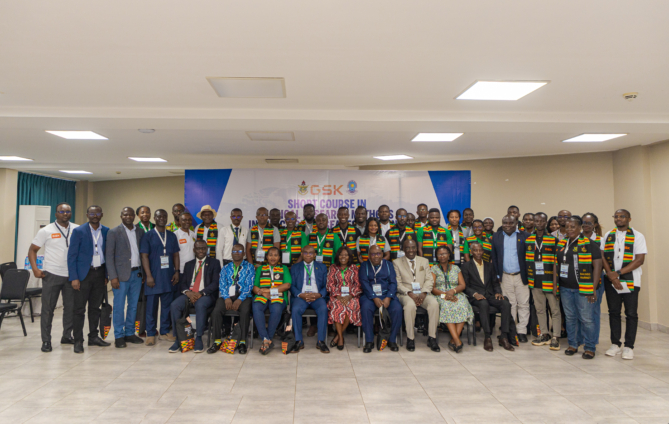
Dr. Addo was addressing participants at the Short Course in Clinical Research Methods in Infectious Diseases (CREMIND), a collaboration between the Kwame Nkrumah University of Science and Technology (KNUST) College of Science and GlaxoSmithKline (GSK) under the GSK Africa Open Lab-funded program.
The event, themed ‘Bridging Research and Public Health Practice,’ seeks to strengthen Africa’s research capacity and reaffirms GSK’s commitment to tackling tuberculosis (TB), malaria, and antimicrobial resistance (AMR) through innovation and collaboration.
Professor Kwasi Torpey, Dean of the University of Ghana’s School of Public Health, called on early-to-mid-career researchers to prioritize evidence-based solutions that directly impact public health and medical practice.
He emphasized the need for research that is academically rigorous yet practical in real-world settings.
Professor Torpey reiterated stakeholder engagement as a crucial strategy for impactful research, urging researchers to actively involve patients, healthcare providers, policymakers, and community members to enhance research quality and applicability.
Additionally, he encouraged a culture of mentorship to support emerging scientists.
“As you advance in your career, support those coming after you. Be versatile but also establish a research niche that defines your expertise and impact,” he advised.
Dr. Addo encouraged participants to engage actively, collaborate, and apply their learning to advance their careers and improve patient outcomes.
Professor Ellis Owusu-Dabo of the KNUST School of Public Health highlighted the expansion of the Clinical Research Methods course, which was initially launched in 2023 as CREDIT (Clinical Research Methods in Tuberculosis), to now cover infectious diseases more broadly.
He noted that Africa faces a dual burden of infectious and non-communicable diseases, which significantly contribute to high mortality rates.
He called on institutions and researchers to tackle infectious diseases head-on and emphasized the need for training researchers in data analysis, research question development, and intervention implementation.
He lauded the unwavering support from GSK and expressed hope that the initiative would be sustained beyond the current period.
Professor Leonard Amekudzi, Provost of the College of Science at KNUST, welcomed the 25 early-to-mid-career researchers from across Africa to the two-week training.
He encouraged them to actively engage in discussions, hands-on sessions, and collaborations, noting that the knowledge and networks gained would strengthen health research and public health impact across Africa.
Participants expressed enthusiasm for the training.
“This is a great opportunity to build on my knowledge and equip myself further. I aspire to become a strong mentor as I advance in my research career,” said Louisa Fokuo Domfe, a research assistant at the Kumasi Centre for Collaborative Research in Tropical Medicine (KCCR), Ghana.
A research fellow from Cameroon, Mr. Jam Etienne Yuh, shared: “For this program, I want to learn how to translate the research ideas I have into practical reality. I have heard the testimonies from previous participants, and I hope this is also a life-changing moment for me.”
Latest Stories
-
The Ghanaian prophet and the mysterious death of his scottish wife Charmain Speirs
26 minutes -
Nearly 400 sentenced in Nigeria for links to militant Islamists
48 minutes -
Ghana’s recovery supported by gold strength despite global oil price pressures – Standard Bank Research
55 minutes -
Kwaku Azar writes: A-G vs OSP
1 hour -
Mfantsipim–Adisadel rivalry built excellence, not division – Sam Jonah
2 hours -
Vice President launches Mfantsipim’s 150 years of shaping Ghana’s greatest mind
2 hours -
I assure Otumfuo, Mahama will join him to commission KNUST Teaching Hospital by end of this year – Haruna Iddrisu
3 hours -
Barcelona dominate derby to extend La Liga lead
3 hours -
Gov’t to roll out free special education for persons with disabilities from July 1 – Education Minister
3 hours -
Importers and Exporters Association declares full support for Publican AI port system
3 hours -
“We used it to test our officiating officials’ readiness” – Bawah Fuseini after CAA Athletics event
4 hours -
Volleyball emerges as Ghana’s fastest rising sport
4 hours -
National Sports Fund needs strong leadership from the top – Administrator David Wuaku
4 hours -
JoySports Exclusive: Steve McLaren in talks with GFA after expressing interest in Black Stars job
4 hours -
Fire guts auto parts warehouse at Bubuashie, one fire officer injured
4 hours