

Audio By Carbonatix
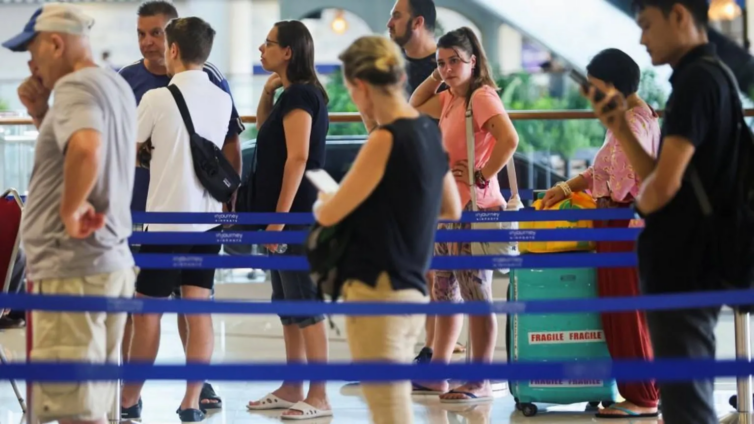
A limited number of flights have been able to leave the United Arab Emirates (UAE) as departures across the Middle East continue to be disrupted by the joint Israeli and US war on Iran.
More than 4,000 flights a day have been cancelled across the region, according to flight tracking service Flightradar24, with hundreds of thousands of passengers affected.
The disruption "will only increase the longer the crisis continues" and it "will have enormous repercussions for the industry," director of communications Ian Petchenik said.
The ongoing airline disruption comes as more than 100,000 Britons have registered their presence in the Middle East with the UK government.
On Monday morning, 79% of global flights to Qatar and 71% of flights to the United Arab Emirates had been cancelled, according to aviation analytics firm Cirium, while 81% of flights to Israel and 92% of flights to Bahrain have also been grounded.
United Arab Emirates national carrier Etihad Airways had suspended services until 14:00 local time (10:00 GMT)on Wednesday. But there were some ad-hoc departures on Monday, including an Etihad flight to London Heathrow (EY67), which landed at 19:17 GMT, according to Flightradar24.
Fay McCaul was on that flight after being stuck with her seven-year-old son in Abu Dhabi over the weekend.
Speaking at Heathrow on Monday evening, the 41-year-old described the situation at Abu Dhabi Airport as "pretty chaotic".
"It was just taking ages to board, with no announcements, so we didn't know what was going on," she said.
"And then after the boarding time, sirens started going off in the airport and everyone started receiving texts on their phones with alarm signals to stay away from windows because of potential missile strikes.
"So then it was pretty chaotic, and the airline obviously didn't know what was going on either."
She added her son had had "a lovely time because he had no idea of what was going on", but she said it had been pretty stressful" for her.
Other Etihad flights have left for destinations including Moscow, Paris, Cairo, Delhi and Karachi, according to Flightradar24.
The airline said: "Some repositioning, cargo and repatriation flights may operate in coordination with UAE authorities and subject to strict operational and safety approvals". All regular scheduled services remain cancelled.
Dubai Airports has announced on social media that a "limited resumption of operations" will begin on Monday evening, with a small number of flights allowed to operate from the region's two main hubs – Dubai International and Dubai World Central.
The Dubai-based airline Emirates says it will prioritise customers with earlier bookings on these flights and will contact passengers directly.
No flights are so far taking off or landing from Doha, as Qatari airspace remains closed.
Earlier in the day, Qatar's national airline, Qatar Airways, said its flight operations remain temporarily suspended on Monday due to the closure of Qatari airspace.
"Qatar Airways will resume operations once the Qatar Civil Aviation Authority announces the safe reopening of Qatari airspace," the airline wrote on X.
From the UK, flights have also been cancelled for many Middle East destinations, including all flights to Israel and Bahrain, three-quarters of the day's scheduled flights to the United Arab Emirates, and more than two-thirds (69%) of flights to Qatar.
My flight has been cancelled - what should I do?
Although some flights have left the UAE today, a large number of passengers remain stranded.
Passengers due to fly with Emirates from Dubai have been told the airline will begin operating a limited number of flights on Monday evening, with priority being given to those who had earlier bookings cancelled.
The airline said it would contact people it has rebooked onto these flights directly, and warned its customers not to head to the airport unless they have been notified. It said further updates would be published on its website and social media channels.
Etihad, which operates out of Abu Dhabi, said its regular scheduled flights would remain cancelled until Wednesday.
It warned customers not to travel to the airport unless they have been directly contacted by the airline. They are also advised to ensure their contact details are up to date within their bookings, and to check the status of their flight online.
Qatar Airways said all operations remain suspended. It plans to provide an update early on Tuesday, and has told passengers to keep up to date with the latest information via its website and app.
Meanwhile, the Foreign, Commonwealth and Development Office (FCDO) said travellers planning to head to the Middle East should check its website for travel advice relating to their destination.
It currently advises against travel to a range of places in the region and says that those who travel against FCDO advice could invalidate their travel insurance.
British nationals in Bahrain, Israel, Kuwait, Palestine, Qatar and the United Arab Emirates can register to receive direct updates from the FCDO.

Ian Scott, from Wedmore in Somerset, told BBC Your Voice he had been travelling back from Melbourne to Venice when his Saturday morning flight out of Doha was forced to turn back mid-air due to the conflict.
"We were in airport for 15 hours before evacuation to a hotel. That was full and we had to shelter underground due to close explosions," he said.
Since then, Scott said he could hear blasts in the area, and is still waiting for an opportunity to leave.
Foreign Secretary Yvette Cooper told the BBC the situation was "deeply stressful" for those affected. She said many of those stuck were people travelling for holiday or business.
Asked if the government was considering launching an evacuation, she said it was in close contact with airlines, airports, Middle Eastern governments and the travel industry.
Cooper added that in previous situations similar to this, the government had worked with airlines to bring people home on normal flights.
Paul Charles, from travel consultancy firm the PC Agency, said the disruption in air travel in the Middle East was having a knock-on effect around the world.
"Indeed at Sao Paolo airport yesterday I saw two Qatar airways planes still on the ground there because they can't fly to the Middle East at the moment," he said.
"Flights are entirely full via other countries because the passengers who were due to go to the Middle East have to reroute via somewhere else in order to find safe haven."
Latest Stories
-
Crowds, deals and home solutions as Republic Bank-JoyNews Habitat Fair enters final day
3 minutes -
Fire Service finds only five functional hydrants in Ministries enclave
18 minutes -
Government to sign 1,200MW gas power deal before end of 2026 – Mahama
18 minutes -
West Mamprusi launches community-led WASH and livelihoods project across 100 communities
19 minutes -
Iran says it will wait for official US response after Trump rejects Strait of Hormuz proposal
34 minutes -
90 Oti communities to benefit from government electrification project
35 minutes -
Floods leave 246 without shelter as 93 houses collapse in North East Gonja
48 minutes -
Labour Minister wants SOEs to help shape new public pay system
6 hours -
IPEC will ensure Equity and Sustainability in SOEs Compensation
6 hours -
White House bars CNN from travelling with Trump on Air Force One
7 hours -
Fennis wins second consecutive ITF J60 title in Accra
7 hours -
Spain beat England in thriller after Kane penalty miss
7 hours -
GPL 2026/27: Zaidan’s late goal ends Hearts of Oak unbeaten start
7 hours -
CEOs demand clarity on pay harmonisation, board autonomy as FWSC engages SOEs bosses over IPEC transition
7 hours -
2026 Women’s Super Cup: FC Savannah, Epiphany Warriors maintain top spots ahead of final group games
7 hours