

Audio By Carbonatix
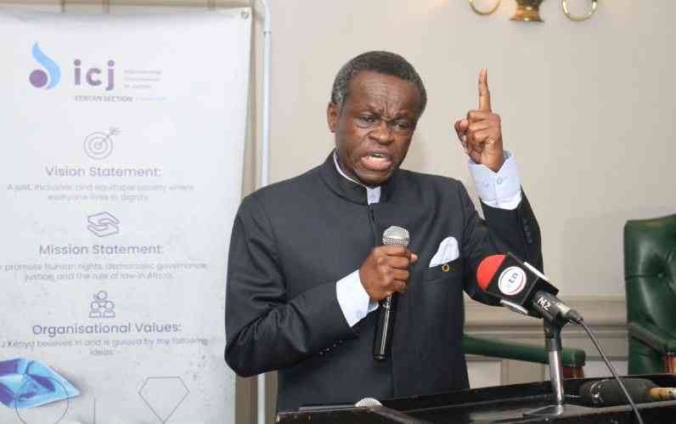
Celebrated Kenyan legal luminary and former Director of the Kenya Anti-Corruption Commission, Professor Patrick Loch Otieno Lumumba, has delivered an indictment of the African political class, urging a radical departure from what he termed "ceremonial" governance.
Addressing a high-level audience at the 2026 African Prosperity Dialogues in Accra, the Professor argued that the continent’s inability to translate its vast potential into tangible prosperity is a direct result of a leadership culture that prioritises prepared statements over practical implementation.
Speaking under the theme “Empowering SMEs, Women and Youth in Africa’s Single Market: Innovate, Collaborate, Trade,” Prof Lumumba lamented the recurring cycle where leaders convene at prestigious forums, deliver eloquent speeches, and promptly return to their respective capitals without fulfilling their commitments.
He contended that this disconnect between rhetoric and action is the primary obstacle to the success of the African Continental Free Trade Area (AfCFTA) and other developmental frameworks.
A central theme of Prof Lumumba’s address was the role of the African citizenry in enabling poor governance.
He suggested that a cultural tendency towards excessive politeness has shielded politicians from the accountability necessary for national progress. To break this cycle, he advocated for a more confrontational and honest engagement between the governed and the governors.
“Until the day our politicians change their modus operandi, this continent will not realise. They must be called out. We have been too nice to politicians for too long. The time is now to tell them the truth in its unadulterated form,” Prof Lumumba declared, drawing significant applause from the assembly of civil society and private sector representatives.
He criticised a system where politicians walk away from their promises the moment they leave the podium.
According to the Professor, the vision of a prosperous and integrated Africa will remain a distant mirage unless there is a fundamental shift in the modus operandi of African leadership—moving away from the "theatre of diplomacy" towards a results-oriented administration.
Prof Lumumba’s critique is supported by a growing body of data regarding the implementation gap across the African Union (AU) member states.
Analysts at the Dialogues pointed to several key metrics that highlight the disparity between policy and practice:
- Protocol Ratification: While nearly all African nations have signed the AfCFTA agreement, a significant percentage have yet to domesticate the necessary legal frameworks required for SMEs to trade across borders seamlessly.
- Youth Demographic Pressure: With 60% of Africa’s population currently under the age of 25, the continent requires the creation of roughly 12 to 15 million jobs annually. Lumumba argued that "ceremonial speeches" cannot provide the industrial base needed to absorb this workforce.
- Trade Barriers: Despite commitments to a "borderless Africa," intra-African trade still accounts for only 15-18% of the continent's total trade volume, compared to over 60% in Europe and 50% in Asia.
The Professor’s intervention served as a challenge to the organisers and participants of the African Prosperity Dialogues to ensure the forum does not become another talk shop.
He urged the African Prosperity Network (APN) to establish rigorous tracking mechanisms to monitor the progress of the resolutions made during the sessions.
He noted that the youth, who are the intended beneficiaries of the "Single Market" theme, are becoming increasingly "frustrated" and "impatient" with a political class that seems disconnected from the realities of the street.
By demanding the unadulterated truth, Prof Lumumba positioned himself as the voice of a growing movement of African intellectuals who believe that the time for diplomatic niceties has passed.
The 2026 Dialogues concluded with a renewed sense of urgency, as participants debated how to institutionalise the accountability measures Prof. Lumumba proposed.
Latest Stories
-
We can tackle multiple priorities – Sam George defends Anti-LGBTQ Bill push
17 minutes -
Statement: Ghana Chamber of Mines’ Response to Claims in Joe Jackson’s “Ananse Stories about the Economy of Ghana”
19 minutes -
GES opens 2026 teacher recruitment for licensed B.Ed graduates
21 minutes -
Ghana must value skilled trades, build resilient learners — Ibn Chambas
29 minutes -
Ghana must rethink education around relevance, resilience and responsibility — Ibn Chambas
32 minutes -
Prince Harry faces defamation lawsuit from charity he co-founded
34 minutes -
South Korea deploys thermal cameras to track escaped zoo wolf
36 minutes -
Calls for royal meeting with Epstein survivors grow ahead of US visit
39 minutes -
Ibn Chambas advocates blend of technology and human values in education
41 minutes -
UMA improves healthcare access in Asutifi North with GH₵700k ‘Kim Taylor Legacy’ Walkway
45 minutes -
Scholarships Authority and Fanaka University offer sponsorship for procurement and supply chain studies
49 minutes -
Bisa Kdei drops new single ‘Go N Look’ featuring Medikal
55 minutes -
Benin facing rising terrorism in north as French military presence faces growing criticism
56 minutes -
UEW Public Lecture Series 2026: Education debate ‘about the soul of Ghana’s future’ — Dr Ibn Chambas
57 minutes -
EU fingerprint and photo travel rules come into force from today
1 hour