

Audio By Carbonatix
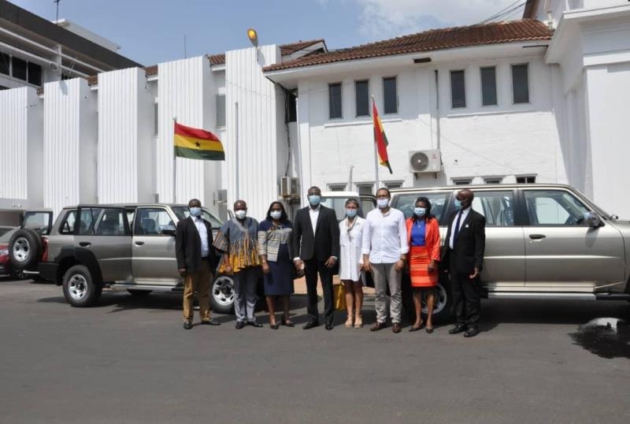
The Accountability, Rule of Law and Anti-corruption Programme (ARAP) has handed over two vehicles to Commission on Human Rights and Administrative Justice (CHRAJ).
ARAP, an EU funded programme, implemented by the Spanish public foundation FIIAPP has been supporting the Commission during the last four years.
These vehicles will improve the capacity of CHRAJ to conduct monitoring activities related to the implementation of the National Anti-Corruption Action Plan (NACAP) on the ground.
A statement issued in Accra by Mrs Ana Sánchez, the ARAP Team Leader, said corruption continued to be a problem that had permeated every sector of global economies.
It said with its devastating effects, it undermined sustainable development and was an affront to human rights.
“It further distorts markets, competition, institutions as well as entire governance structures,” it said.
The statement said arguably, corruption was identified as a major root cause of poverty, deprivation and underdevelopment.
It said in the particular case of Ghana, the high prevalence of corruption has resulted in poor service delivery and a lack of access to necessities of life.
“Corruption is equally a threat to Ghana’s democratic ideals (particularly the rule of law, justice for all and equality before the law,” it said.
Ghana’s anti-corruption policy, the National Anti-Corruption Action Plan (NACAP) is coordinated and monitored by the Commission in collaboration with the National Development Planning Commission (NDPC).
Through the Monitoring Committee (MONICOM), composed of the above institutions, the vehicles will strengthen the committee's work in monitoring and evaluating the implementation of the NACAP by the Implementing Partners in the regions.
The ARAP supports the efforts of the government in its fight against corruption.
The objective of the programme is to contribute to current reform processes to reduce corruption and improve accountability, and compliance with the rule of law, particularly when it comes to accountability, anti-corruption and environmental governance.
It does so through support key institutions, while at the same time increasing the ability of the public, civil society organisations and the media to hold the government to account.
Latest Stories
-
Gov’t to establish Prison Industrial Hub to equip inmates with income-generating skills – Prison Service boss
12 minutes -
Alhassan Tampuli donates cement, roofing sheets to support storm victims in Gushegu
12 minutes -
Alhassan Tampuli appeals for urgent support for storm victims in Gushegu
15 minutes -
The hypocrisy must stop; pass Anti-LGBTQ+ Bill now – Alhassan Tampuli to Mahama
19 minutes -
Imprisonment should be rehabilitative, not punitive – Ghana Prisons boss at UNGA
41 minutes -
Ga Adangbe traditional priests petition Mahama over McDan aviation licence revocation
52 minutes -
Anti-LGBTQ Bill: NDC’s arrogance is worrying – Hassan Tampuli
1 hour -
Let’s give OSP time to mature, not to scrap it – Hassan Tampuli
1 hour -
Nigeria convicts 386 Islamist militants in mass trials
1 hour -
Djibouti president wins election with 97.8% of vote, state media says
1 hour -
We don’t have mandate to deduct tax from rent allowance of security services personnel – Interior Ministry clarifies
2 hours -
Ablakwa receives Presidential Special Envoy on Reparations to advance global agenda
2 hours -
Christina Koch becomes first woman to travel around the moon on Artemis II
2 hours -
Epstein survivors’ calls to meet King Charles and Queen harder to ignore as US visit approaches
2 hours -
UN Secretary-General names Ghana’s Anita Kiki Gbeho as South Sudan envoy
2 hours