

Audio By Carbonatix
President John Mahama has announced that the government’s ban on the export of non-ferrous scrap is expected to boost Ghana’s processed metal exports by between "$250 million and $300 million annually", describing the move as a decisive step toward strengthening the country’s industrial base.
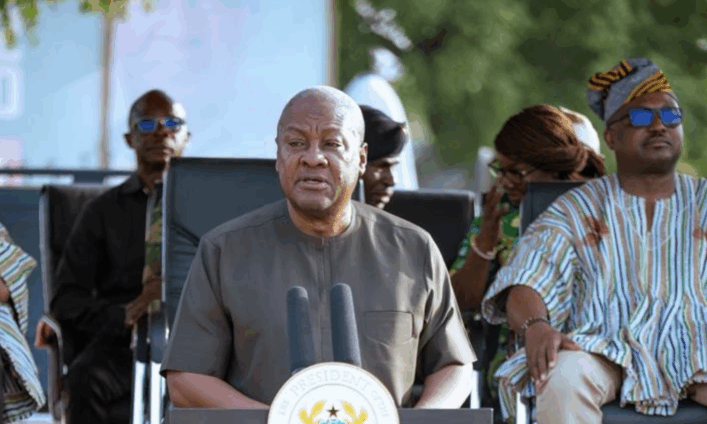
Speaking at the commissioning of the B5 Plus Limited Steel Manufacturing Plant at Prampram on Friday, February 20, the President said the policy is designed to secure raw materials for local manufacturers and accelerate value addition in the metals industry.
He explained that Ghana generates substantial volumes of scrap metal each year through construction, demolition, vehicle imports and other industrial activities. However, for years, a significant portion of that scrap has been exported in its raw form.
“Industrial capacity requires raw material security. By restricting non-ferrous scrap exports, the government ensures local processors have priority access to raw material for their production,” he said.
According to him, the policy will not only increase processed metal exports but also create between 5,000 and 10,000 new jobs across the value chain.
President Mahama added that the move would further enhance domestic revenue mobilisation through value-added tax, corporate taxes and pay-as-you-earn contributions.
He commended B5 Plus Group for its tax compliance, noting that the company is among the Ghana Revenue Authority’s most reliable taxpayers.
"They've paid more than $300 million in taxes and are looking to exceed $500 million very soon."
While acknowledging concerns raised by the company over frequent audits, he suggested that regulatory oversight must be balanced and predictable.
The President said the broader objective is to move Ghana up the value chain by exporting finished and semi-finished products rather than raw scrap materials.
Linking the policy to the government’s “Big Push” infrastructure agenda, he said massive investments in roads, highways, railway modernisation, bridges, interchanges, energy transmission lines, affordable housing and industrial parks will require a strong and reliable supply of iron and steel.
"Africa is projected to require over $100 billion annually in infrastructure development. West Africa alone faces significant infrastructure deficits.
"If Ghana develops a strong steel base, we not only build our own roads and bridges, we will also supply steel to the whole sub-region. This is how infrastructure becomes industrial strategy. The 24-hour economy program is particularly relevant to energy-intensive industries such as steel manufacturing," President Mahama added.
Latest Stories
-
AG joins plaintiff to scrap OSP ?: We should be mindful of the mischief in this – Bobby Banson
6 minutes -
Samson Lardy Anyenini questions willingness of Attorneys-General to prosecute political colleagues
8 minutes -
It is only fair the OSP is heard in Supreme Court case – Bobby Banson
14 minutes -
Asiedu Nketia resumes Ashanti tour, second leg kicks off on Sunday
22 minutes -
NLA denies salary cut claims, threatens legal action over reports
26 minutes -
BoG Governor honoured for stabilising cedi, improve inflation
29 minutes -
Trade Minister applauds GUTA as a pillar of economic growth; Prez Mahama honoured
1 hour -
President’s brother’s takeover of Damang Mines is ‘untidy’ – Alhassan Tampuli
2 hours -
It’s not true that gov’t decided not to renew the lease for Gold Fields – Bobby Banson
2 hours -
Ghana to boost tomato production with 60-hectare irrigated farms and processing initiatives
2 hours -
E&P’s takeover process of Damang Mines was very clean – Inusah Fuseini
2 hours -
Damang takeover: There is not going to be any job loss; it is a lease change – Bobby Banson
2 hours -
Gold Fields didn’t stop mining at Damang mines; such claims are untrue – Bobby Banson
3 hours -
Engineers and Planners currently operate only in Ghana – Bright Simons
3 hours -
Lands Minister has no legal basis to restrict lease to Ghanaian firms – Bright Simons
3 hours